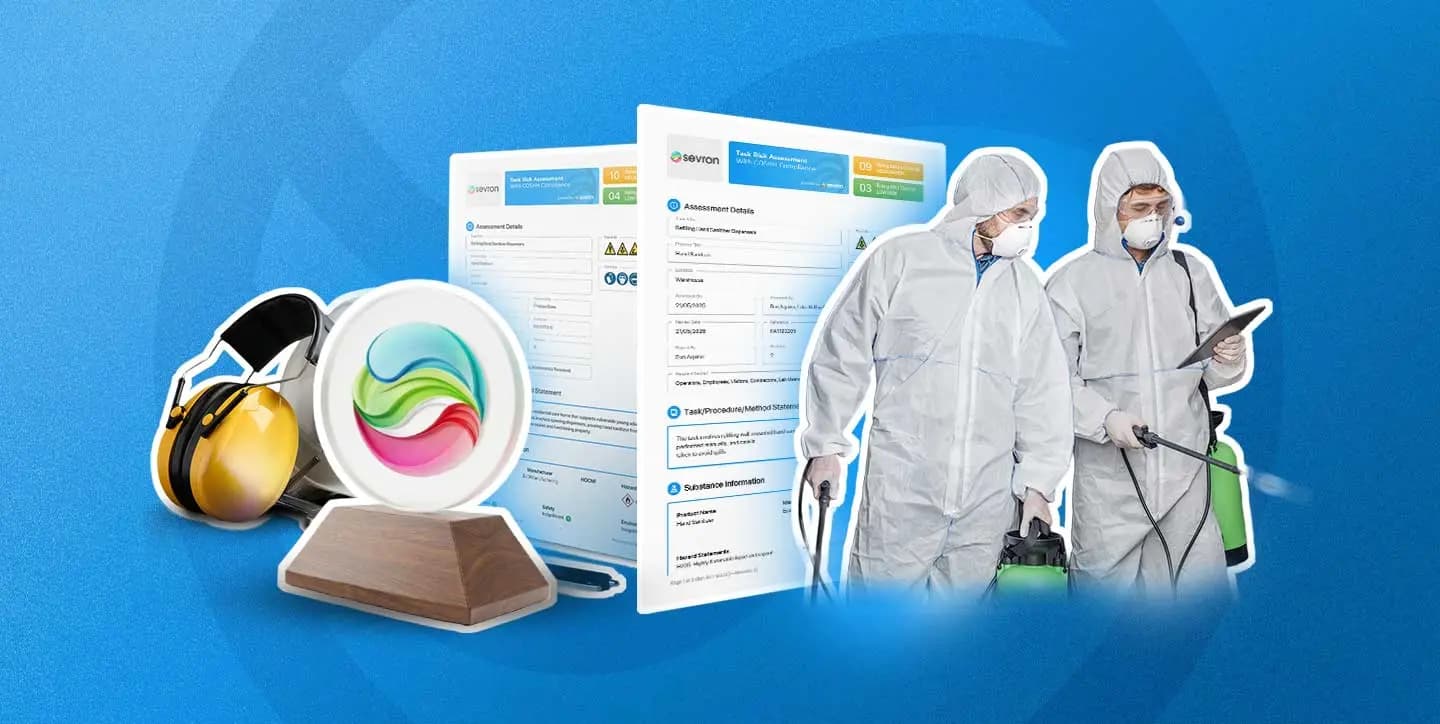

Knowledge alone is not enough. A COSHH assessment is a written check of the substances that could harm health in your workplace, and the steps you take to control them. It is a legal duty under the Control of Substances Hazardous to Health Regulations 2002, and it is not a form you complete once and file. It is a working record you keep current.
We walk you through what each step actually means in practice, so the assessment protects your people rather than just your paperwork. Done well, it is also the document that turns a stressful inspection into a short conversation.
What a COSHH Assessment Is
A COSHH assessment identifies the substances that could harm health, judges the risk from how they are actually used, and sets out how you will control that risk. The law calls it a suitable and sufficient assessment under regulation 6. The phrase matters. Suitable means it fits the real task, not a generic version of it. Sufficient means it goes far enough to actually control the exposure. A tick-box form copied from a template usually meets neither test.
Who Has to Do One, and Who Counts
Any employer who works with, or creates, substances hazardous to health. That covers far more businesses than people expect, from salons and garages to schools and food producers. If you have five or more employees you must record the assessment in writing. Smaller employers still have to carry it out, they simply are not required to write it down, though a written record protects everyone and is usually expected by clients.
COSHH also reaches beyond the obvious chemicals. It covers chemicals, fumes, dusts, vapours, gases, mists and some biological agents, and substances produced by your work, not only the ones you buy. Wood dust, respirable crystalline silica from cutting stone, welding fume and flour dust are all common examples that catch businesses out, because nobody bought them deliberately. If a product carries a CLP hazard pictogram, or your process throws off dust or fume, COSHH applies.
Writing It, Step by Step
- List the substances and how they are used. Walk the job, not just the store cupboard. Note each substance, the task, the amount and how often. Include the things made by the work, like dust and fume.
- Decide who could be harmed, and how. Include workers, contractors, cleaners and anyone nearby. Think about route of exposure, whether by breathing in, skin contact, or swallowing, and about people who are not doing the task but share the space.
- Gather the information. Use the supplier safety data sheet for each substance, check whether it has a Workplace Exposure Limit (WEL) in HSE's EH40, and read the label. The safety data sheet is the starting point, not the finish.
- Evaluate the risk. Judge exposure by route, level, duration and frequency. The risk comes from how a substance is used, not from the substance alone. A small amount used badly can be more dangerous than a large amount handled well.
- Decide the controls. Work down the hierarchy: eliminate the substance, substitute a safer one, engineering controls such as local exhaust ventilation, then safe ways of working, then PPE as the last line rather than the first. HSE sets out eight principles of good control practice to guide this.
- Record it and tell your team. Write it up if you have five or more employees, and share it with the people doing the work, in plain language they will actually read. An assessment locked in a manager's drawer protects no one.
- Put the controls in and keep them working. Maintain them. Local exhaust ventilation must be examined and tested, usually every 14 months. Where needed, monitor exposure under regulation 10 and provide health surveillance under regulation 11.
- Review it. Revisit regularly, and whenever a substance, process or team changes, or after any incident. The review is not optional housekeeping. It is what keeps the assessment lawful.
What is a WEL?
A Workplace Exposure Limit is the maximum concentration of a substance in the air, averaged over a set time, listed in HSE's EH40. It is the yardstick you measure exposure against. Not every substance has one, and where there is none, you still have to control exposure as far as is reasonably practicable.
Who Counts as a Competent Person
The assessment must be done by a competent person, meaning someone with the right training, knowledge and experience for the substances and the work. That does not mean you have to hire a consultant. Many businesses do this in-house once someone has the knowledge, and that is perfectly lawful. What competence is not is the most available person handed a template with no understanding of the hazards. The point of the duty is judgement, and judgement needs knowing why a control matters, not just that the form asks for one.
How Often to Review It
There is no fixed expiry date stamped on a COSHH assessment, but the duty is to keep it valid. Review it regularly, after any change to substances, processes, volumes or people, and after a spill or near miss. Compliance does not break all at once. It erodes, one stale sheet and one skipped review at a time, until the document on file describes a workplace that no longer exists.
The Mistakes That Catch People Out
A few recur often enough to be predictable: generic templates that do not match the actual task; safety data sheets that are years out of date; assessments written once and never reviewed; no records to show an inspector who asks; controls fitted on paper but never maintained in practice.
Take the most common of all. A business downloads a generic COSHH assessment for a cleaning chemical, fills in its name, and files it. Two years later the supplier reclassifies the product, the real hazards shift, and the assessment now describes controls that no longer fit. It looked complete the whole time. It just was not suitable, and suitable is the test that matters.
What HSE actually finds
Each of these gaps is exactly what an inspector looks for: a template that does not match the task, a sheet that has not been updated since the supplier revised it, controls on paper that nobody maintains, and no review since the assessment was first written. None of them looks like a failure until someone asks to see the evidence.
Keeping It Current, Not Just Complete
The hard part is never writing the first assessment. It is keeping a hundred of them valid as products, sheets and teams change over the years. Safety365 helps you build assessments, link them to up-to-date safety data sheets from one of the UK's largest SDS databases, and flag when a review is due before it lapses.
How Safety365 keeps assessments valid
When a supplier reissues a safety data sheet, Safety365 flags it against every assessment and mixture that uses that sheet. Instead of discovering a classification change after an incident or inspection, you see it when the sheet changes, while there is still time to update the controls.
That is Accelerated Compliance in practice: the path from certified to competent to compliant, with the records keeping pace rather than falling behind.
Build assessments that stay valid.
Linked safety data sheets, review reminders, and one place to prove it.
Watch the demo · Read the Ultimate Guide to Chemical Safety
Frequently Asked Questions
Is a COSHH assessment a legal requirement?
Yes. The COSHH Regulations 2002 require it for any employer working with substances hazardous to health. There is no exemption for small firms.
Do I have to write it down?
You must record it if you have five or more employees. Smaller employers must still carry it out, and a written record is sensible either way.
Who can carry out a COSHH assessment?
A competent person with the right training, knowledge and experience. It can be done in-house and does not always need an external consultant.
How is the risk decided?
By how the substance is used, not the substance alone. Route, level, duration and frequency of exposure all shape it.
What is a generic assessment, and is it enough?
A template not tailored to your task. On its own it rarely meets the suitable and sufficient test, because it does not reflect your real substances, amounts and controls.
A complete assessment that nobody reviews is a gap in waiting. See how Safety365 keeps yours current.

Safety & Compliance Experts
The Sevron team brings decades of combined experience in health and safety compliance, risk assessment, and workplace safety solutions.

Reviewed by
Dale Allen
CEO & Founder