
Safety Management Tools for Safety Officers
Free 14-day trial. No credit card required.

Key Challenges for Safety Officers
Safety officers carry the compliance burden for entire organisations, often with limited support and competing demands on their time. The daily reality involves managing workplace health documentation across multiple regulatory requirements, staying current with substance safety risks, and being permanently ready for scrutiny. These are the recurring pressure points we see across the sector.
- Maintaining accurate safety documentation: Assessments go out of date. Safety processes change, new substances arrive, equipment gets replaced, and the documentation that was accurate six months ago no longer reflects what is happening on the shop floor. Maintaining compliance requires a review cycle that most safety officers simply cannot sustain manually alongside their other responsibilities.
- Tracking hazardous substances in the workplace: Safety data sheets change when manufacturers update formulations or revise classification criteria. Every SDS update has a knock-on effect: the COSHH assessments referencing that substance need reviewing, potential hazards may need reassessing, control measures may need adjusting, and affected staff need informing. Multiply that across dozens or hundreds of substances and the administrative burden becomes a full-time job in itself.
- Ensuring employees have access to safety information: Regulations require that workers can access relevant safety information for the substances and tasks they encounter. When that information is scattered across shared drives, filing cabinets, and individual email inboxes, access becomes theoretical rather than practical. Building a strong safety culture requires that information is not just available but actually accessible. Finding it quickly is the real challenge.
- Preparing for compliance inspections: An HSE visit or client audit demands evidence, not assurances. EHS software helps organisations maintain up-to-date records for audits and external reviews, but pulling together current assessments, action logs, training records, and review histories still takes hours of preparation when documentation is scattered. The underlying anxiety is the same: emerging risks have been missed, corrective actions are overdue, or something was updated in one place but not another.
How Safety365 Supports Safety Officers
Benefits of Safety365 for Safety Officers
Safety officers carry the weight of health and safety management across their organisations. The work is part record-keeping, part firefighting, part trying to prevent accidents and workplace injuries before they happen. Safety365 was built to reduce the administrative workload that buries safety teams under paperwork, so more time goes toward the safety performance improvements that actually protect people.
Automated review tracking
Safety365 runs daily checks against every assessment's review date and sends notifications 30 days before deadlines arrive. If a deadline passes without action, the system escalates to location managers and configurable email groups automatically. These automated workflows remove the single biggest cause of lapsed compliance: forgotten dates.
Live SDS-to-assessment linking
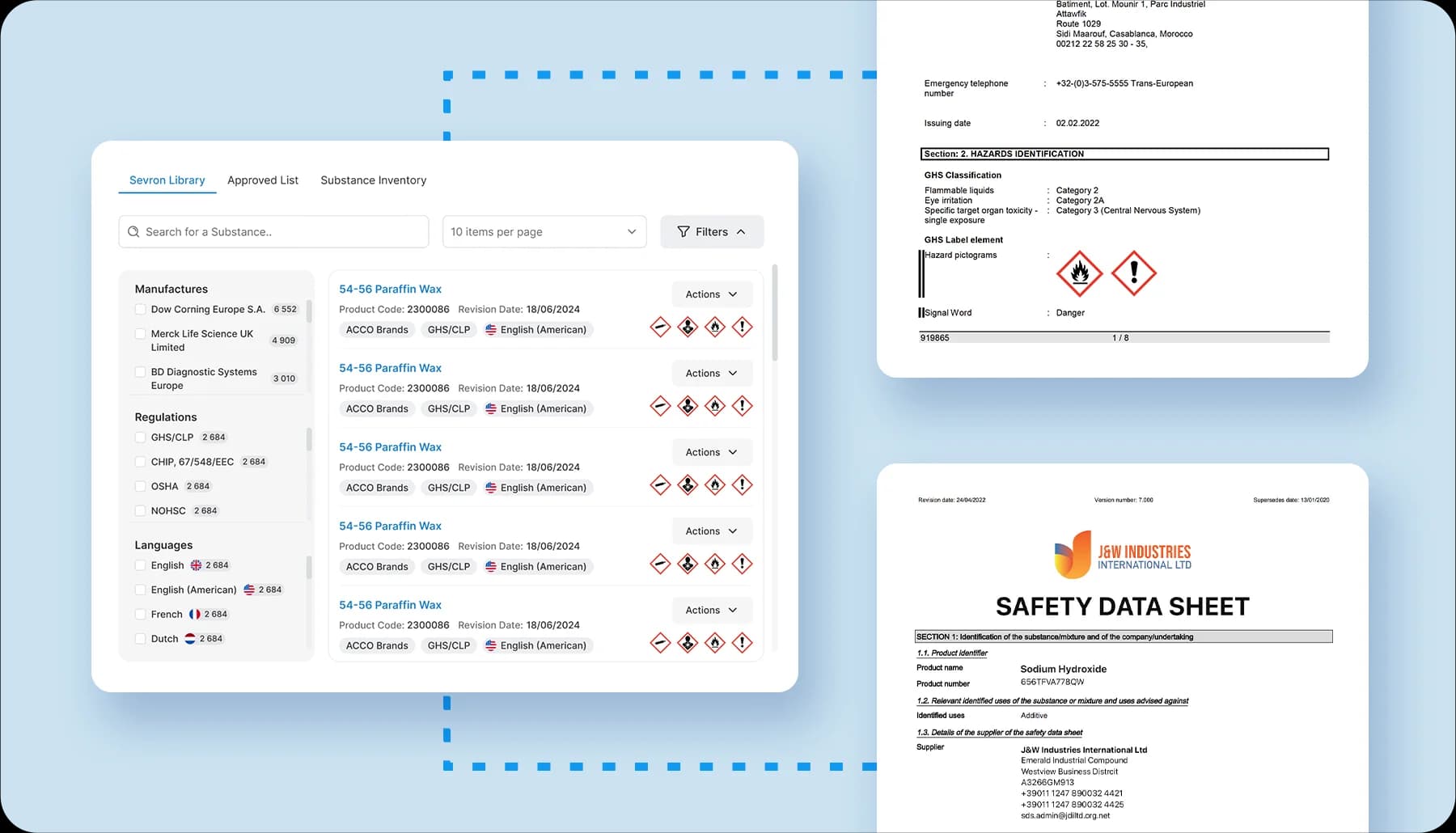
When a safety data sheet updates in our library of 1.6 million+ sheets from over 7,000 manufacturers, Safety365 flags every assessment linked to that substance. No more manually cross-referencing SDS revisions against a folder of assessments to check what still applies.
Compliance scoring across nine metrics
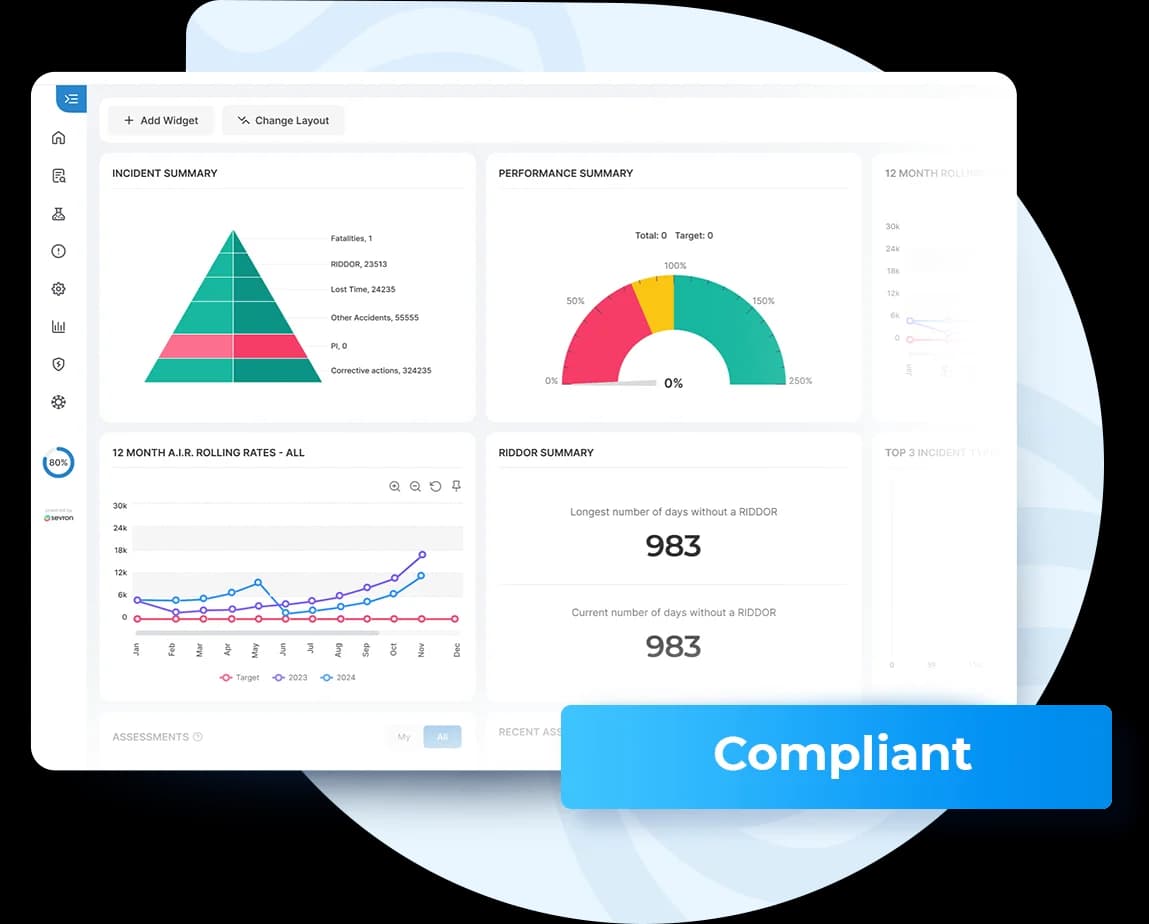
The dashboard calculates a 0 to 1,000 compliance score covering overdue assessments, hazards without controls, incomplete emergency procedures, missing environmental hazards, overdue actions, out-of-date SDS records, unpublished assessments, short task descriptions, and tasks without identified hazards. The Areas of Concern widget colour-codes severity so safety teams can see where operational risks sit at a glance.
Location-scoped access and visibility
The Safety Officer role grants full assessment and publishing rights scoped to assigned locations and their child locations. For organisations managing multiple sites, each safety officer sees only the locations they are responsible for, with complete control over those sites.
Audit-ready reporting at any time
Reports export in PDF, Excel, and CSV. When an inspector arrives or a client asks for documentation, it is produced in minutes. Published assessments also serve as training resources for supervisors running toolbox talks and inductions, saving time across the whole organisation.
AI-assisted COSHH assessment creation
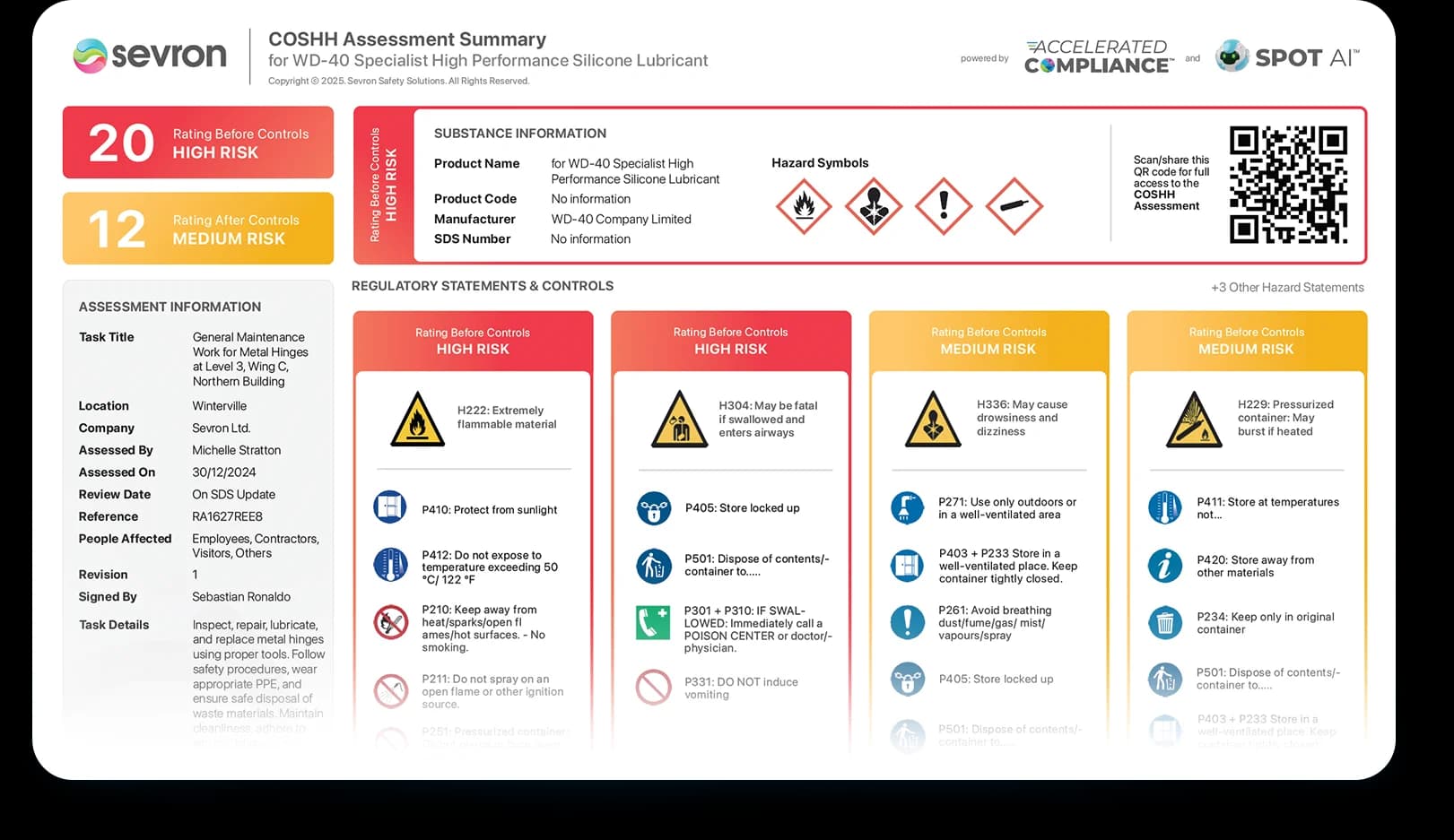
The SPOT AI wizard walks through a five-step process: select the substance, identify hazards from the linked SDS, set control measures, assign actions, and publish. It pulls hazard classifications and exposure information directly from safety data sheets, so the risk identification step starts from verified manufacturer data.
Frequently Asked Questions
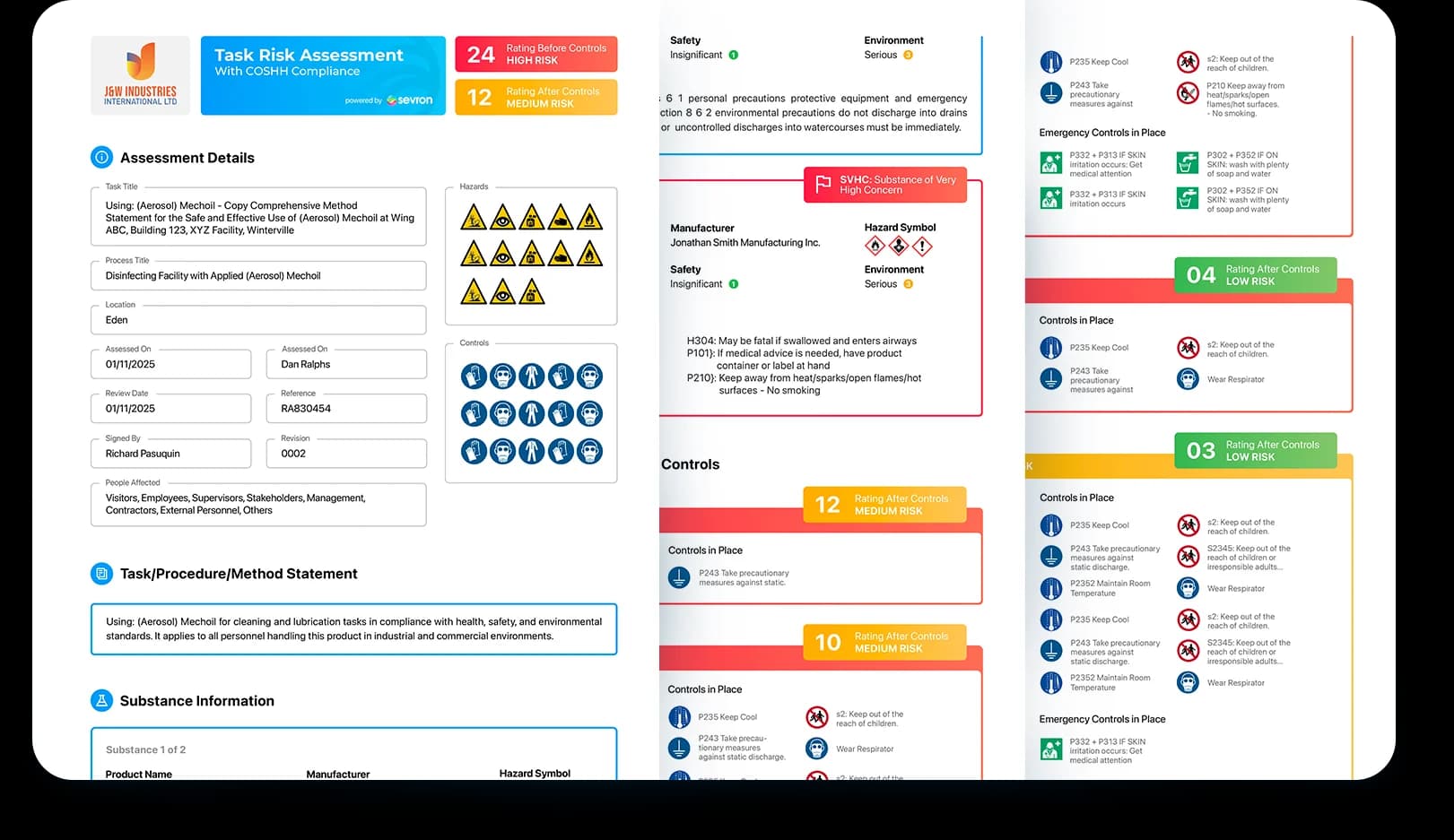
Safety365 centralises all safety documentation in one platform, including COSHH assessments, task risk assessments, incident records, and action tracking. Everything is searchable, filterable by location, and stored with full version history. Automated review date tracking ensures nothing lapses without notification.
The platform includes access to over 1.6 million safety data sheets from more than 7,000 manufacturers. SDS records link directly to COSHH assessments, so when a sheet is updated, every affected assessment is flagged automatically, helping you manage health risks and stay current. You can also request any SDS we do not yet hold.
Yes. Every substance is logged with its SDS, linked to the relevant COSHH assessment, and tracked by location. The system records which substances are in use at each site and alerts assessment owners when an SDS update affects their documentation, supporting a proactive approach to hazard management.
The compliance dashboard provides a live overview of your organisation's status across assessments, actions, incidents, and RIDDOR records. Reports are exportable in audit-ready formats at any time. There is no preparation period required because the system maintains inspection readiness as a default state.
All published assessments are accessible to employees at the relevant location. Content is scoped by site, so workers only see documentation that applies to their workplace. When assessments are updated or republished, the current version replaces the previous one automatically.
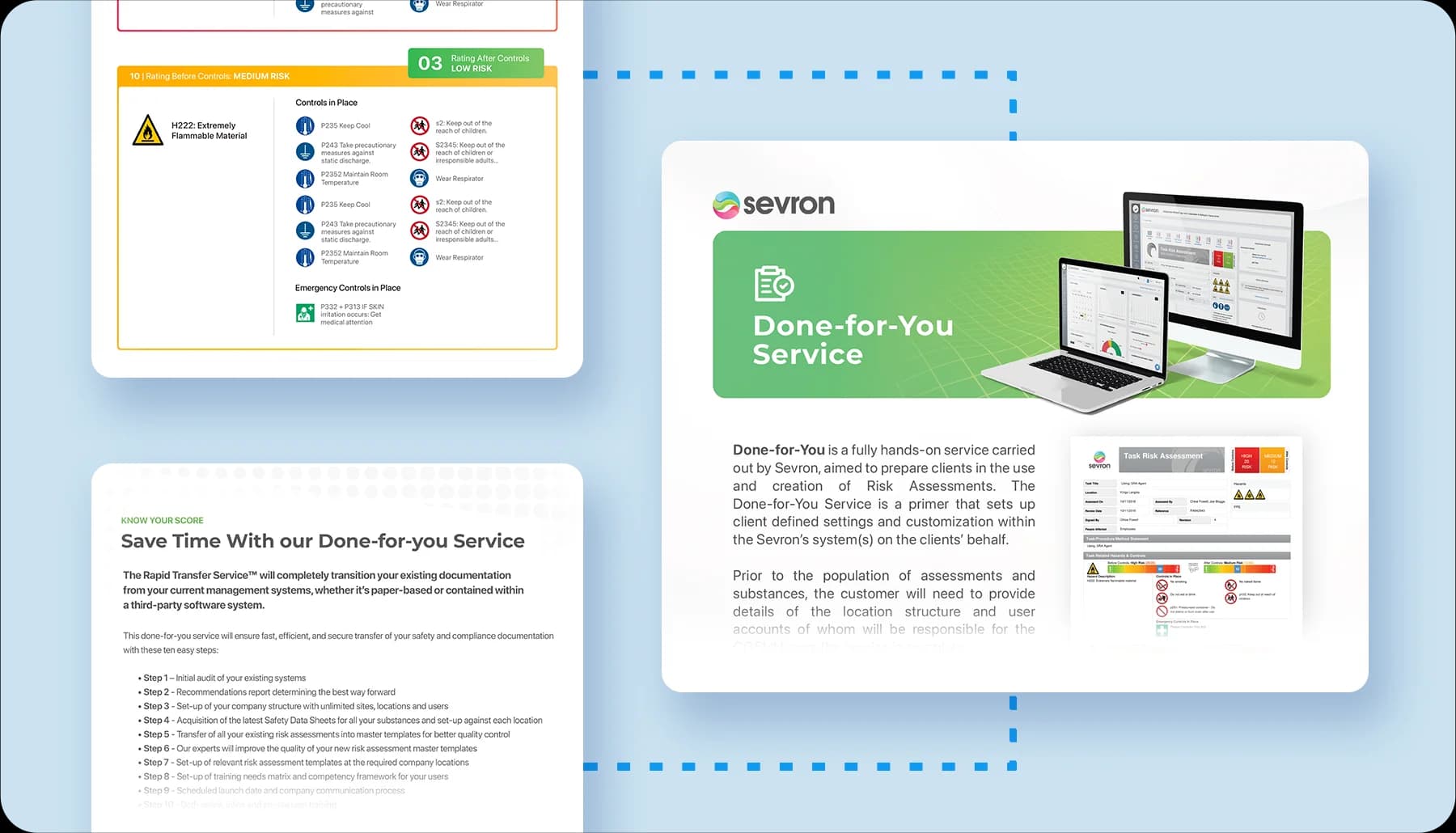
The platform includes COSHH assessment creation with SPOT AI guidance, task risk assessments, SDS search and monitoring, incident management with RIDDOR reporting, a compliance dashboard with 14 customisable widgets, compliance scoring, action tracking with escalation, and exportable reports. A Done-For-You service is also available for organisations that want Sevron's team to build their documentation.
Safety365 provides a single view of compliance across all locations, with scoring that quantifies performance against nine metrics. Automated notifications catch lapsed reviews and overdue actions before they become enforcement risks. Location-scoped access ensures the right people see the right data, and the dashboard makes it straightforward to identify which sites or areas need attention.
Use Cases

Multi-Site Director
Gain real-time oversight across locations. Standardise compliance workflows, monitor performance, and generate reports in minutes.

Manufacturer
Handle chemical complexity at scale. Centralise SDSs, automate SVHC tracking, and meet customer audit demands with confidence.

Small Business Owner
Easily manage safety without a team. Get tools that simplify compliance and save time across daily operations.

Construction & Engineering
Ensure equipment safety, manage site risks, and maintain compliance across evolving project scopes.
685,800+ health and safety professionals in 135+ countries
rely on Sevron to simplify chemical safety compliance.
