
Safety & Compliance Management for Multi-Site Organisations
Free trial available. Enterprise pricing on request.

Challenges of Managing Safety Across Multiple Sites
Running safety across various locations introduces problems that single-site operations never face. Each site develops its own habits and inconsistent safety practices around what compliance looks like. Without consistent practices across locations, these differences compound into gaps that a manual, administratively heavy management system will struggle to keep on top of.
- Inconsistent documentation and reporting standards: One site produces thorough COSHH assessments with full control measures. Another uses general forms with minimal detail. Records end up scattered across shared drives, filing cabinets, personal folders, and email attachments with no common standard connecting them. Without company-wide policies that standardise what an assessment looks like and how it gets recorded, every audit becomes a reconciliation exercise.
- Difficulty tracking chemical use across sites: Each location maintains its own substance inventory, isolated from other locations. When a manufacturer updates a safety data sheet or a product gets reclassified, there is no mechanism to flag that change across every site that uses the substance. Assessments go stale without anyone realising.
- Fragmented compliance systems creating silo syndrome: Different sites using different spreadsheets, different software, or paper-based processes makes it impossible to aggregate data at director level. Obtaining health and safety performance data becomes a manual collection exercise, with weeks of lag between what is happening on the ground and what appears in reports.
- Limited central oversight of safety performance: When local teams report upward through email and spreadsheet attachments, directors lose real-time visibility of where the organisation actually stands. Risk assessment compliance, overdue assessments, outstanding corrective actions, expired safety data sheets: none of these surface until someone specifically asks.
- Resource allocation discrepancies between locations: Larger sites with dedicated safety officers tend to maintain higher standards. Smaller satellite operations, where safety responsibilities sit alongside other duties, often fall behind. Without a way to monitor compliance at each business unit and identify where safety support is needed, these discrepancies widen quietly and continuously.
How Safety365 Supports Multi-Site Operations
Benefits of Safety365 for Multi-Site Directors
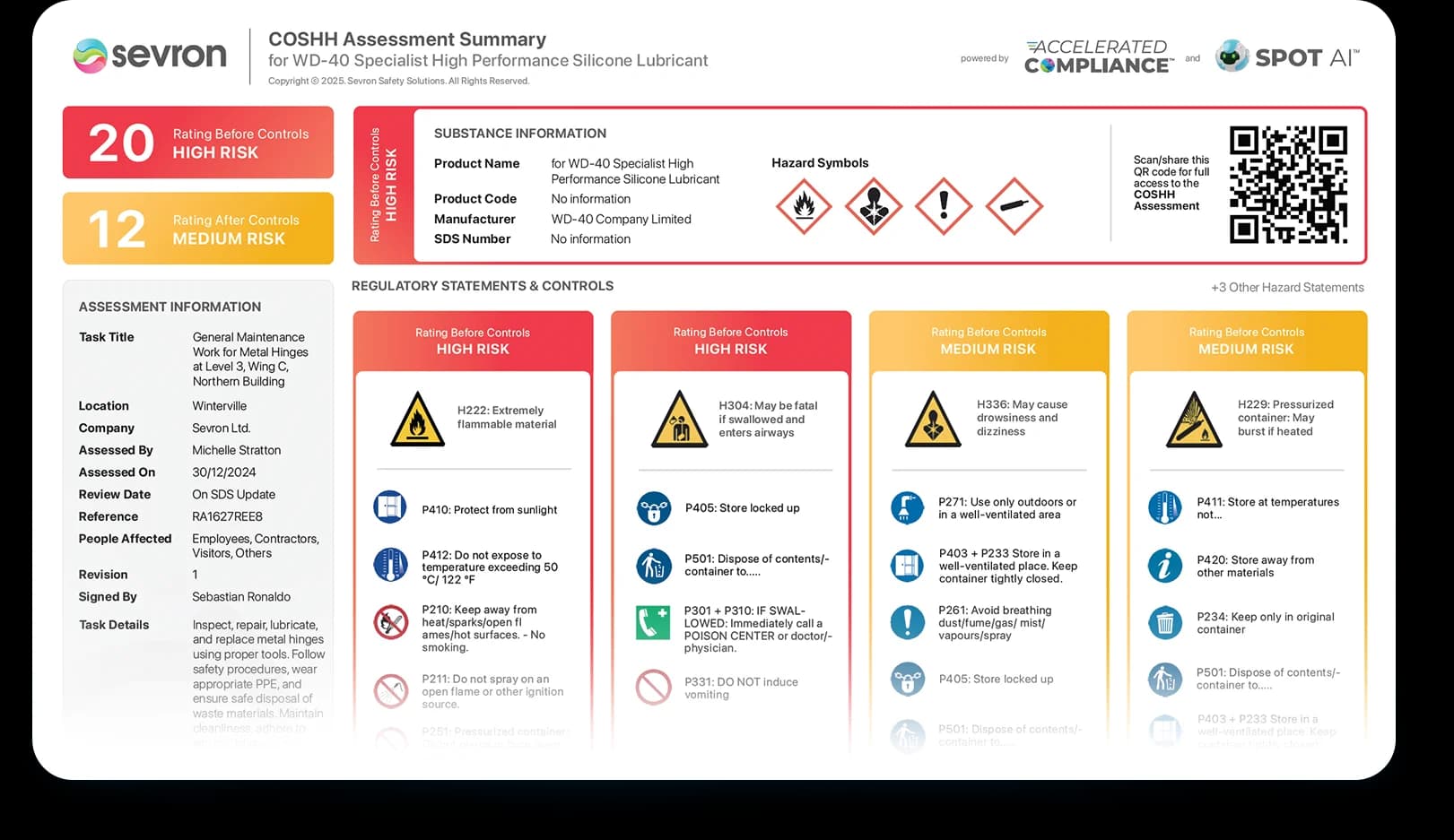
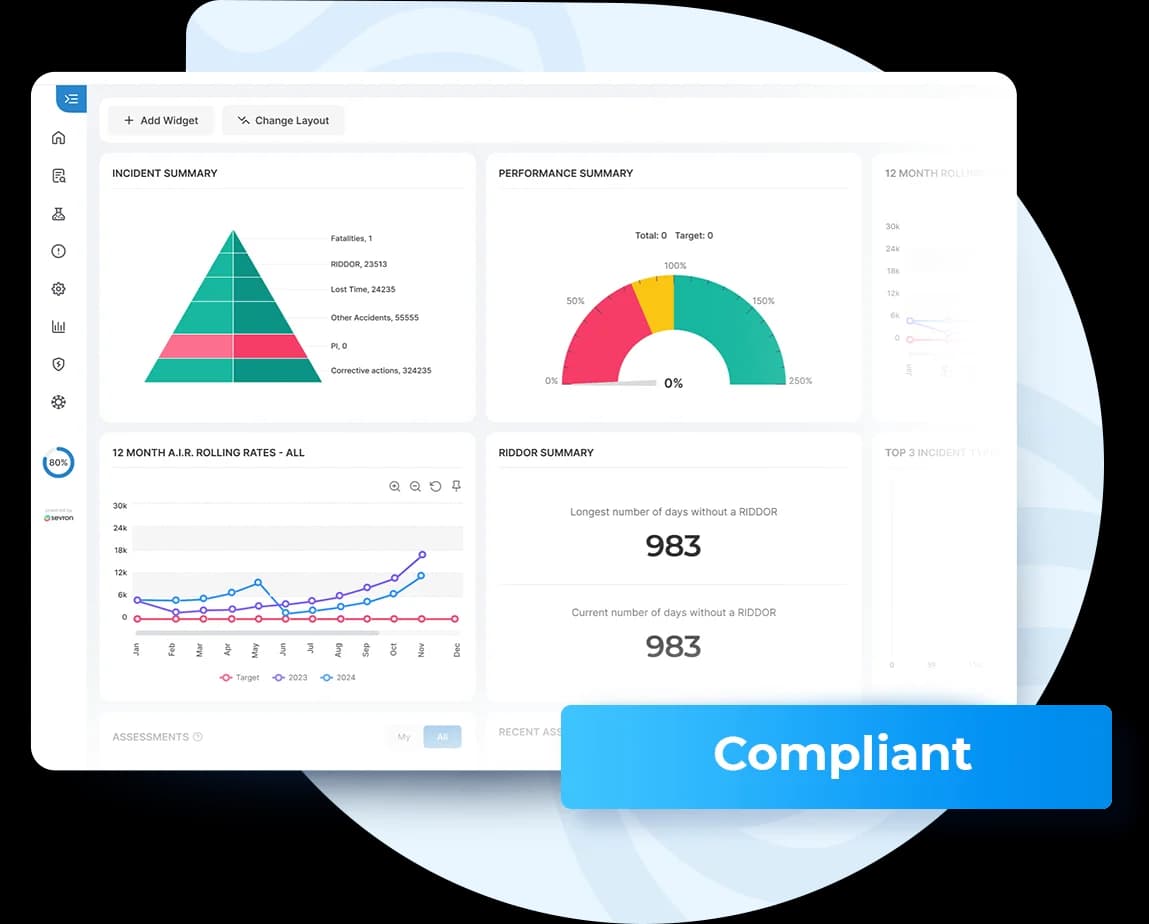
An effective health and safety management system produces a volume of outputs that need to be managed and monitored. When those outputs are spread across dozens of sites using different tools and processes, critical information gets lost. Safety365 centralises everything into a single safety management system that scales with the organisation.
Ensure consistency across all locations
Standardised templates, shared reporting standards, and a single platform mean that every site follows the same safety standards. What passes as compliant at one location will pass at every location. Clear communication channels between sites and head office keep safety practices aligned without requiring constant oversight.
Real-time visibility of safety performance across the business
Directors see live compliance scores, overdue items, and action status for every site without waiting for spreadsheets to arrive. Real-time data accessibility means decisions get made on current information, and problems get addressed before they compound.
Centralised safety performance data for establishing KPIs
With all sites reporting through the same system, extracting key performance indicators becomes a reporting function. Compare site performance and track trends over time using data that is already normalised and current. The data-gathering step disappears.
Employee engagement through accessible tools
The Health and Safety at Work etc Act 1974 requires businesses to provide information, instruction, training, and supervision to relevant staff. When local teams have tools that make assessment and reporting straightforward, safety becomes part of their routine. Our partnership with TKoS Academy provides cost-effective training that scales across the organisation.
Scalability as the organisation grows
The location hierarchy uses a parent-child tree structure that mirrors the organisational chart, with roles assigned per-location so the same user can hold different permissions at different sites. Adding more sites means adding new nodes in the hierarchy. The platform accommodates growth without requiring reconfiguration of the entire system.
Frequently Asked Questions
Safety365 uses a hierarchical location tree where every assessment, substance record, and action item is scoped to a specific site. Organisations set up parent-child structures that mirror how they actually operate. A user tagged to a parent location automatically sees documentation from all child locations beneath it, so directors access everything relevant without switching between systems. Assessment references inherit site-specific prefixes, keeping records clearly organised by location.
Access is controlled through the Portfolio tagging system. Tagging a user to the root location grants access to aggregated data from every site. The compliance dashboard pulls in scores from all accessible locations, and the SDS inventory combines each site's substances into a unified view. The global SDS database of over 1.6 million sheets is accessible to all users regardless of their location tag.
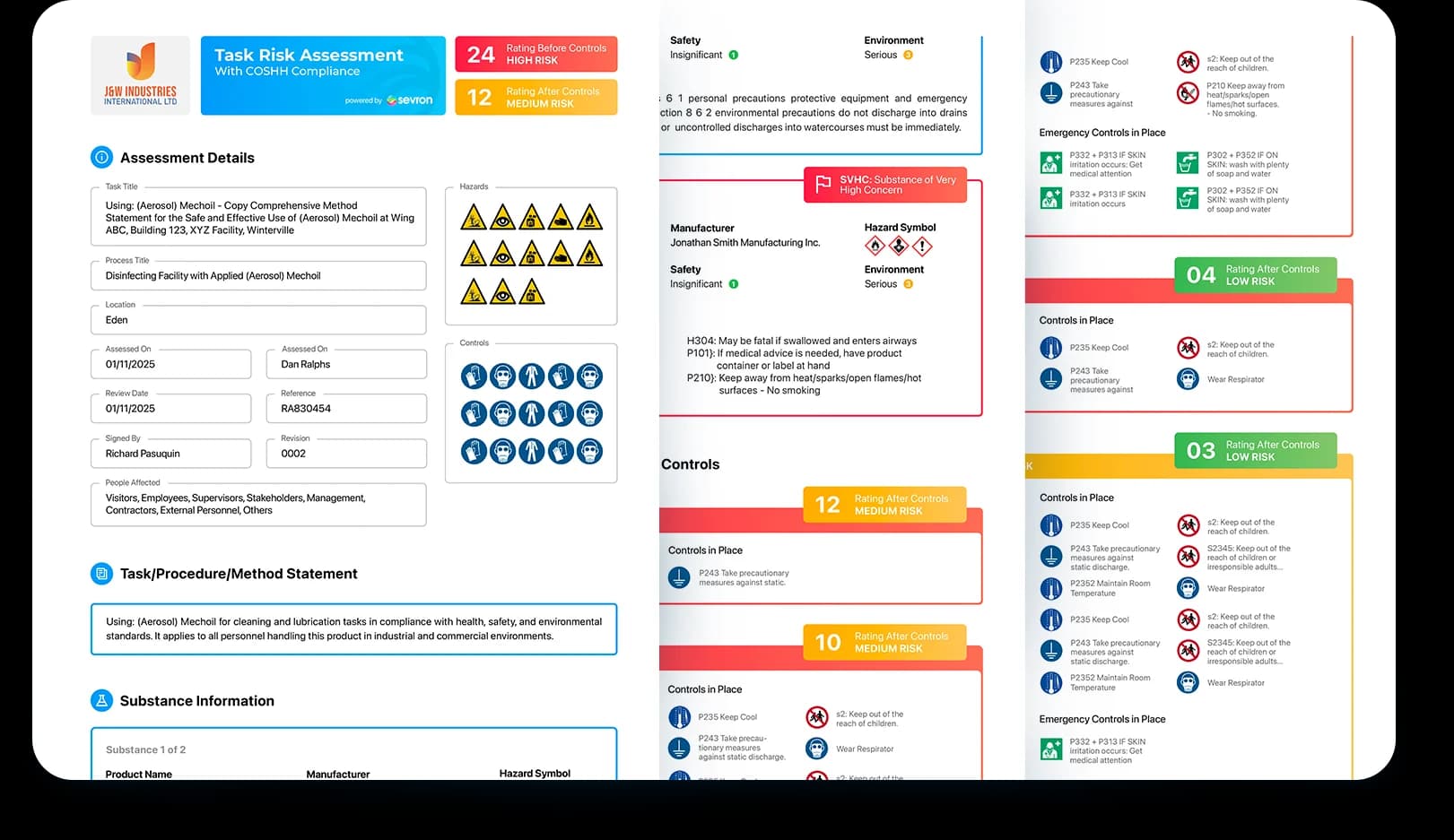
Safety365 enables consistent procedures across all locations. Every COSHH assessment and task risk assessment follows the same structure and scoring methodology, regardless of which site creates it. Assessment references are automatically prefixed by location, so inconsistencies between sites become visible immediately. Users at parent locations see all child location data through the same dashboard, and the compliance scoring system applies identical metrics everywhere.
The compliance dashboard scores compliance from 0 to 1,000 points across nine metrics, aggregated from every location the user can access. A director tagged to the root level sees overdue assessments, SDS currency status, and open actions for the entire organisation in a single view. Reports filter by any level of the location hierarchy and can be exported for board reporting or regulatory submissions.
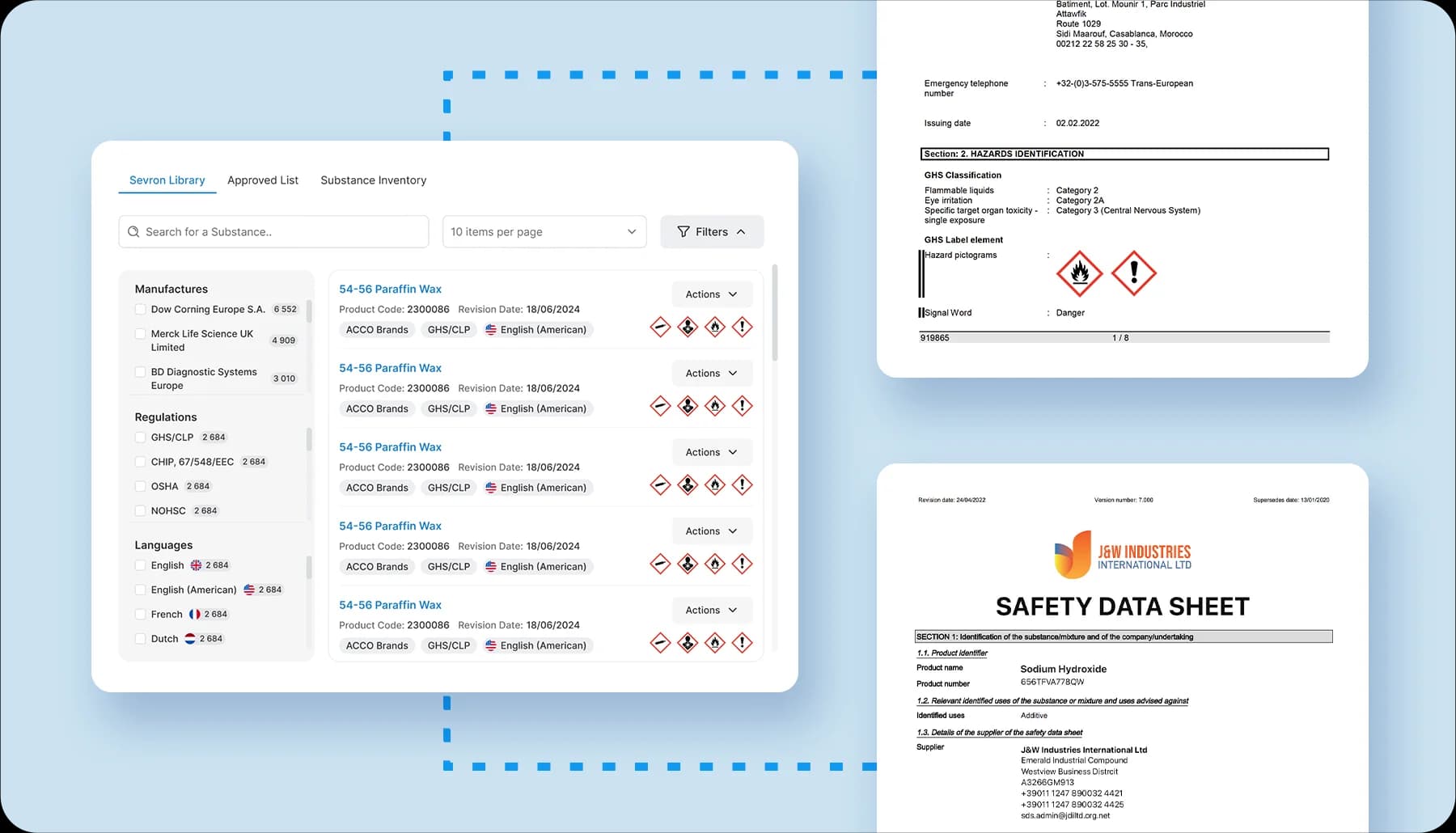
Every site maintains its own substance inventory within the location hierarchy, and employees see the inventory for their tagged location plus all child locations. Beyond site-specific inventories, all users have access to the global SDS database containing over 1.6 million sheets from more than 7,000 manufacturers. When a manufacturer updates an SDS, Safety365 flags linked assessments across all locations.
The location hierarchy enforces a shared organisational structure, and the role-based permission system ensures oversight matches the actual chain of responsibility. Roles are assigned per-location, meaning the same user can hold different permission levels at different sites. The compliance scoring system applies identical metrics to every location, so each site is measured against the same standard.
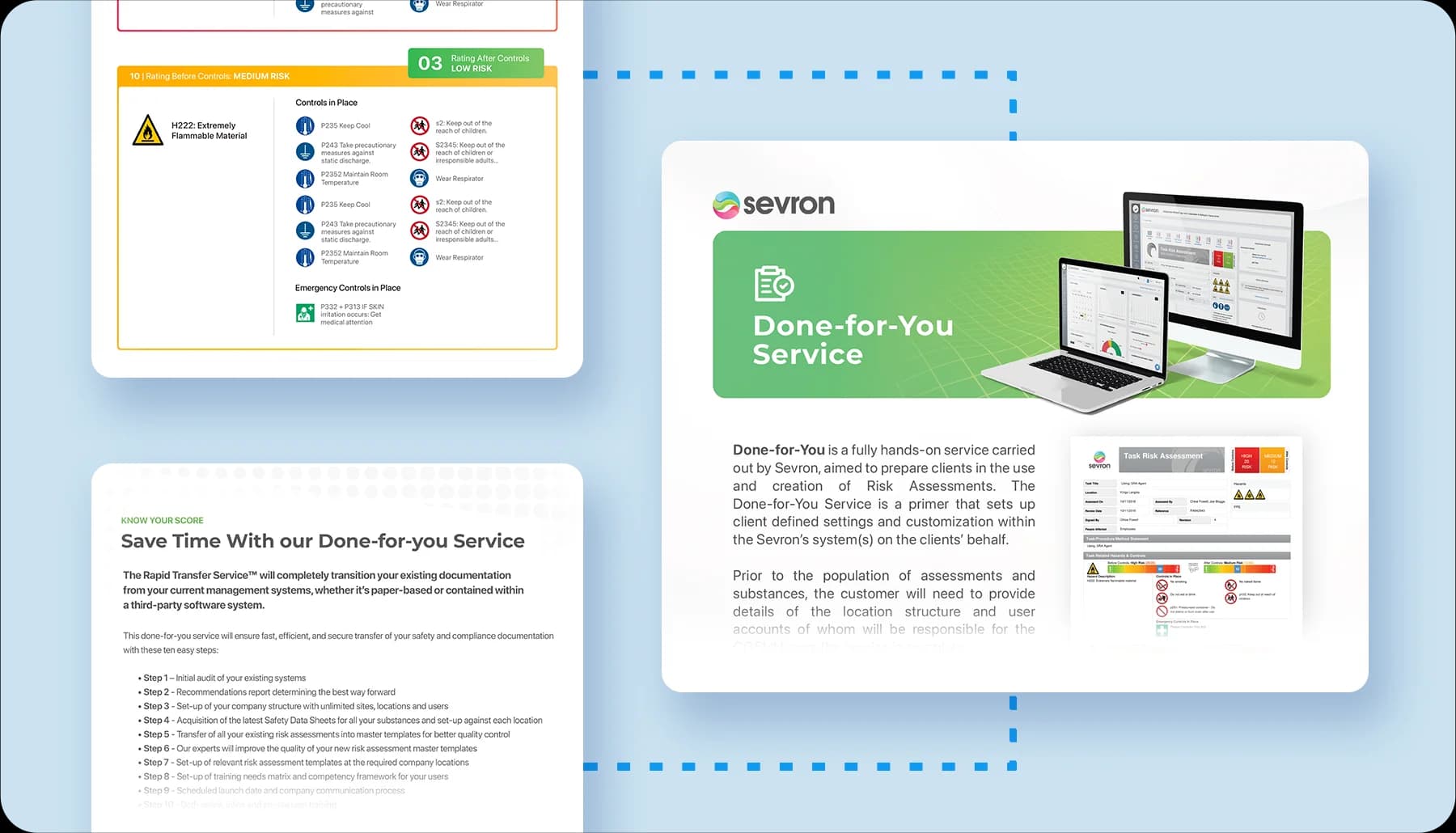
The location hierarchy solves the central problem of multi-site compliance: the gap between accountability and visibility. Directors are accountable for every site but lack real-time visibility into what is happening at each location without a unified system. Safety365 closes that gap with location-scoped data, aggregated dashboards, and hierarchical reporting. The Done-For-You service removes the implementation burden, configuring the full location tree and importing existing inventories so organisations are operational across all sites.
Use Cases

Manufacturer
Handle chemical complexity at scale. Centralise SDSs, automate SVHC tracking, and meet customer audit demands with confidence.

Manufacturing
Automate assessments and chemical safety across complex operations and fast-moving production environments.
Construction & Engineering
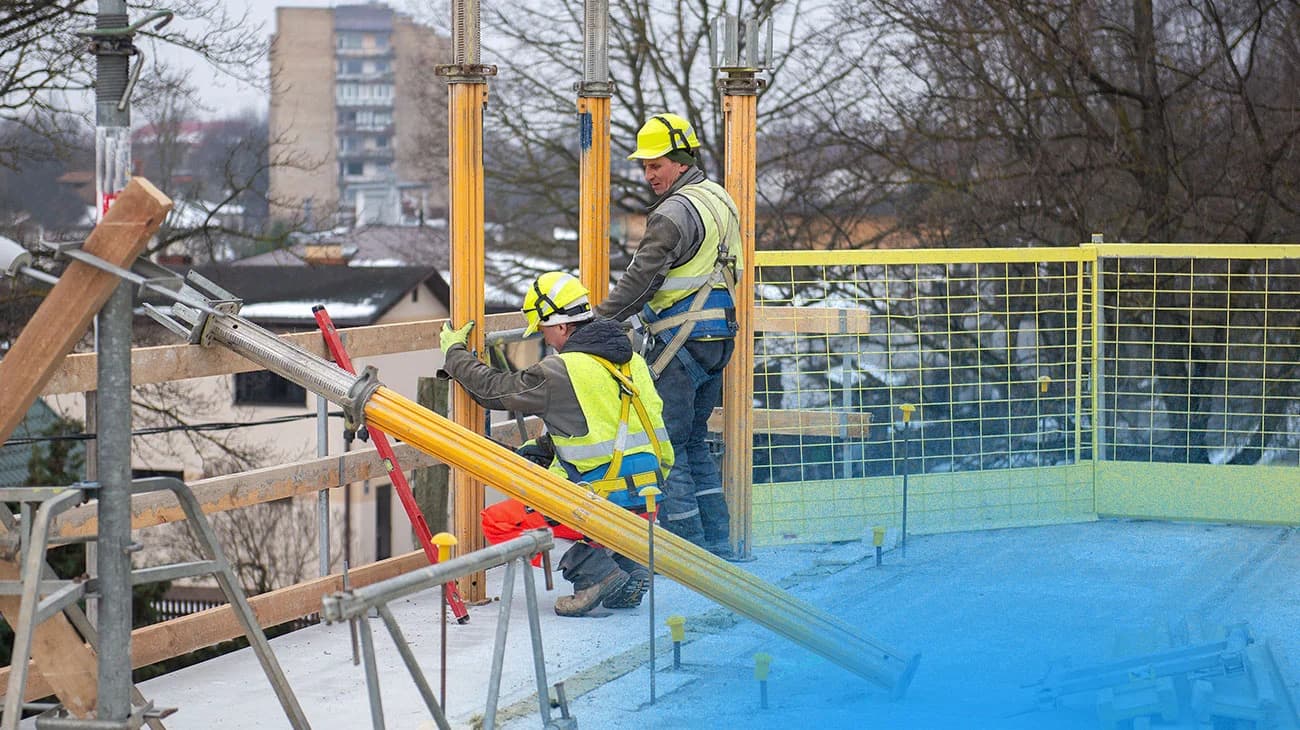
Ensure equipment safety, manage site risks, and maintain compliance across evolving project scopes.

Safety Consultant
Support more clients efficiently. Deliver compliant assessments faster and manage multiple client sites with ease from one platform.
685,800+ health and safety professionals in 135+ countries
rely on Sevron to simplify chemical safety compliance.
