
Thick bleach is one of the most ordinary things in any cleaning cupboard, which is exactly why it slips past people. It does its job, it smells like cleaning, and nobody gives it a second thought. Then someone tops up a toilet with bleach right after using an acidic descaler, and within seconds the room has to be cleared.
It is a genuine COSHH substance, and it came up near the top of the safety data sheets workplaces requested from our database last month. So what does it actually do, and what is the one mistake worth drilling into every cleaner?
What Thick Bleach Actually Is
Thick bleach is a solution based on sodium hypochlorite, thickened so it clings to surfaces. The safety data sheet (section 2) will typically flag it as corrosive to skin and eyes and irritating to the respiratory system, with the exact classification depending on concentration. In normal use, diluted and handled sensibly, it is manageable. The risks come from contact with the concentrate, from splashes to the eyes, from breathing the fumes in a poorly ventilated space, and above all from mixing it with the wrong thing.
The Mix That Releases Chlorine Gas
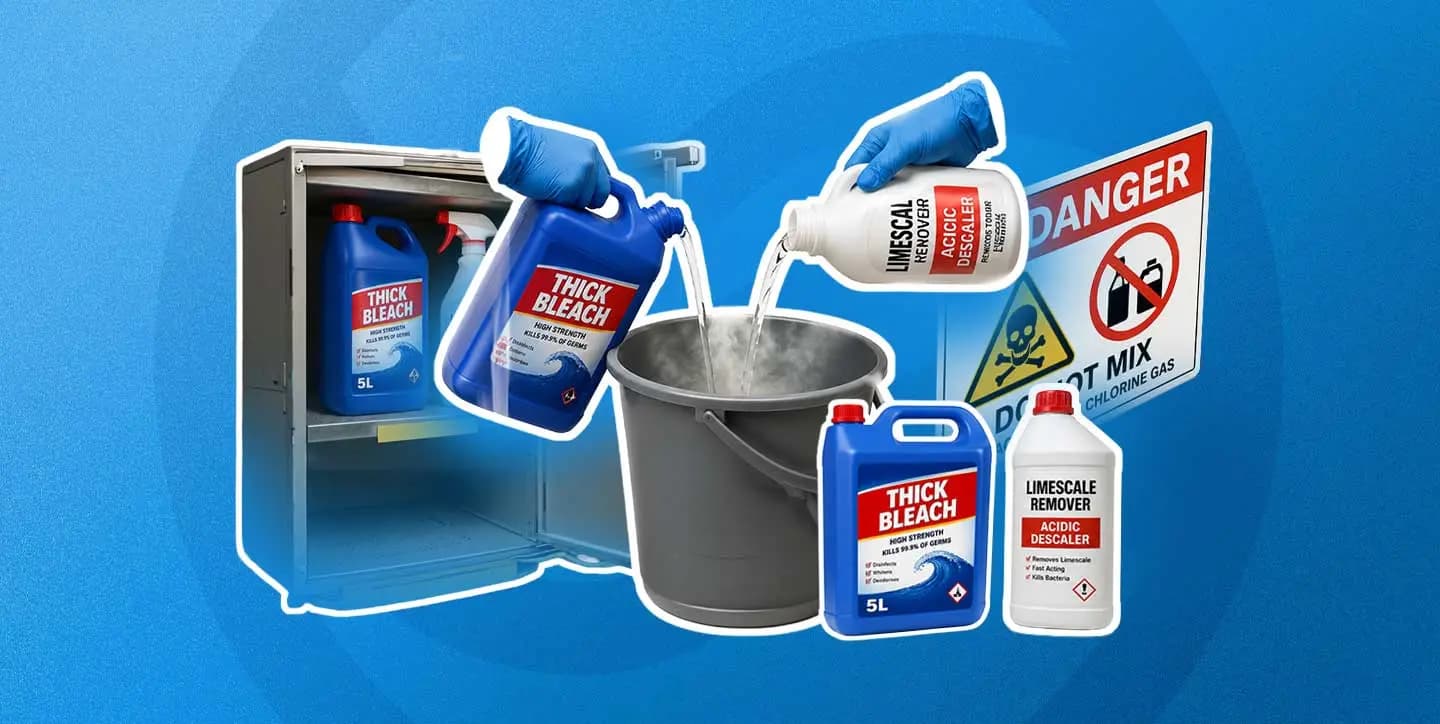
This is the part that turns a routine product into an emergency. Mixing bleach with an acidic cleaner releases chlorine gas, which attacks the eyes and airways and can be dangerous quickly in an enclosed space. The trap is that the acidic product is often another ordinary cleaner: a limescale remover, a strong toilet cleaner, or a descaler. Nobody sets out to make chlorine gas. They use one product, then reach for another on the same job, and the reaction does the rest. Mixing bleach with ammonia-based cleaners causes a similar problem, releasing irritant chloramine vapours.
Never mix bleach with another cleaner
- Bleach + acidic cleaner (limescale remover, strong toilet cleaner, descaler): releases chlorine gas, which rapidly irritates and can damage the eyes and airways.
- Bleach + ammonia-based cleaner: releases chloramine vapours, also an irritant and potentially dangerous in enclosed spaces.
- If someone is exposed to fumes: get them to fresh air immediately and seek medical advice.
Use one product at a time, ventilate the space, and rinse surfaces between products. This single rule prevents most bleach incidents.
What the Law Expects
As a COSHH substance, bleach needs a proper COSHH assessment wherever it is used at work, and the controls are practical rather than elaborate. Suitable gloves and eye protection for handling the concentrate. Ventilation in the space where it is used. Dilution as directed rather than by guesswork. And firm rules against mixing products and against decanting bleach into unlabelled bottles, which is how the wrong two liquids end up in the wrong hands.
None of this is heavy engineering. It is the sort of sensible, written-down control covered in our COSHH control measures guide that turns a known hazard into a non-event.
Decanting is a hidden risk
Pouring bleach into an unlabelled container removes the product name, the hazard warnings, and the incompatibility information. If another person picks it up later and uses it alongside an acidic cleaner, nothing on the bottle warns them. The HSE expects substances to be kept in their original labelled containers where possible. Where decanting cannot be avoided, the new container must be properly labelled.
Storage and Shelf Life
Bleach does not keep forever, and that surprises people. Sodium hypochlorite degrades over time, faster in heat and light, losing strength and changing as it breaks down. Store it cool, dark, sealed and upright, well away from any acidic products so a leak cannot bring the two into contact. Keep it in its original labelled container, and rotate stock so old bottles are used or disposed of rather than left to deteriorate at the back of the cupboard. Section 7 of the safety data sheet sets out the specifics for the product you hold.
Where It Bites
Picture the cleaner working through a washroom at the end of a shift, alone and in a hurry. They use a limescale remover on the taps, then bleach in the toilet, in a small room with the door shut and no extraction. Within a minute the air is sharp and their eyes are streaming. Nothing about either product was unusual. The harm came from the order they were used in and the lack of ventilation, in exactly the kind of small, unsupervised moment where these incidents happen.
Cleaning, catering, healthcare and leisure all carry the same risk, because all of them use bleach and acidic cleaners side by side — the same pattern we see with other everyday products that slip through unassessed, like hidden chemicals in the workplace and washing up liquid in the download-led series.
Turn the SDS Into an Assessment in About a Minute
If you have pulled the safety data sheet for your bleach, the assessment is the natural next step, and it is the step most people put off. SPOT AI reads the sheet and produces a compliant COSHH assessment in around 60 seconds through a five-step wizard you finish and own, capturing the corrosivity, the eye and respiratory risks, and the all-important incompatibility with acids.
Safety365 keeps the sheet and the assessment linked in one place, and a free SDS account through the Small Business Bundle is a practical starting point for smaller firms. That is Sevron's Accelerated Compliance approach in practice, taking you from a downloaded sheet to certified, competent and compliant, with the do-not-mix rule written where your team will actually see it.
Downloaded the bleach SDS? Finish the assessment.
SPOT AI turns it into a compliant COSHH assessment in around 60 seconds, free to start.
Book a free call if you would rather talk it through.
Frequently Asked Questions
Is thick bleach a COSHH substance?
Yes. It is based on sodium hypochlorite, which is corrosive and an irritant, so a workplace needs a COSHH assessment for it however ordinary it seems. The classification, and the specific controls required, will depend on concentration, so check section 2 of the safety data sheet for the product you hold.
What happens if you mix bleach with other cleaners?
Mixing bleach with an acidic product releases chlorine gas, and mixing it with ammonia releases chloramine vapours. Both can cause rapid harm to the eyes and airways in an enclosed space. The rule is to use one product at a time, ventilate, and rinse between products.
How should bleach be stored?
Cool, dark, sealed and upright, in its original labelled container, and well away from acidic products. Section 7 of the safety data sheet gives the specifics for the product you hold. Rotate stock regularly and do not leave old bottles at the back of the cupboard.
Does bleach go off?
Yes. Sodium hypochlorite degrades over time, faster in heat and light. Old stock may no longer be effective and should be disposed of in line with section 13 of the safety data sheet, not poured down a drain alongside other cleaning products.
How do I complete a COSHH assessment for bleach?
Pull the safety data sheet for the specific product you use from the Sevron SDS database, then use SPOT AI to turn it into a compliant assessment in around 60 seconds. The assessment will capture the corrosivity, the eye and respiratory hazards, and the incompatibility with acids, the critical controls for this substance.
One product at a time, and write the rule down. Turn your bleach SDS into a COSHH assessment with SPOT AI.

Safety & Compliance Experts
The Sevron team brings decades of combined experience in health and safety compliance, risk assessment, and workplace safety solutions.

Reviewed by
Dale Allen
CEO & Founder