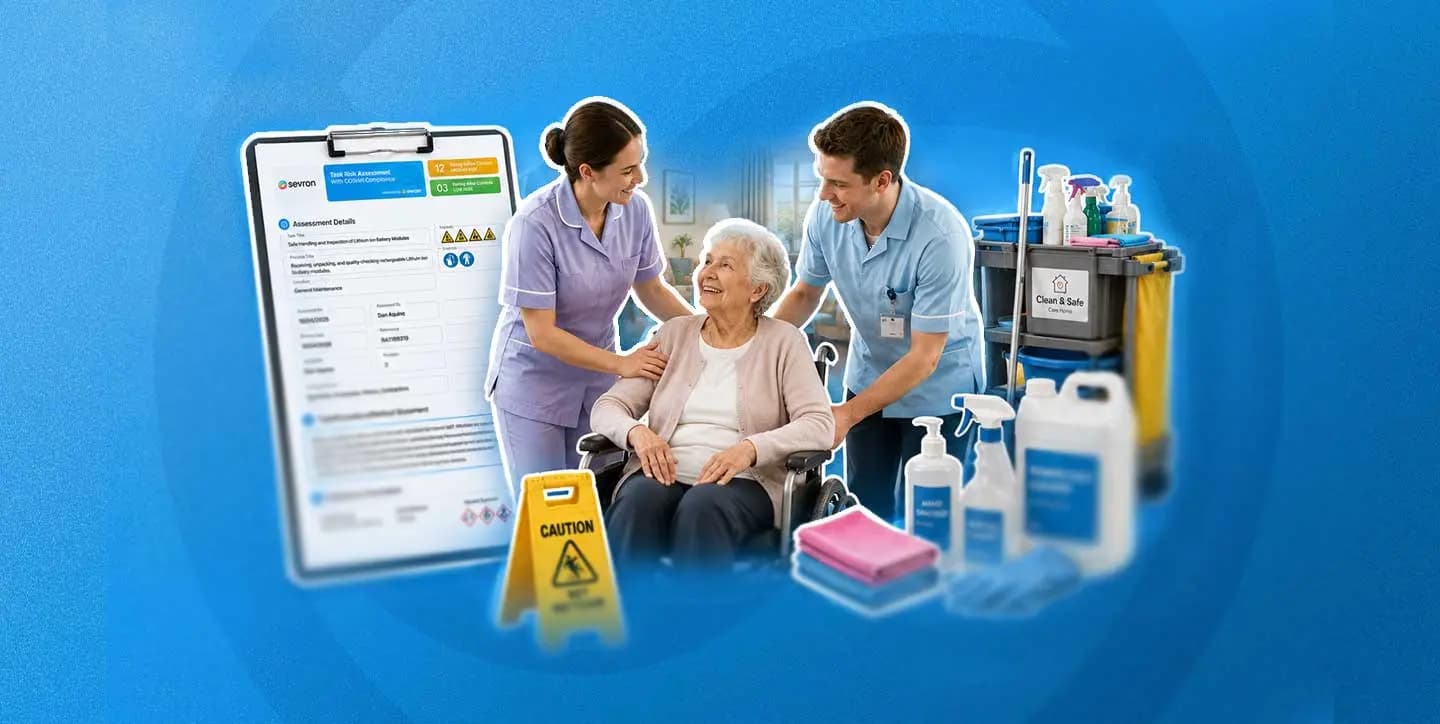

A care home is a workplace and a home at the same time. HSE makes that point in the opening pages of its care homes guidance, and it is the one fact that makes COSHH harder here than in a factory. In a factory, everyone exposed to the chemicals is at work, inducted, and issued with the right gloves. In a care home, the person most likely to open the wrong cupboard has dementia.
The duty reflects that. HSE guidance for care homes is explicit that you must assess the health risk to staff, residents and visitors, and then decide what action prevents or controls exposure. Three groups, one assessment, and only one of them turns up to an induction.
Most care home COSHH files are not wrong. They are thin in the same handful of places, and those places have very little to do with the substances on the shelf.
Two regulators are reading the same cupboard
HSE is the health and safety regulator for care settings across Great Britain, whether privately owned, local authority run or NHS. In England, the Care Quality Commission (CQC) registers and inspects the service itself under the Health and Social Care Act 2008, and HSE has confirmed that CQC generally deals with the majority of serious incidents involving people who use the service.
COSHH sits with HSE and covers exposure arising from work. That means your staff, and anyone else affected by the work, which in a care home includes the people who live there. CQC arrives from the other side. Regulation 12 requires providers to assess the risks to the health and safety of people using the service and do all that is reasonably practicable to reduce them, and to make sure premises and equipment are safe. Regulation 15 expects regular health and safety risk assessments of the premises and equipment, with findings acted on without delay.
Two remits, one bucket of chlorine-releasing disinfectant. An assessment written purely around staff exposure answers half of what you will be asked.
The original container rule is the one most often broken
HSE sets out a clear order for care homes. Establish what substances and biological hazards are present, remove the substance where that is reasonably practicable, and where it cannot be removed, substitute something milder. Swapping an irritant cleaning product for a gentler one is HSE's own example. Only once substitution is ruled out does the guidance move to safe handling, secure storage, keeping products in their original containers, and the right protective equipment.
That fourth item is the one real homes lose. A trolley gets loaded and the product leaves its packaging. Bleach into an unlabelled trigger spray because the original nozzle failed. Concentrate into a jug because the dosing cap went missing. Every time that happens, the label goes with the container, and so do the hazard warnings, the dilution instruction, and any chance of a paramedic knowing what was swallowed.
If a resident drinks from an unlabelled bottle left on a trolley in a corridor, what does your file say was in it?
What decanting costs you
An unlabelled secondary container breaks the link between a product and its assessment. The carer cannot check the dilution, the manager cannot audit it, and the file now describes something that is no longer identifiable at the point of use. Your supplier is required by law to give you an up-to-date Safety Data Sheet for anything classified as dangerous for supply. Where one has gone missing from your records, a free SDS database you can search without an account will usually find it faster than the supplier's inbox will.
Wet work is the exposure nobody writes down
The chemical you can name is rarely the one doing the damage.
HSE describes contact dermatitis as the most common work-related skin disease among nurses and other health and social care professionals, and estimates around 1,000 nurses develop it through work each year. Its rule of thumb is that anyone washing their hands more than twenty times a day is at risk. Care staff pass that before the lunch round. Add glove occlusion, alcohol gel, soaps, and the stronger disinfectants that appear during an outbreak, and the exposure becomes continuous rather than incidental.
None of that shows up in a COSHH file organised by product, because wet work is not a product. It is a task.
Where to start on skin
HSE expects health surveillance for dermatitis to be proportionate to the risk rather than universal. Where the risk is clear, that means a baseline skin assessment soon after someone starts relevant work (HSE's guidance on dermatitis health surveillance suggests within six weeks), regular visual skin checks by a trained responsible person, an annual questionnaire, and a health record for each individual. The cheapest control is also the earliest. Staff who know to watch for itchy, dry or cracked skin, and know who to tell, get seen before the condition costs them the job.
Locked away is not the same as out of reach
HSE's own prompt for care home managers asks whether hazardous substances are safely stored, locked in a cupboard and out of reach of vulnerable adults. That is two conditions, and homes tend to evidence the first and assume the second.
The second one is about routine. A trolley parked in a corridor for the ninety seconds it takes to answer a call bell. A sluice door propped open on a warm afternoon. A keypad whose code has not changed since the last inspection and is known to half the building. The sluice room usually holds the strongest products on site, which makes it the room where these habits carry the most weight.
There is a genuine tension here, and HSE names it. Care home risk assessment is meant to be proportionate, balancing a resident's freedom and dignity against the risk of harm. Nobody is asking you to strip the building. The question is narrower. Which products would actually hurt someone who cannot read the label, and are those controlled tightly enough that the answer does not depend on who is on shift?
The agency shift that nobody briefed
Turnover is the quiet gap in most care home COSHH arrangements.
HSE is direct on employment status. The employment business may be an agency carer's legal employer, but you hold responsibilities for them while they are on your premises, and shared responsibility needs assigning rather than assuming. HSE also singles out the induction of new staff, permanent and temporary alike, along with night workers. COSHH requires information, instruction and training for anyone liable to be exposed. An agency carer working a Sunday night, using your products, in your sluice room, sits squarely inside that.
A site-specific briefing does not need to take long. It needs to cover four things:
- Which products they are expected to use on this shift
- Where those products live and who holds the key
- What to do about a spill, and where the kit is kept
- Who to tell if their hands start to crack
General competence is the slower build underneath that briefing. Sevron's external training partner, The Knights of Safety Academy, runs a free COSHH Risk Assessor Certification that takes an hour or two and covers storage, dermatitis and health surveillance. HSE's care homes guidance advises keeping training records, and each completion leaves a dated certificate against the individual.
How it looks when the file matches the corridor
The honest test of a COSHH file is the worst shift you had last month. Two carers off sick, an agency carer on the floor for the first time, and a suspected norovirus case that put the chlorine-releasing product into three rooms at once. Everything in this article either held that night, or it did not.
When it holds, that shift is unremarkable. The assessment for that product is on the tablet in the sluice room with the dilution on it. The agency carer's induction record shows they were walked through the store, and the spill kit an hour ago. The Safety Data Sheet behind the assessment is current, because the supplier reformulated in March and the file moved with it. Nobody rings the on-call manager.
That is the whole objective, and it is mostly an admin problem. Which is where it usually breaks.
Keeping the record and the substance together
The breakage is usually the same one. A record and the substance it describes drift apart over months, across shifts and through supplier changes. Safety365 is Sevron's cloud-hosted compliance platform, and keeping those two attached is most of what it does for a care home.
Our COSHH Assessment module holds site-specific assessments against the products a home uses. Each one links to a live Safety Data Sheet, so a supplier reformulation flags every assessment it affects, and review dates are tracked so a lapse surfaces internally before anyone external finds it.
For providers running several homes under one registration, the group view shows where the gaps sit without a round of calls to registered managers. Homes with nursing carry a wider substance range, including medicines and cytotoxic drugs, which is covered by our healthcare compliance work.
Sevron's Accelerated Compliance approach runs from certified training through team competence to audit-ready proof, which maps closely onto the way care services already get inspected. The platform supports the evidence side of chemical safety. It does not replace the duty, and no software does.
Keep the record and the substance together.
Assessments, current safety data sheets and review dates in one place, ready for the worst shift.
Frequently Asked Questions
Do we need a COSHH assessment for ordinary cleaning products?
Yes, where the product is classified as hazardous, which covers most disinfectants, bleaches, descalers and oven cleaners. The assessment does not need to be elaborate. HSE says COSHH assessments in a care home should be relatively simple, and products used in similar ways can be grouped under one set of control measures.
How often should a care home review its COSHH assessments?
There is no fixed statutory interval. Review when something changes, which in a care home usually means a new product, a supplier reformulation, a new task, an outbreak that brings stronger disinfectants into use, or an incident that shows a control is not working. An annual sweep on top of that is common practice rather than a legal deadline.
Who is responsible for COSHH training for agency carers?
Their employment business is their legal employer and carries the training duty, but you keep responsibilities for them while they are working on your premises. In practice that means a briefing on your products, your storage arrangements and your spill procedure before the shift starts, recorded so it can be evidenced later.
Does the CQC inspect COSHH?
Not as COSHH. CQC assesses whether care is safe under Regulation 12 and whether premises and equipment are safe and properly maintained under Regulation 15, and your chemical storage and infection control evidence feeds both. HSE remains the regulator for the COSHH duty itself.
Chemical safety in a care home lives in the gap between what the file says and what happens in the corridor. Close that gap and the shift where nobody is watching stops mattering.

Safety & Compliance Experts
The Sevron team brings decades of combined experience in health and safety compliance, risk assessment, and workplace safety solutions.

Reviewed by
Dale Allen
CEO & Founder