
The folder is ready. Every assessment signed, every Safety Data Sheet filed, every date recent enough to survive a glance. None of it answers the question that actually gets asked.
A COSHH inspection tests what you can evidence. Enforcement sits with the Health and Safety Executive or your local authority, and the Control of Substances Hazardous to Health Regulations 2002 set the ground it covers. Whether the assessment describes the work as it is actually carried out. Whether the controls named in it are still the controls in use. Whether the records come out on the day they are asked for.
Which is where the folder stops helping. Who is exposed to the degreaser in the wash bay during a shift changeover, and what is stopping it reaching them? The assessment names a control. It cannot tell you whether the extractor was switched on, whether the operator was ever shown how to use it, or whether the product in the container is still the product the assessment was written for.
Nothing in the working week prompts an organisation to ask itself those questions. No trigger, no deadline, no obvious reason to go hunting for problems in arrangements that look like they are working. So they wait, until someone with statutory powers and a clipboard asks them first, and the answers go on a record.
What would that first question expose in your organisation this week?
What a COSHH inspection looks at first
COSHH duties cluster into four areas. Any credible COSHH inspection checklist works through the same ground, because the Control of Substances Hazardous to Health Regulations 2002 put it there.
Hazard identification and documentation
A current record of every hazardous substance in use, and Safety Data Sheets the people handling them can actually reach. Regulation 6 requires a suitable and sufficient assessment of the risk before the work starts. The test is whether that assessment describes the task as it is performed and names who is exposed.
Exposure and risk control
Whether the controls in place answer the risks the assessment identified, and whether anything confirms they still work. Regulation 9 requires control measures to be maintained in efficient working order and, where relevant, examined and tested. Emergency arrangements sit here too. Regulation 13 covers procedures for foreseeable incidents, which means a reporting route and named contacts as much as a spill kit on a wall.
Competence, training and worker protection
Regulation 12 requires information, instruction and training for anyone liable to be exposed. What gets probed is whether it suited the role, and whether it was refreshed when the substance or the process changed. Health surveillance sits alongside it under regulation 11, together with the harder question of whether anyone acted on what it found.
Compliance assurance and inspection readiness
How quickly you could produce COSHH records if somebody asked today. Whether assessments are reviewed on a schedule and whenever something significant changes, which regulation 6 also requires. And whether corrective actions from the last review were tracked through to completion, or logged and left.
Where COSHH management comes apart
Taken one at a time, those four areas are manageable. Things come apart in the joins between them.
An assessment built from the Safety Data Sheet is complete, current, and describes a substance nobody in the building handles in that form. The SDS covers a sealed drum. The work involves decanting into a spray bottle in a room with one extractor fan. Both are accurate documents. Only one of them describes the exposure.
A control selected correctly three years ago is still sitting in the assessment. The process has changed twice since. The supplier reformulated the product last spring. Nothing in the record flags any of it, because a static record has no way of knowing. Regulation 6 requires a COSHH Assessment review when there has been a significant change in the work, and a supplier quietly altering a formulation qualifies. Worth checking the current Safety Data Sheet against what is on the shelf before assuming otherwise.
Health surveillance runs on schedule and the results come back. Somebody files them. Nobody adjusts a control, restricts a task, or moves anyone away from an exposure. The monitoring happened, which on its own protects nobody, because surveillance only does its job when the findings change something.
Then there is the failure almost nobody expects. Assessing too much.
COSHH Assessments written for hand soap, washing-up liquid and every unclassified product in the cleaning cupboard do not make an organisation safer. They bury the substances that carry real risk under a volume of paperwork nobody can navigate under pressure. An inspector asking about the isocyanate-based product does not want to watch someone work through forty documents to find it. Effort spread evenly across everything is effort taken away from the things that matter. Some of it shows up as mistakes in individual COSHH Assessments, and some only surfaces when you look at the whole system at once.
The case for checking yourself first
Here is the version of this that actually happens.
A supplier changed a product three months ago. The delivery arrived, the label looked close enough to the old one, and it went into the same cupboard it always goes in. Nobody logged it as a new substance because nobody experienced it as one. Then somebody picks that container off the shelf and asks who is exposed to it and what is controlling that exposure.
You already know the answer. You have known it since the container left the shelf.
The gap existed either way. What changes is who found it and what happens next. A gap you find yourself is a task with a date against it. The same gap surfaced during an inspection becomes a finding on a record, and everything that follows runs on somebody else's timetable.
That is the whole argument for a structured COSHH compliance check. A self-assessment carries no legal weight and proves nothing to anyone. What it does is get the uncomfortable questions asked in a room where the only consequence is a to-do list.
How many of your COSHH records could you stand behind without checking first?
A COSHH inspection you can run on yourself
So we built one.
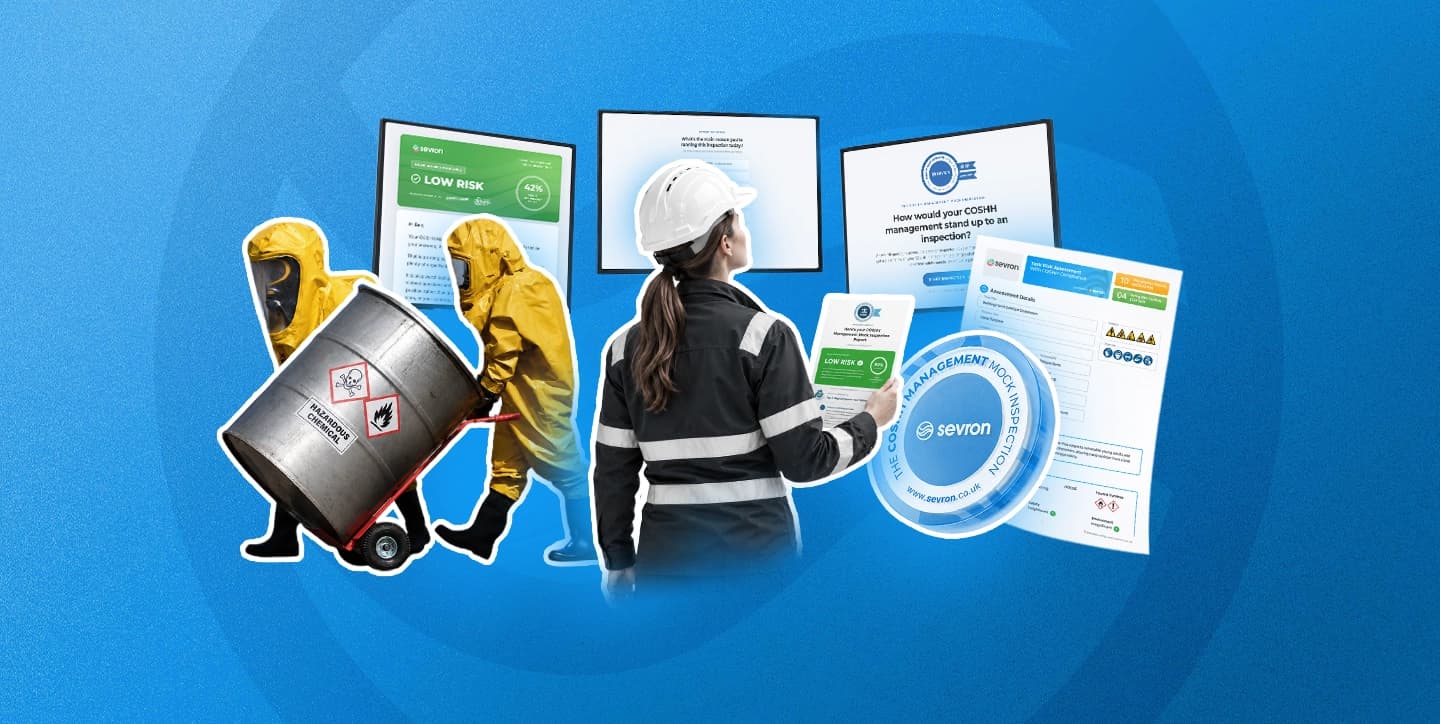
The COSHH Management Mock Inspection is live now. Sixteen questions across the same four areas set out above, about five minutes end to end, and a report that rates where you stand in each area and sets out what to address first. It has been co-developed with The International Association for Chemical Safety (IACS) and Safety-Verse, drawing on their expertise in chemical safety management alongside Sevron's nearly twenty years in COSHH compliance.
It is not an audit. It cannot see your site, your substances, or how the work is really done, and it does not make anyone compliant. What it does is put the questions in front of you while the answers are still yours to fix.
The tool sits at the front of the same path Sevron's Accelerated Compliance framework describes, taking teams from certified training through competent day-to-day management to records current enough to produce on demand. For organisations that want that running continuously rather than as a periodic check, Safety365 handles COSHH Assessments alongside Safety Data Sheet management and assessment reviews in one place.
Frequently Asked Questions
What is a COSHH inspection?
A COSHH inspection is a check by an enforcing authority, usually the Health and Safety Executive or a local authority, on how an organisation manages substances hazardous to health. It covers the assessment, the controls, worker training and health surveillance, and whether records can actually be produced. It can form part of a wider health and safety visit rather than standing on its own.
How do I prepare for a COSHH inspection?
Start with the substances rather than the paperwork. Confirm the register is current, check that each assessment describes the task as it is genuinely carried out, and test how quickly you could produce the records. A COSHH mock inspection run internally is a practical way to find the gaps first.
What does an HSE inspector check?
Inspectors look for evidence that the duties are being met in practice. Under the Control of Substances Hazardous to Health Regulations 2002 that means a suitable and sufficient assessment, controls maintained and working, training appropriate to the role, and health surveillance where it is required. Being able to show the records quickly matters as much as holding them.
How often should COSHH Assessments be reviewed?
Regulation 6 requires a review where the assessment is no longer valid or there has been a significant change in the work. Setting a fixed interval as well gives you a backstop for periods when nothing obvious has shifted. A supplier reformulating a product, a new process, or a change in the law all trigger a review regardless of when the last one happened.
For the deeper background, the Ultimate Guide to COSHH Compliance covers how to assess, document and defend chemical risk, with an eight-step action plan.
Find the gaps on your own terms, before anyone else asks the question.

Safety & Compliance Experts
The Sevron team brings decades of combined experience in health and safety compliance, risk assessment, and workplace safety solutions.

Reviewed by
Dale Allen
CEO & Founder