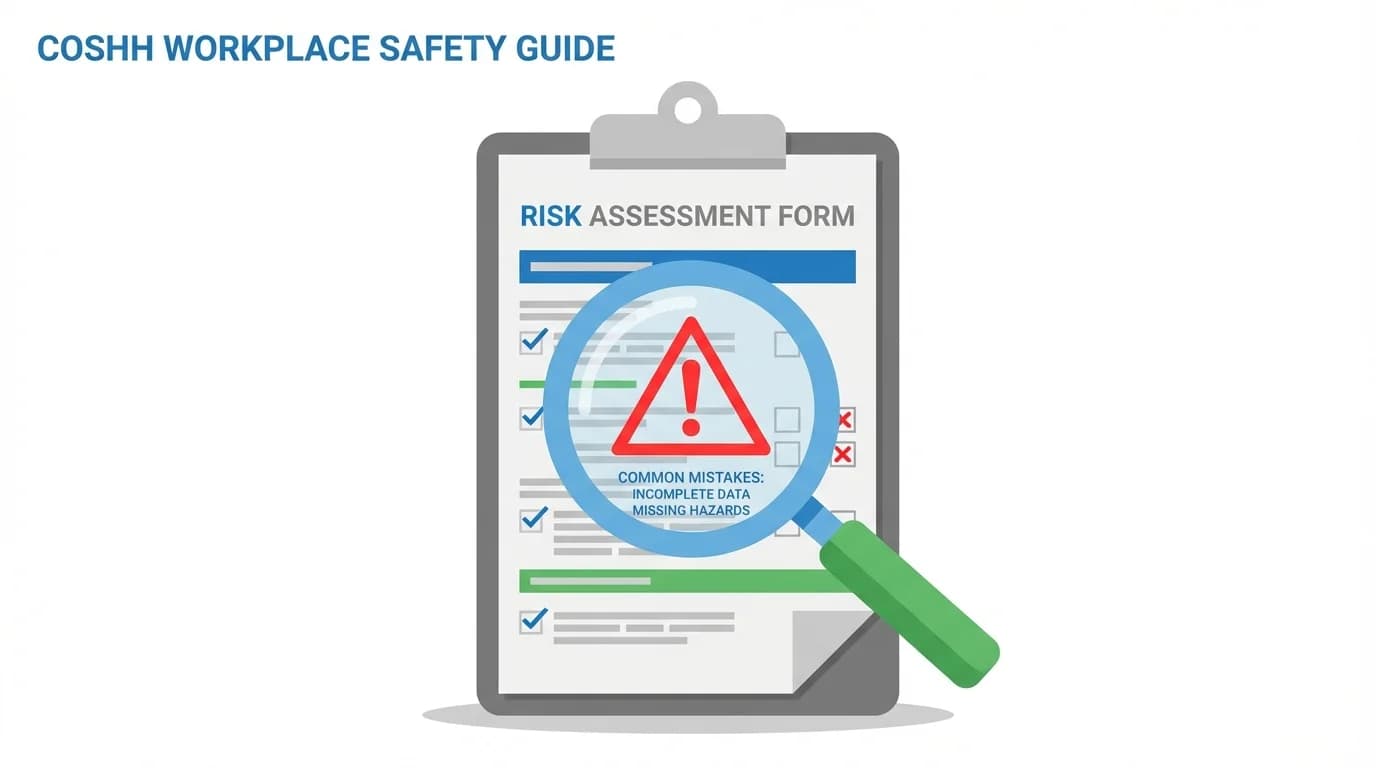
Building a safer workplace begins with moving beyond a "tick-box" mentality. A COSHH risk assessment is a legal requirement in the UK that helps protect employees and others from hazardous substances. The Control of Substances Hazardous to Health (COSHH) Regulations set the requirements for employers and employees regarding the usage and storage of hazardous substances.
However, many organisations view the assessment process as paperwork to be filed away. These common mistakes can lead to serious harm when workers are exposed to hazardous substances. Understanding the common COSHH risk assessment mistakes that occur is crucial for employers to maintain compliance with COSHH regulations.
See Sevron in Action
Watch our demo to see how Sevron simplifies COSHH compliance with automated risk assessments and real-time SDS data.
BOOK A DEMOWhy COSHH Risk Assessments Commonly Fail?
These common mistakes harm workplace health and safety and leave employees exposed to hazardous substances:
-
COSHH assessments are often treated as paperwork: Instead of being used as a practical safety tool, many risk assessments are tucked away in a folder to satisfy auditors, meaning the actual control measures never reach the shop floor.
-
Templates are reused without thought: Relying on a generic assessment template without tailoring it to the specific environment leads to incomplete data that ignores unique site hazards.
-
Real exposure is underestimated: Incompetent staff often fail to evaluate the actual duration and frequency of exposure, leading to a false sense of security regarding health risks. Allowing inexperienced employees to conduct COSHH risk assessments is both dangerous and illegal.
-
Controls exist on paper but not in practice: An assessment might mandate local exhaust ventilation or specific safety measures, but if these are broken or ignored by staff, the document provides zero protection and fails to control exposure to hazardous substances.
Thinking COSHH Only Applies to "Chemicals"
While many associate COSHH with liquid chemicals bearing bright warning labels, the regulations require employers to identify hazardous substances in all forms. This includes dusts, fumes, vapours, mists, and biological agents - not just liquids in bottles. Substances created by work processes still count, even if no product was bought from a supplier.
Examples in the construction industry:
- Construction dust
- Welding fumes
- Diesel exhaust
Using Generic or Copy-Pasted COSHH Assessments
A comprehensive assessment template provides a structured framework for conducting risk assessments, but many businesses use generic data sheets without cross referencing them against their specific site.
Generic templates can lead to irrelevant controls or missed hazards in COSHH assessments. Generic assessments lack the site-specific and task-specific detail inspectors require. For compliance, assessments must be tailored to the process, people involved, and workplace conditions.
Confusing Hazard Identification with Risk Assessment
Identifying a hazard is only the beginning; it is not the same as a full risk assessment. Evaluating risks involves assessing the severity of each identified hazard to determine necessary actions. While labels and symbols identify hazards and safety data sheets (SDS) list the dangers of a substance, COSHH risk assessments must evaluate actual exposure.
Exposure factors include:
- Who is exposed (employees, contractors, visitors)
- How they are exposed (inhalation, skin contact, ingestion)
- How often exposure occurs (daily, weekly, occasional)
- For how long each exposure lasts (minutes, hours, continuous)
Control measures must be implemented after identifying and evaluating risks in a COSHH risk assessment.
Assuming PPE Is an Adequate Control Measure
The hierarchy of control should prioritise elimination, substitution, and engineering controls before PPE. Personal protective equipment is the last resort, not the first line of defence. While employers must provide staff with the correct PPE and training when handling hazardous substances, PPE fails without higher controls because it relies on correct usage and maintenance.
Inspectors will challenge assessments that jump to PPE without demonstrating why substituting hazardous substances or engineering controls was not reasonably practicable.
Start Managing COSHH Compliance Today
Get a demo of our premium software, or get started with free tools.
Ignoring Substances Created by Work Processes
Ignoring process-generated substances like welding fumes and wood dust is a common error in risk assessments. Substances hazardous to health are frequently generated during work processes. When these potential hazards go unassessed, workers remain vulnerable to health complications.
Examples include:
- Wood dust from cutting/sanding
- Welding fumes from metalwork
- Vapours from reactions or evaporation
Failing to Consider Who Else Might Be Exposed
A COSHH risk doesn't just apply to the person holding the tool. Employers must identify all people affected by workplace substances, including those performing non-routine tasks like maintenance or using cleaning products. Engaging employees in the assessment procedure provides a clearer picture of who is at risk.
This includes:
- Other workers
- Contractors
- Cleaners
- Visitors
- Members of the public
Not Linking COSHH Assessments to Real Controls
An assessment is hollow if control measures are never implemented. This is where safety issues arise: controls are listed but not implemented, engineering controls are broken or missing, and there is no maintenance or testing to ensure systems work. COSHH compliance requires evidence that measures are active and maintained, not just documented.
No Review or Update of COSHH Assessments
To protect employees effectively, treat your risk evaluations as living documents. When circumstances change, reviews must be carried out promptly or the existing evaluation becomes obsolete. Cross referencing with older risk assessments is essential to monitor ongoing risks.
Review triggers include:
- New substances
- Process changes
- Incidents
- New evidence
Treating Training as a Tick-Box Exercise
Providing employees with training is an essential requirement, yet it is often undervalued. Inadequate training leaves staff vulnerable when handling hazardous substances. Effective training goes beyond documentation:
- Handing out SDS does not constitute effective training
- Workers must understand the risks and how to apply control measures in practice
- Competence matters more than collecting signatures on attendance sheets
Training courses on COSHH are available to help organisations educate staff about handling hazardous substances safely and meeting requirements.
Assuming Small Businesses or Self-Employed Are Exempt
The law and COSHH regulations apply to every employer, regardless of company size. Small businesses still handle harmful substances and have a strict requirement to conduct risk assessments. Two key points to remember:
- COSHH applies based on the level of risk present, not the number of staff
- Company size does not remove the legal responsibility to protect staff from harmful substances
What HSE Inspectors Typically Find During COSHH Audits?
During an audit, HSE inspectors look for evidence that a competent person has examined all exposure routes, including skin contact and inhalation. Common findings include:
- Generic assessments that lack site-specific detail
- Poor dust control in environments where cutting, grinding, or sanding occurs
- Over-reliance on PPE without adequate engineering controls
- No health surveillance for workers exposed to hazardous substances
- No evidence that listed controls are being used in practice
How to Avoid These COSHH Risk Assessment Mistakes?
To ensure your assessment is robust, involve staff directly in the process. Their feedback prevents incomplete data and ensures control measures are practical. Having a competent person conduct the assessment ensures you meet regulations. Best practices include:
- Start with tasks, not products, to identify substances created or used
- Focus on actual exposure levels rather than listing hazards
- Apply the hierarchy of control, prioritising elimination and substitution over PPE
- Check that controls work in practice, not just on paper
- Review regularly when new materials, processes, or incidents occur
Ready to Simplify Your COSHH Assessments?
Create professional COSHH risk assessments in minutes with our free online tool. No credit card required.
CREATE FREE ASSESSMENTTopics:
