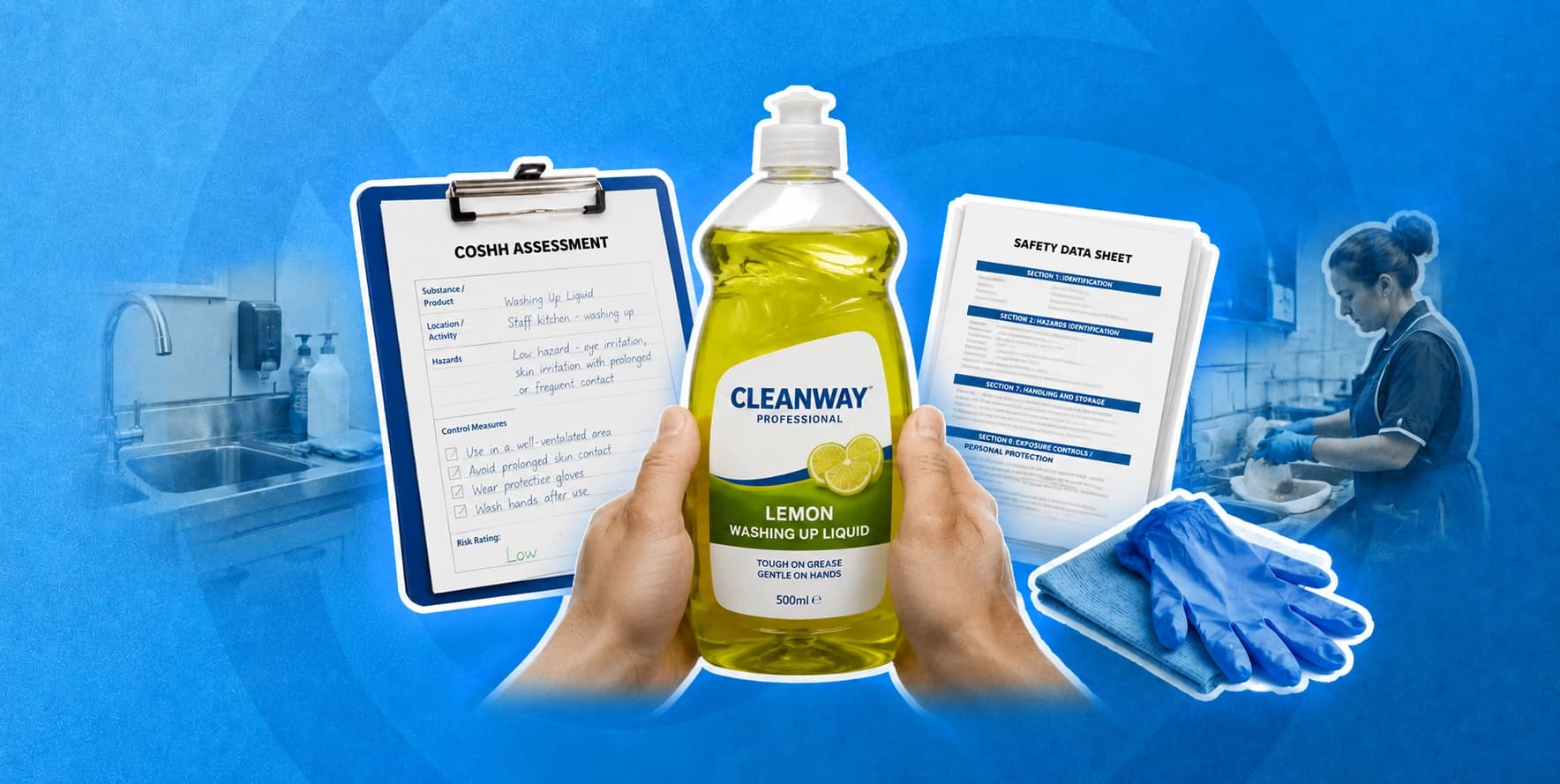

Of all the safety data sheets pulled from our database last month, the one at the top of the list was not an industrial solvent or a tankful of acid. It was washing up liquid. The same product sitting by every sink in the country was requested again and again, by people across different companies.
That is worth pausing on. Why would a business go looking for the safety data sheet on something so ordinary? Because someone, somewhere, asked the right question. Does this need a COSHH assessment? The answer is yes, and the reason is more interesting than it first sounds.
Why is washing up liquid the most downloaded SDS?
The honest read is that workplaces are getting more careful, not less. A few years ago the everyday products rarely made it into a COSHH file at all. The solvents and the strong cleaners did, and the washing up liquid by the staff sink was waved through as obviously harmless. Now the requests tell a different story. Businesses are pulling the sheet because they are no longer sure that obvious is the same as exempt. It is not. COSHH does not have a household-products carve-out, and the people downloading that sheet have worked that out.
Is washing up liquid a COSHH substance?
Yes, in a workplace. COSHH covers any substance hazardous to health, and a detergent qualifies even when the hazard is mild. That word mild matters, and it cuts both ways. Most washing up liquids are low hazard, with eye irritation the main flag, and the specific safety data sheet is what confirms the detail for any given product. So the duty here is not to panic. It is to assess. The point of COSHH is judgement, deciding how much control a substance actually needs, and a low-hazard product is a perfectly valid answer to that question, as long as someone has asked it and written it down.
Low hazard, real duty
COSHH applies to a substance because of what it can do to health, not because of how dangerous it feels. A product can be low hazard and still sit inside the duty. The assessment for it may be short, but a short assessment and no assessment are not the same thing to an inspector or a client.
The real risk is wet work, not the bottle
Here is where the ordinary product earns a second look. The bigger risk with washing up liquid is rarely the liquid itself. It is the activity around it. Hands in and out of water all shift, with detergent stripping the skin's natural barrier, is what HSE calls wet work, and it is one of the leading causes of occupational contact dermatitis in Britain. Catering, cleaning, healthcare and hairdressing all run on it. The harm builds slowly, a bit of dryness, then cracking, then the kind of dermatitis that keeps someone off work, and it is almost entirely preventable.
So the substance you waved through as harmless turns out to carry a genuine, recognised work health risk, just not the one the word chemical usually brings to mind. That is exactly why the assessment is worth doing properly rather than skipping.
The product everyone assesses last
Businesses reliably assess the degreaser and the oven cleaner, then miss the washing up liquid the team touches fifty times a shift. Frequency of contact is part of the risk, and the most-used product is often the least-assessed. What does your assessment say about the substance your staff handle most?
What a proportionate assessment looks like
For a low-hazard product used in a high-contact way, the assessment does not need to be long, but it needs to be real. Start with the safety data sheet. Section 2 tells you the actual hazard classification for that specific product, section 7 covers storage, and section 8 covers protection and exposure controls. Then judge how it is used in your workplace, how often, and by whom. For wet work the sensible controls are practical rather than heavy: suitable gloves where contact is prolonged, a proper skin care and drying routine, and rinsing rather than leaving residue on the skin. You are not building a containment booth for washing up liquid. You are showing you recognised the wet-work risk and managed it sensibly.
Where it matters most
Picture the catering manager who has done everything right on paper. The degreaser is assessed, the oven cleaner is assessed, the descaler has its own sheet and a warning about acids. The washing up liquid, used by the whole kitchen brigade across every service, is not assessed at all, because it never felt like a chemical. Six months later a chef is signed off with contact dermatitis, and the question becomes what was done to prevent it. The answer should not be a blank. In commercial kitchens, cleaning contractors and care homes, the wet-work products are the ones quietly doing the damage, precisely because nobody treats them as a risk.
Turn the SDS into an assessment in about a minute
If you have just downloaded the safety data sheet, you are already at the right starting point. The next step is the one that usually stalls, turning that sheet into a compliant COSHH assessment. SPOT AI does exactly that, reading the safety data sheet and producing a compliant assessment in around 60 seconds through a simple five-step wizard you finish and own. It works just as well for a low-hazard washing up liquid as for anything stronger, and Safety365 keeps the sheet and the assessment linked in one place so a reissued SDS does not slip past unnoticed. That is Sevron's Accelerated Compliance approach in its simplest form, taking you from a downloaded sheet to certified, competent and compliant without losing an afternoon to it.
Downloaded the sheet? Finish the job.
SPOT AI turns a safety data sheet into a compliant COSHH assessment in around 60 seconds, free to start.
Watch the demoFrequently Asked Questions
Do I need a COSHH assessment for washing up liquid?
Yes, in a workplace. COSHH covers any substance hazardous to health, so even a low-hazard detergent needs an assessment, though it can be brief and proportionate to the low risk.
Is washing up liquid actually dangerous?
Mostly it is low hazard, with eye irritation the usual flag. The bigger risk is to the skin from frequent wet work, not from the product itself.
What causes dermatitis from washing up liquid?
Repeated contact with water and detergent, known as wet work, which strips the skin's protective barrier over time. HSE treats it as a leading cause of occupational contact dermatitis.
Where do I find the safety data sheet?
On the Sevron SDS database or from the manufacturer. Section 2 lists the hazards, and sections 7 and 8 cover storage and protection.
Can SPOT AI assess a low-hazard product?
Yes, and quickly. It reads the safety data sheet and produces a compliant assessment in around 60 seconds, whatever the hazard level.
Low hazard is still a duty, and the duty takes about a minute. Turn your safety data sheet into a COSHH assessment with SPOT AI.

Safety & Compliance Experts
The Sevron team brings decades of combined experience in health and safety compliance, risk assessment, and workplace safety solutions.

Reviewed by
Dale Allen
CEO & Founder