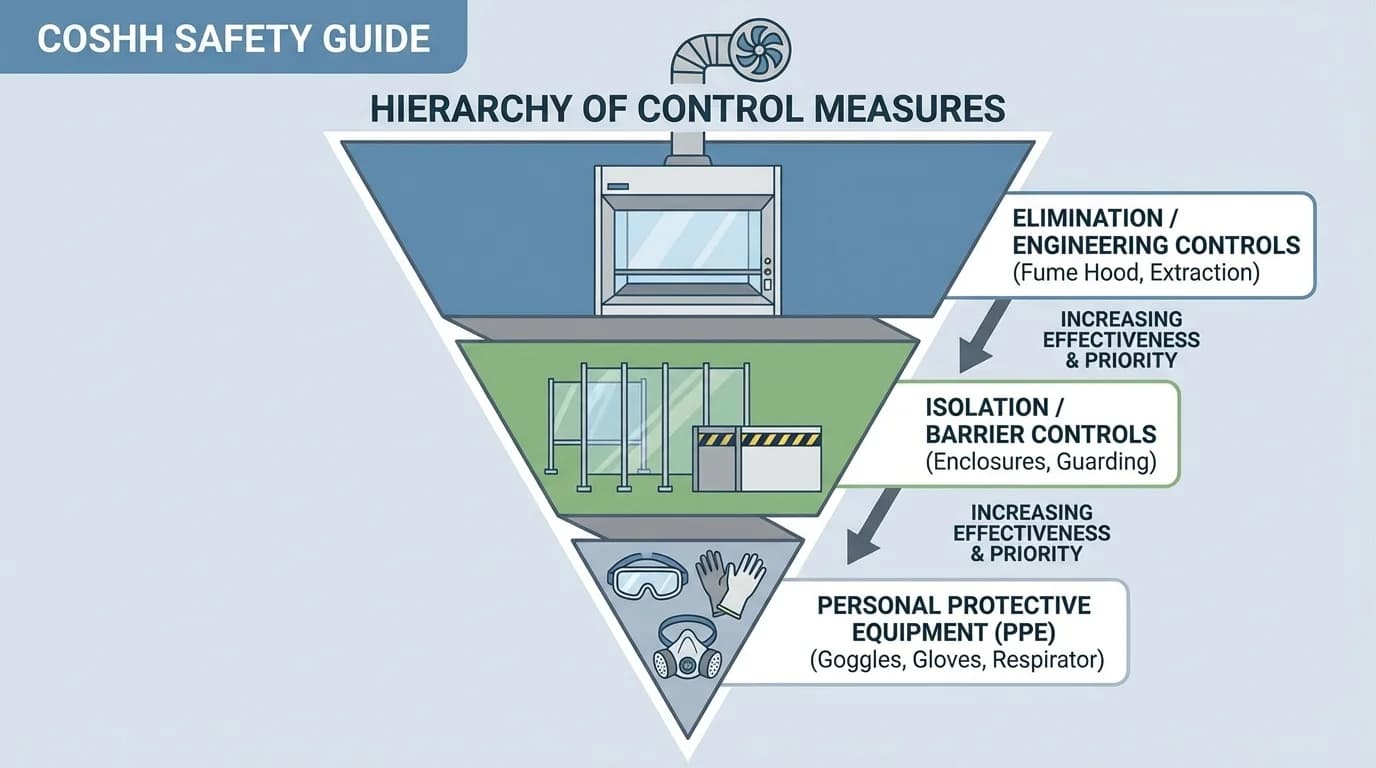
The COSHH regulations require employers to control substances that can harm workers' health. Employers must assess the risks to health and safety from hazardous substances and prevent or properly control exposure as far as is reasonably practicable.
Understanding what control measures are, how they must be selected and applied, and what adequate control actually means is important for legal compliance with COSHH and any specific regulations that apply to the workplace.
See Sevron in Action
Watch our demo to see how Sevron simplifies COSHH compliance with automated risk assessments and real-time SDS data.
BOOK A DEMOWhat Are COSHH Control Measures?
COSHH control measures are actions taken to prevent or reduce contact with substances hazardous to health in the workplace. A hazardous substance means any chemical, toxic substance, fume, dust, fibres, and biological agents.
The COSHH regulations apply to a wide range of substances including chemicals, fumes, dusts, vapours, mists, gases, and biological agents.
Under COSHH, exposure must be prevented or adequately controlled. Common hazardous substances may have a Workplace Exposure Limit (WEL) set by the UK Health and Safety Executive, but compliance requires more than staying below these limits. Measures must be as rigorous as possible within what is practicable for the specific workplace and task.
Exposure to hazardous substances can cause health issues such as asthma, dermatitis, and cancer. These measures prevent health effects by reducing exposure to the lowest level reasonably achievable.
The COSHH Hierarchy of Control (Core Principle)
The hierarchy of control measures should be followed, prioritising elimination of hazards before considering other options. Apply measures in order. Lower-level options never replace higher ones.
The hierarchy from most to least effective:
-
Elimination – Removing the hazardous substance or task entirely
-
Substitution – Replacing with a safer option
-
Engineering controls – Physical measures at source
-
Administrative controls – Procedures and systems to reduce exposure
-
Personal Protective Equipment (PPE) – Protective equipment worn by workers
Elimination of hazardous substances is the first priority in COSHH control measures. Consider each level before moving to the next. Skipping directly to lower-level options without justification represents a COSHH compliance failure.
Elimination – The Most Effective Control
Elimination of hazardous substances is the most effective control measure to prevent exposure. Removing the substance or process that generates it through design, method, or process changes eliminates risk completely.
Practical methods of elimination include:
-
Using pre-cut materials to avoid dust generation from cutting operations
-
Outsourcing high-risk processes to specialist contractors with dedicated facilities
-
Removing unnecessary chemical use by redesigning processes or selecting different methods
-
Changing work sequences so that hazardous operations are not required
Elimination should always be the first consideration during COSHH risk assessment. Where elimination is not reasonably practicable, documented justification should explain why before moving to substitution or other options.
Substitution – Using Safer Alternatives
Substitution involves replacing hazardous substances with less harmful alternatives or reducing the inherent hazard through changes to form or concentration. A safer alternative reduces the potential severity even when other measures fail.
A less hazardous alternative may include:
-
Water-based products instead of solvent-based products to eliminate or reduce harmful vapour exposure
-
Low-silica materials in place of high-silica alternatives to reduce the risk of silicosis
-
Cleaning agents with lower toxicity or reduced skin sensitisation properties
-
Using substances in a safer form, such as pellets instead of powder to minimise airborne dust
When considering substitution, employers must ensure that the replacement substance or process does not introduce new risks. Risk assessments must be carried out by a competent person with sufficient skills, knowledge, and experience regarding the chemicals and processes involved.
Safety Data Sheets (SDS) provide essential information for conducting risk assessments related to hazardous substances. Identifying hazards involves reading product labels displaying hazard symbols and Safety Data Sheets to determine harmful substances present in the workplace. Employers must provide safety data sheets for classified substances to the recipient under UK REACH.
Engineering Controls (Preferred Practical Controls)
Engineering controls are designed to minimise exposure to hazardous chemicals at the source. These are physical measures that reduce exposure at source and do not rely on worker behaviour, giving them inherent reliability compared to administrative measures or PPE.
Engineering controls can help minimise exposure to hazardous substances. Common and effective options include:
-
Local Exhaust Ventilation (LEV): Captures and extracts contaminants at the point of generation, preventing them from entering the breathing zone. LEV systems that extract emissions must be properly designed for the specific substance and process, with adequate capture velocity and airflow.
-
On-tool dust extraction: Integrated extraction systems that capture dust directly at powered tools during use, particularly effective for construction and woodworking operations.
-
Enclosures and isolation: Physical barriers that contain substances hazardous to health within a defined space or separate workers from the hazard. Examples include spray booths, glove boxes, and fully enclosed material handling systems.
-
Automation and remote handling: Removes workers from direct exposure by performing hazardous operations mechanically or remotely.
Employers must ensure that control measures are regularly inspected and maintained by a person with necessary skills. For LEV systems, thorough examination by a professional is required at least every 14 months under COSHH regulations.
Regular maintenance and checks of control measures are essential to ensure their effectiveness in managing hazardous substances.
Measures must work in real conditions, not just general principle. Engineering options designed for ideal conditions may fail when faced with variable temperatures, high production demands, or operational constraints. Testing and maintenance must verify that they remain effective under actual workplace conditions.
Start Managing COSHH Compliance Today
Get a demo of our premium software, or get started with free tools.
Administrative Controls (Supporting Measures)
Supervisory controls involve monitoring and enforcing rules to ensure that control of substances hazardous to health is optimised. Administrative measures are systems and procedures that reduce the duration or likelihood of exposure, but they are never sufficient alone for high-risk substances because they depend on consistent compliance.
Examples of administrative measures include:
-
Safe systems of work that specify how tasks involving substances hazardous to health should be performed
-
Task planning and sequencing to minimise exposure duration or the number of exposed individuals
-
Restricted access zones to limit unnecessary exposure
-
Training and supervision to ensure correct use and recognition of failures
-
Job rotation to limit individual exposure time, though this distributes risk rather than eliminating it
Training is essential for workers to use controls and personal protective equipment (PPE) correctly. Employers should ensure that all employees are informed and trained on the hazards and risks associated with the substances they work with. Workers need to understand the outcome of risk assessments and what this means for them.
Training should involve operators, supervisors, and managers to ensure everyone can identify when controls are being misused. Motivation comes from understanding what the health risks are and why control measures are important.
Regular reviews of training and information provided to employees are necessary to ensure ongoing awareness of hazards. Training employees on the proper use of control measures is crucial for their effectiveness in reducing exposure to hazardous substances.
Workers should know what to do in the event of an accident or emergency involving hazardous substances. Emergency procedures for accidents and spill management must be established and easily accessible.
Personal Protective Equipment (PPE) Under COSHH
Appropriate personal protective equipment (PPE) is considered a last resort in the hierarchy under COSHH. PPE is the last line of defence and does not control exposure at the source. Instead, devices worn provide a barrier between the worker and the hazard, functioning only when properly selected, correctly fitted, consistently worn, and adequately maintained.
PPE must be suitable, fitted, maintained, and enforced. Selection must be based on the specific substance, exposure route, and level of risk.
Common examples include:
-
Respiratory Protective Equipment (RPE): Prevents inhalation of harmful substances. The type required depends on the substance, its concentration, and the duration. Tight-fitting RPE requires face-fit testing to ensure an adequate seal.
-
Protective gloves: Must be selected based on the specific chemical or substance. Glove materials have different permeation resistance to different chemicals. Manufacturers provide breakthrough time data that indicates how long gloves remain effective against specific substances.
-
Eye protection: Goggles or face shields to prevent contact with eyes from splashes, vapours, or airborne particles.
-
Protective clothing: Coveralls, aprons, or specialised garments to prevent skin contact with hazardous substances.
Combining different control measures can provide a more effective approach to managing exposure to hazardous substances. PPE should only be used where higher-level options are not reasonably practicable or as additional protection when engineering and administrative measures cannot reduce exposure to adequately controlled levels.
Selecting the Right COSHH Control Measures
Measures should be tailored to the specific hazardous substances and processes present in the workplace. Selection depends on multiple factors that must be evaluated during the COSHH assessment process:
-
Nature of the substance: The physical and chemical properties, including volatility, particle size, toxicity, and corrosiveness. Different substance properties require different approaches.
-
Exposure route: Whether exposure occurs through inhalation, skin absorption, ingestion, or injection. Some substances present multiple exposure routes that require combined approaches.
-
Duration and frequency: The length of time workers are exposed and how often exposure occurs. Longer or more frequent exposures require more robust measures.
-
Number of people exposed: The total number of exposed individuals, including not only direct operators but also nearby workers, maintenance personnel, and others who might be affected.
-
Workplace conditions: Available space, existing ventilation, temperature, humidity, and other environmental factors that affect effectiveness and practicality.
Employers must decide who might be harmed and how during the risk assessment process. Employers are required to keep an inventory of all hazardous substances present in the workplace. This inventory forms the basis for identifying requirements and ensuring no substances hazardous to health are overlooked during COSHH assessment.
Monitoring and Reviewing Control Measures
Once risks are assessed, employers must implement control measures to minimise exposure to hazardous substances. Measures should be regularly reviewed to ensure they remain effective and account for any changes in the workplace.
Regular reviews of risk assessments are needed to ensure the effectiveness of control measures and to account for changes in the workplace. Changes that trigger review include new substances, modified processes, equipment changes, organisational changes affecting exposure, or incidents indicating failure.
Monitoring and review methods include:
-
Visual checks: Regular inspections to verify measures are in place, functioning correctly, and being used as intended. Visual monitoring can identify obvious defects such as damaged equipment, blocked ventilation, or non-use of required measures.
-
Air monitoring: Measurement of airborne contaminants to verify levels are adequately controlled. Personal air monitoring provides the most accurate assessment of actual worker exposure. Air monitoring is particularly important when working near Workplace Exposure Limits or when health surveillance indicates potential issues.
-
Worker feedback: Workers performing the tasks can identify when measures are ineffective or impractical. Symptoms such as respiratory irritation, skin problems, or headaches may indicate failure.
-
Maintenance records: Documentation of inspections, testing, repairs, and replacements ensures control equipment remains functional. These records provide evidence of ongoing compliance and identify patterns of failure or deterioration.
Regular cleaning and maintenance of work areas can help control contact with hazardous substances. Housekeeping practices prevent accumulation of hazardous substances on surfaces, which can cause secondary exposure.
Health surveillance may be necessary for workers exposed to hazardous substances to protect their health. Employers must provide health surveillance when there is a reasonable likelihood that an identifiable disease or adverse health effect associated with exposure will occur. Health surveillance detects early signs of exposure-related health effects before serious harm develops.
COSHH Control Measures and Risk Assessments
Employers are required to conduct risk assessments for hazardous substances to protect employees and others from harm. The COSHH risk assessment identifies hazards and evaluates exposure, while measures reduce the risk to adequately controlled levels.
Risk assessments must be carried out by a proficient person with sufficient skills, knowledge, and experience regarding the chemicals and processes involved. A competent person understands the hazards, can evaluate scenarios, and can select appropriate options based on the hierarchy.
Measures must be documented and reviewed as part of the COSHH risk assessment process. Employers must keep a record of their risk assessments if they have five or more employees, but it is advisable to document assessments regardless of the number of employees. Employers must record their findings from risk assessments if they have five or more employees.
COSHH risk assessment and measures must reflect actual workplace conditions and practices, not idealised or theoretical scenarios.
Ready to Simplify Your COSHH Assessments?
Create professional COSHH risk assessments in minutes with our free online tool. No credit card required.
CREATE FREE ASSESSMENTExamples of COSHH Control Measures (Practical Scenarios)
Construction Dust
Cutting concrete, brick, or stone generates respirable crystalline silica dust. Elimination involves using pre-cut materials where practicable. Substitution is rarely possible for structural materials. Engineering options such as on-tool water suppression or on-tool extraction are essential. Water suppression reduces airborne dust but creates wet slurry requiring management. Dust extraction captures particles at source.
Administrative measures include limiting the number of workers in proximity and restricting task duration. Respiratory protection rated at least FFP3 provides additional protection when engineering options cannot eliminate exposure entirely.
Solvent Use in Workshops
Small workshops using solvent-based paints, thinners, or degreasers face inhalation and skin contact risks. Substitution with water-based alternatives eliminates most solvent exposure. Where solvents remain necessary, local exhaust ventilation at the point of use prevents vapour accumulation. For spray applications, extraction booths are required.
Administrative measures include minimising the quantity of solvent decanted at any time and ensuring adequate general ventilation. Gloves compatible with the specific solvents prevent skin contact and absorption.
Cleaning Chemicals In Offices
Substitution with less hazardous alternative reduces risk. pH-neutral multi-surface cleaners replace strong alkalis or acids. Concentrated products with controlled dilution systems prevent misuse and overexposure.
Administrative measures include training cleaners to read product labels and Safety Data Sheets, correct dilution procedures, and ensuring adequate ventilation during use. Appropriate PPE includes chemical-resistant gloves and, where required by the product, eye protection.
Common COSHH Control Measure Failures
Many workplaces fail to achieve proper control due to poor selection, implementation, or maintenance of measures required. The key message is that documented controls must match actual practice.
-
PPE used as the primary option: Relying on respiratory protection or gloves as the main approach when higher-level control options such as elimination, substitution, or engineering are reasonably practicable violates the hierarchy.
-
Broken or untested LEV: Extraction systems that have degraded significantly from their original performance due to filter blockage, ductwork damage, or fan deterioration. Systems that have never been thoroughly examined since installation despite the legal requirement for 14-monthly testing fail to adequately control exposure to substances hazardous to health, potentially causing ill health.
-
Generic measures copied from templates: COSHH assessments and measures copied from standard templates without adaptation to the actual substances, processes, or workplace conditions rarely match specific requirements.
-
No review as work changes: Measures documented for original substances and processes that remain unchanged despite changes to materials, suppliers, work methods, or equipment mean documented approaches no longer reflect actual scenarios.
-
Measures ignored in practice: A gap between documented approaches and actual workplace practices indicates failure of training, supervision, or enforcement.
Topics:
