When discussing workplace safety, it is easy to get lost in spreadsheets and legal jargon. At its heart, carrying out a COSHH risk assessment is about one thing: looking out for each other. Whether it's managing a cleaning crew, a construction site, or a laboratory, we want to ensure that our team goes home as healthy as they arrived.
In this guide, we are going to walk through the process together. We will move past the "compliance for compliance's sake" mindset and look at how these assessments actually protect our lungs, our skin, and our long-term health.
Start Managing COSHH Compliance Today
Get a demo of our premium software, or get started with free tools.
Why Carrying Out a COSHH Risk Assessment Matters?
We do not perform these assessments to simply satisfy a health and safety document requirement. We do it because hazardous substances can have devastating effects if left unchecked.
Exposure to harmful substances can lead to acute symptoms like skin burns or eye irritation. More so, it is the long-term conditions that we should worry about most. Talk about occupational asthma, neurological damage, and even various cancers. By taking the time to assess the health risks properly, we are protecting our organisation's reputation and reducing absenteeism.
What Should a COSHH Risk Assessment Look Like?
If you have ever wondered what a COSHH risk assessment should look like, you are not alone. While there is not one single mandated layout, a high-quality COSHH assessment form should be a clear and living document.
At a minimum, your safety document should include:
- Assessor Information: details of the competent person with the knowledge to lead the process
- Substance Details: a list of hazardous substances, including biological agents
- Hazard Identification: specific health hazards like skin irritation or lung damage
- Control Measures: the actions taken to protect workers
- Emergency Procedures: clear steps for first aid or accidental spills
What are the 5 Steps of COSHH Risk Assessment?
Step 1: Identify the Hazards in Your Workplace
The first step of any risk assessment is to identify exactly what you are working with. List every substance that could potentially cause harm.
Safety Data Sheets (SDS)
It is necessary to collect and keep Safety Data Sheets for every identified hazardous substance. These sheets provide the safety information needed to understand the health risks. However, do not rely on the SDS alone. You must also scrutinise your specific work processes.
Identifying Hidden Hazards
Some of the most dangerous harmful substances are not found on bottle labels. They are generated by the task itself. Examples include:
- Fumes from welding or soldering
- Dust such as silica dust or wood dust from cutting and sanding
- Waste and by-products created during a chemical reaction
The physical form of a chemical affects how likely it is to get into the air. Dustiness is the factor for solids, while volatility is the primary concern for liquids.
Step 2: Decide Who Might Be Harmed and How
Once you know what the hazards are, it is a must to assess the potential exposure for your employees.
Understanding the Routes of Exposure
How a substance enters the body determines the level of risk. Consider these four main routes:
- Inhalation - breathing in dust, fumes, or vapours.
- Ingestion - swallowing substances, often through contaminated hands.
- Absorption - contact with the skin or eyes.
- Injection - sharp objects puncturing the skin.
Identifying At-Risk Groups
You must consider everyone who might be exposed. This includes your regular workers as well as others who may be on-site:
- Maintenance contractors who may encounter hazardous substances less frequently
- Cleaners who handle chemicals daily
- Vulnerable groups such as expectant mothers or young, inexperienced staff
Step 3: Evaluate Risks and Implement Control Measures
After identifying the hazards and the people at risk, decide on the best control measures. The goal is to control exposure and prevent ill health.
The Hierarchy of Control
When choosing how to adequately control exposure, it is recommended to follow a specific order. This is known as the hierarchy of control:
- Elimination - can you remove the substance entirely?
- Substitution - can you use a safer alternative chemical?
- Engineering Controls - can you use local exhaust ventilation (LEV) or fume cupboards?
- Administrative Controls - can you change the work activities to reduce the time a person is exposed?
- Personal Protective Equipment (PPE) - the last line of defence.
Understanding Workplace Exposure Limits (WELs)
Workplace Exposure Limits are legal limits on the concentration of hazardous substances in workplace air. We must ensure that the levels of dust or chemicals remain below these permitted limits through regular exposure monitoring.
See Sevron in Action
Watch our demo to see how Sevron simplifies COSHH compliance with automated risk assessments and real-time SDS data.
BOOK A DEMOStep 4: Record Your Significant Findings
Once the risk assessment is complete, it must be documented. If you are an employer with five or more employees, recording the risk assessment is a legal requirement under health and safety law.
Creating a Practical Health and Safety Document
A COSHH assessment should never be just a piece of paper that sits inside a drawer. It must be a practical health and safety document that is accessible in the workplace. Supervisors must ensure that the team understands the outcome of the assessment and what the specific control measures mean for their daily task.
Including Safe Disposal and Emergency Procedures
A complete assessment must go beyond the usage phase. It needs to include:
- Waste Disposal: the appropriate safe disposal of reagents and contaminated materials after a procedure is finished
- Emergency Procedures: clear instructions for accidental spills, fires, or first aid needs
- Storage Requirements: specific storage instructions for substances that present a risk due to flammability or incompatibility with other chemicals
Step 5: Review and Update Your Assessment Regularly
A COSHH risk assessment is not a "one-time-be-done" event. Assessment reviews must be done regularly to ensure they remain up to date and account for any changes in the workplace.
Triggers for a Further Action Review
While a regular annual review is a good benchmark, you must take further action and update the document immediately if:
- There is a significant change in the work processes or equipment
- New hazardous substances are introduced to the site
- An accident, near miss, or case of ill health occurs
- Exposure monitoring or health surveillance results suggest that current control measures are failing
Who Is Responsible for Carrying Out a COSHH Risk Assessment?
The employer holds full legal accountability under the COSHH Regulations 2002. If you own or manage a business, you must ensure all health risks are assessed and controlled.
While the legal duty stays with the employer, the work is often delegated to a competent person. This is an individual (internal or external) with the specific training and experience to evaluate chemical hazards.
Effective assessments must also involve the workforce. Employees handling substances daily offer the best insight into how tasks happen in reality. They identify hidden hazards like localised dust or fumes and can confirm if PPE or engineering controls actually work for the job.
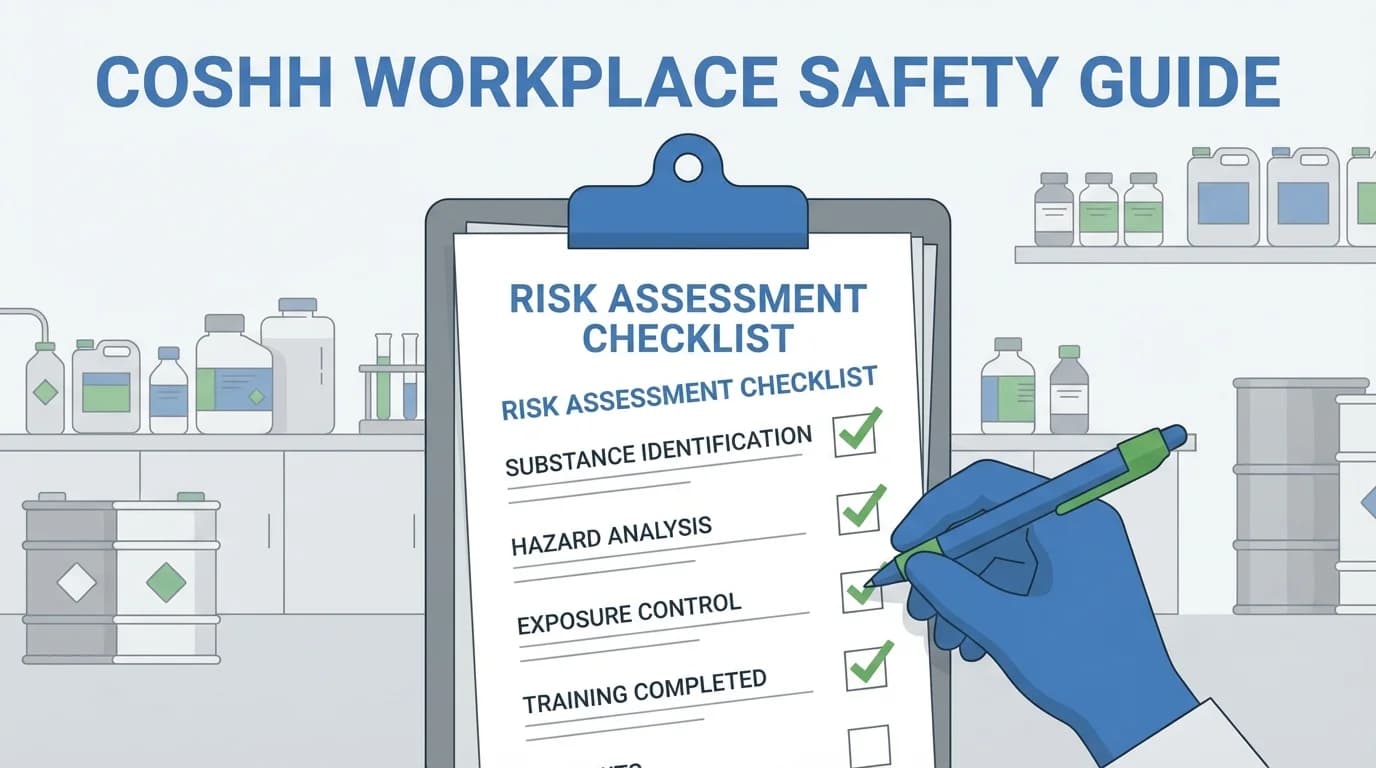
COSHH Risk Assessment Checklist
Use this quick checklist to ensure your assessment is thorough and compliant:
- Inventory Check: Have you listed every substance (liquids, solids, gases) and process-generated hazard (dust, fumes)?
- SDS Collection: Do you have the most recent Safety Data Sheets for every chemical on site?
- Exposure Path: Have you identified how the substance enters the body (Inhalation, Ingestion, Absorption, or Injection)?
- Who's at Risk: Have you considered contractors, cleaners, and vulnerable groups like pregnant workers?
- Control Review: Are you following the Hierarchy of Control (prioritizing elimination and substitution over PPE)?
- Maintenance: Are engineering controls, like Local Exhaust Ventilation (LEV), being inspected regularly?
- Emergency Readiness: Are eyewash stations, spill kits, and first aid procedures clearly marked and accessible?
- Training: Has every person involved in the task been briefed on the findings of this assessment?
Building a Safer Workspace Together
Carrying out a COSHH risk assessment might seem like a heavy administrative lift, but it is the most effective tool we have to prevent ill health in our teams. By identifying hazards, implementing the hierarchy of control, and keeping our significant findings updated, we create a workplace where everyone feels protected.
At Sevron, we are dedicated to making chemical safety simple and accessible. Whether you are looking for an automated COSHH assessment form or need expert guidance, our goal is to help you protect the health and lives of your people every single day.
Topics:
