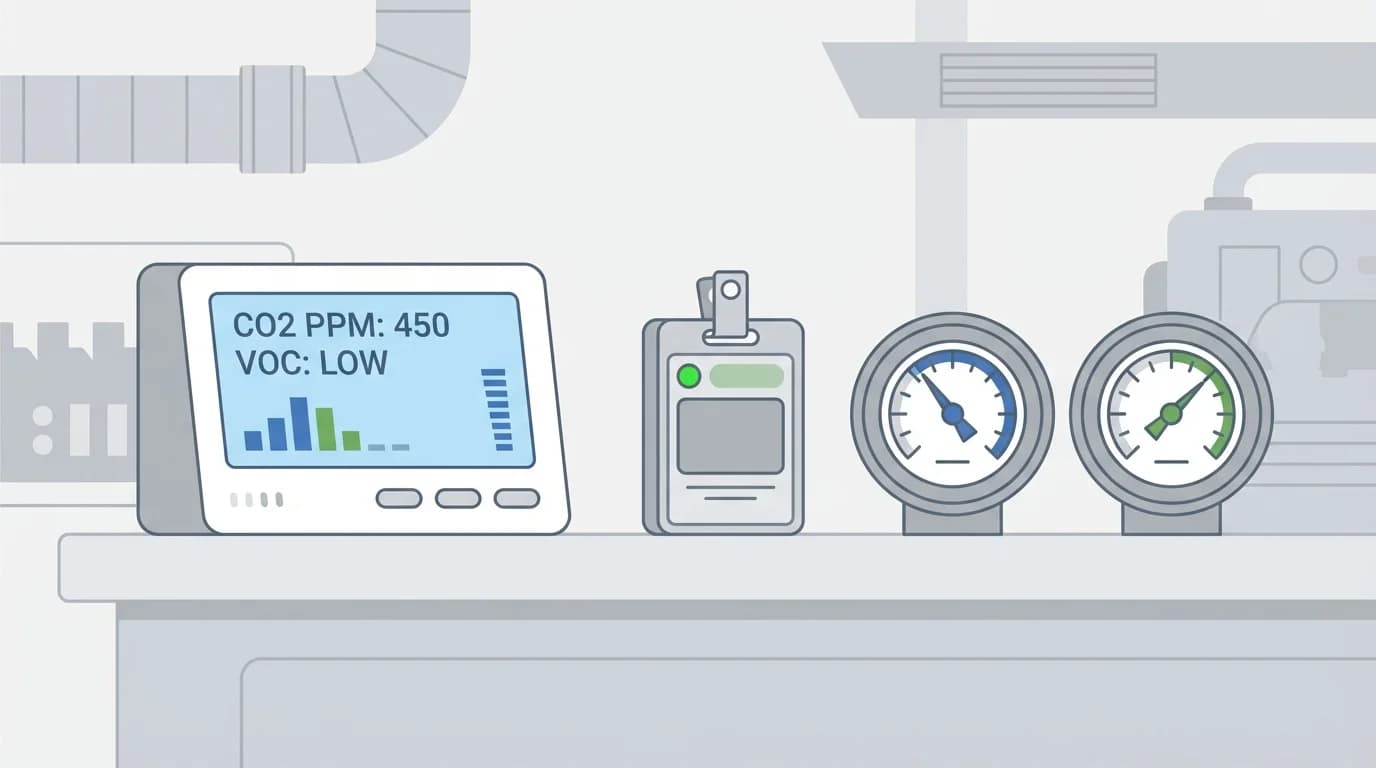
Managing health and safety risks in environments containing dangerous substances requires a clear understanding of legal limits. Under the COSHH regulations, Workplace Exposure Limits (WELs) are approved and enforced by the Health and Safety Executive (HSE) in Great Britain. These serve as the primary benchmark for protecting the working environment. These limits are legally binding thresholds designed to protect workers' health by defining the maximum concentration of substances hazardous to health that a worker breathes in over a specific reference period. Under the Health and Safety Work Act 1974, employers must also ensure these protections extend beyond employees to include contractors, clients, and members of the public.
Start Managing COSHH Compliance Today
Get a demo of our premium software, or get started with free tools.
What Are Workplace Exposure Limits (WELs)?
Workplace exposure limits are legal limits set under the Control of Substances Hazardous to Health Regulations (COSHH). They represent the maximum concentration of hazardous substances permitted in workplace air.
-
Measured as an airborne concentration: Personal air sampling specifically targets the breathing zone of the employee.
-
Not for surface or storage: These limits do not apply to the volume of chemicals stored. They focus on the intensity of workplace exposure through inhalation.
Why Workplace Exposure Limits Exist?
The Health and Safety Executive (HSE) mandates these limits to ensure health and safety is maintained through rigorous control of substances hazardous to the respiratory system. They exist to:
-
Prevent long term occupational disease: Many adverse effects, such as lung disease from Respirable Crystalline Silica (RCS), manifest after prolonged exposure.
-
Control invisible exposure risks: Since many hazardous to health regulations deal with invisible dusts and gases, WELs provide a means measuring invisible threats.
-
Support enforcement and monitoring: The HSE is currently conducting inspection drives targeting occupational lung diseases. These specifically look at silica, isocyanates, and bakery dust.
Types of Workplace Exposure Limits Under COSHH
Under the COSHH regulations, there are two distinct types of occupational exposure limits. Both are essential because they address different time periods and physiological impacts; one does not replace the other, as a substance may have both a chronic and an acute exposure limit.
Long-Term Exposure Limit (LTEL)
-
8 hour time weighted average (TWA): This represents the highest safe level for a standard workday.
-
Examples: Aluminium dust is set at 10 mg/m³ and Iron Oxide fume is set at 5 mg/m³.
-
Chronic health effects: These are designed to prevent ill health from regular shifts over many years.
Short-Term Exposure Limit (STEL)
-
15 minute reference period: This indicates the maximum safe amount for any 15 minute window throughout the shift.
-
Examples: Chlorine is capped at 1.15 mg/m³ and Iron Oxide fume has a STEL of 10 mg/m³.
-
Acute exposure spikes: These are critical for tasks like mixing or spraying where brief intensity causes immediate harm.
Where COSHH Workplace Exposure Limits Are Published?
All current workplace exposure limits are found in the HSE publication known as EH40/2005.
-
EH40 Workplace Exposure Limits: This is the authoritative technical information list for Great Britain.
-
Periodic Updates: The Health and Safety Executive issues revised WELs as new toxicological data emerges.
-
Legal Expectation: Employers are legally required to reference the most current version of EH40 to remain compliant with health regulations.
-
Global Context: While the UK follows EH40, other regions are updating. For instance, Australia will transition to "Workplace Exposure Limits" on December 1, 2026.
-
Scientific Evolution: Agencies like the HSE frequently lower allowable limits as new toxicological evidence emerges to better protect people.
What COSHH Requires Employers to Do with WELs?
COSHH regulations impose specific duties on employers regarding these legal limits:
-
Prevent exposure exceeding WELs: It is a criminal offense to allow employee exposure to go above the limits set in EH40.
-
Reduce exposure further: Meeting the WEL is the bare minimum; employers must reduce exposure as far below the limit as is reasonably practicable.
-
Inform risk assessments: WELs must be used to create assessment criteria for COSHH reports and to select appropriate control methods.
Monitoring and Measuring Exposure
Workplace exposure monitoring is a requirement when health and safety risks cannot be clearly managed by observation alone.
Monitoring is required when:
-
Suspected exposure: There is reason to believe exposure levels are near the legal limits.
-
Uncertainty: It is unclear if existing control measures are working effectively.
-
Regulatory triggers: Specific substances hazardous to health (like carbon monoxide or certain biological agents) may require periodic checks.
Monitoring involves:
-
Air monitoring: Measuring the substance concentration in the workplace air.
-
Personal vs Area sampling: Sampling strategies usually prioritize personal monitoring within the breathing zone to get an accurate time weighted average.
-
Competent testing: Measurements must be carried out by someone with the necessary skills and equipment.
COSHH WELs and the Hierarchy of Control
A common misconception is that exposure levels below the WEL justify a heavy reliance on Personal Protective Equipment (PPE). This is incorrect.
-
Hierarchy First: Control methods must follow the hierarchy: elimination, substitution, and engineering controls (like LEV) must come before PPE.
-
Verification: Workplace exposure monitoring should be used to verify that control measures are working, not as a substitute for implementing better working procedures.
See Sevron in Action
Watch our demo to see how Sevron simplifies COSHH compliance with automated risk assessments and real-time SDS data.
BOOK A DEMOCOSHH Workplace Exposure Limits in Practice (Example)
Scenario: Dust exposure during wood sanding in a workshop.
-
Where exposure occurs: Fine dust particles become airborne during the sanding process, entering the workplace air.
-
Why WELs matter: Hardwood dust has a specific long term exposure limit; exceeding it can lead to occupational asthma or sino-nasal cancer.
-
Expected controls: Instead of just a mask, the employer should provide On-Tool Extraction (engineering control) to control exposure at the source.
What Happens If Exposure Limits Are Exceeded?
If exposure measurements show a breach of the legal limits:
-
Immediate Investigation: You must identify why the control measures failed.
-
Corrective Action: Faulty equipment or poor working procedures must be fixed immediately.
-
Enforcement Action: The HSE may issue improvement or prohibition notices.
-
Health Surveillance: Affected employees may require medical checks, with results recorded in surveillance reports.
Topics:
