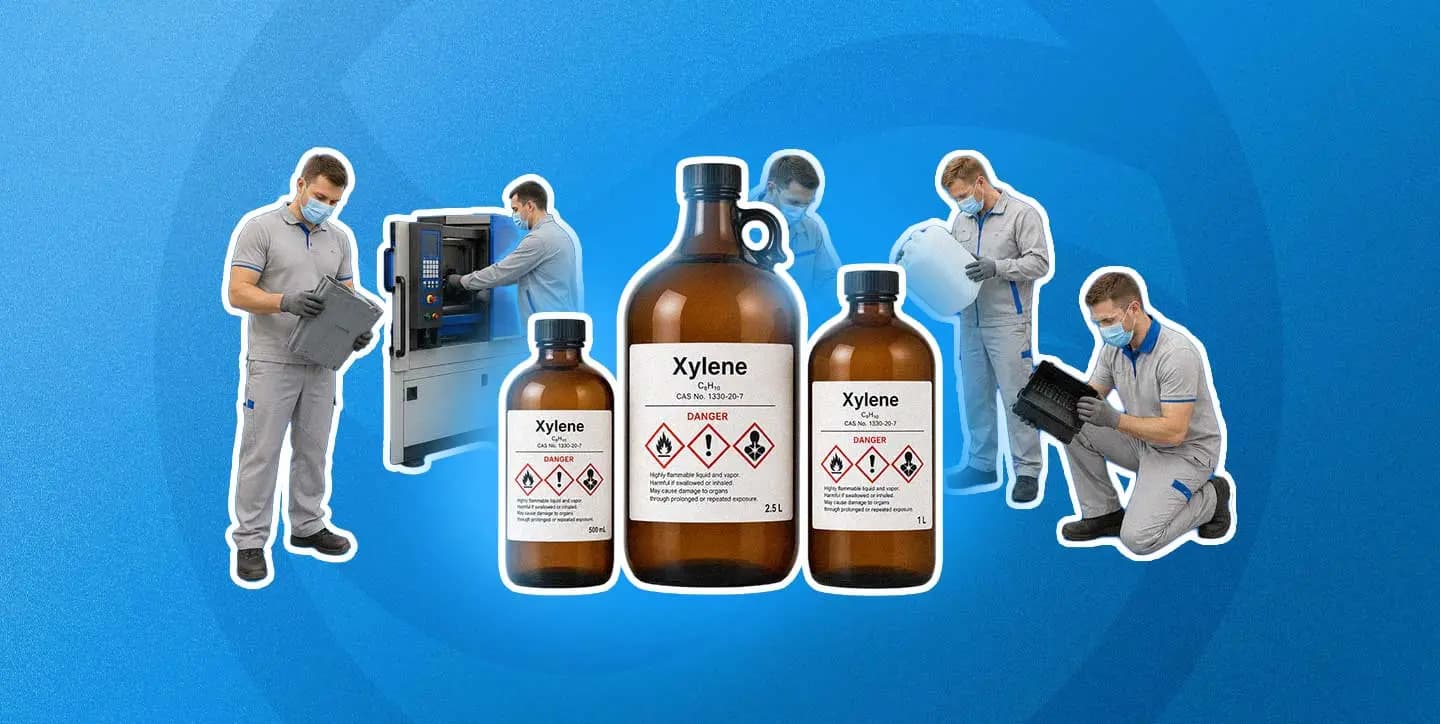

Some substances have come up again and again in conversations with businesses lately, and xylene is one of them. It is easy to see why. It looks and sounds industrial, so people know it deserves care, but it is so common across so many trades that the COSHH duty often lags behind the actual use. This is the opposite problem to the mild products that slip through unassessed. Xylene gets handled by people who know it matters, and still gets controlled less well than it should.
It is a real hazard with a real legal limit behind it. So what does xylene actually do, where does it hide, and what does a sound COSHH assessment for it look like?
What xylene is and where it turns up
Xylene is a clear, sweet-smelling solvent, sold as a single isomer or, more often, as mixed isomers. It dissolves oils, resins and rubbers well, which is exactly why it appears in so many products. Paints, varnishes and lacquers. Printing inks. Adhesives and sealants. Cleaning and degreasing fluids. Vehicle refinishing and body shop work. And, in a corner people forget, histology and pathology laboratories, where it is used as a clearing agent. If your work involves solvent-based coatings, print, glue or lab tissue processing, there is a fair chance xylene is somewhere in the building, named on a safety data sheet you may not have read closely.
Why it earns more respect than it gets
The risks are not subtle once you know them. Breathing xylene vapour irritates the eyes, nose and throat, and at higher levels it acts on the central nervous system, causing headaches, dizziness, nausea and drowsiness, the state often described loosely as solvent intoxication. Repeated exposure over time is linked to longer-term effects on the nervous system. On the skin, xylene strips the natural oils and causes drying, cracking and dermatitis, and it does not stop at the surface. The harm is rarely a single dramatic event. It is the slow accumulation that COSHH exists to prevent, in a product that feels routine to the people who use it daily.
What the exposure limit is
The GB workplace exposure limit for xylene, all isomers and mixed, is 50 ppm (220 mg/m³) averaged over eight hours, and 100 ppm (441 mg/m³) over a 15-minute short-term period, listed in HSE's EH40. You are expected to keep exposure as far below the limit as is reasonably practicable, not simply at it. The limit is the ceiling, not the target.
The skin point that catches people out
Here is the detail that trips up even careful businesses. Xylene carries a skin notation, written as Sk in EH40. That means a significant amount can be absorbed through the skin, not just breathed in. The consequence is important. You can have airborne levels comfortably under the exposure limit and still be over-exposing someone whose hands are in regular contact with the liquid, because the air monitoring never sees the dose going in through the skin. This is why gloves are not an afterthought for xylene, and why the right glove matters. Many common glove materials are permeated by solvents quite quickly, so the safety data sheet, in section 8, should be checked for the recommended material and breakthrough time rather than reaching for whatever box is nearest.
Air monitoring is not the whole picture
Because xylene absorbs through the skin, airborne results can give false reassurance. Xylene has a biological monitoring guidance value, which means a urine test can show how much has actually entered the body. Where skin contact is a real part of the job, biological monitoring tells you something air sampling cannot.
The hearing risk most people have never heard of
One effect of xylene gets almost no attention and deserves more. It is an ototoxic solvent, meaning it can damage hearing. On its own that is a concern, but the bigger issue is combined exposure. Where workers are exposed to xylene and to noise at the same time, the risk of hearing loss is greater than either would cause alone. Body shops, print rooms and workshops often have both, solvent and noise together, and treat them as two separate problems on two separate forms. Under COSHH and the noise rules they are connected, and an assessment that looks at the solvent in isolation misses half the picture.
Xylene is flammable
Xylene is a flammable liquid and its vapour can form an explosive mixture with air. Keep it away from heat, sparks and open flames, store it in line with the rules for flammable liquids, ventilated and segregated, and keep it in its original labelled container. The safety data sheet, sections 7 and 9, gives the flash point and storage detail for the specific product you hold.
What the law expects
As a COSHH substance, xylene needs a suitable and sufficient assessment wherever it is used at work, and the controls follow the hierarchy rather than jumping straight to protective equipment. Start by asking whether you need xylene at all. For some jobs a water-based or less volatile alternative removes the hazard at source, which is the most effective control there is. Where you do need it, control the vapour with engineering controls, local exhaust ventilation at the point of use or a properly ventilated booth, and keep quantities and open surfaces to a minimum. Then add the right gloves, checked against the safety data sheet, and respiratory protection where airborne control is not enough, typically an organic vapour respirator that has been face-fit tested. Manage the fire risk throughout. None of this is exotic, but it has to be chosen for xylene specifically, not borrowed from a generic solvent template.
Where it bites
Picture a busy vehicle body shop on a Friday afternoon. The sprayer is masked up and the booth extraction is running, so the airborne reading would pass. But the same person has been wiping panels and cleaning equipment with xylene-based thinners all week, bare-handed, because the gloves to hand dissolve and nobody ordered the right ones. The air monitoring says fine. The skin says otherwise, and so would a urine test. Add the compressor and the grinder running next to the booth, and the noise and the solvent are quietly compounding a hearing risk that neither assessment, done separately, ever flagged. Nothing here is reckless. It is a series of small, reasonable-looking gaps, which is exactly how solvent harm accumulates.
Turn the SDS into an assessment in about a minute
If xylene is on your shelf, the safety data sheet is the starting point and the assessment is the step that usually stalls. SPOT AI reads the sheet and produces a compliant COSHH assessment in around 60 seconds through a simple five-step wizard you finish and own, capturing the flammability, the skin notation, the exposure limit and the controls the substance actually needs. In Safety365, the sheet and the assessment stay linked in one place, and you get flagged when a supplier reissues the SDS so a reclassification does not slip past. That is Sevron's Accelerated Compliance approach in practice, taking you from a downloaded sheet to certified, competent and compliant, with the controls for a real solvent written where your team will actually see them.
Got xylene in the building? Get the assessment right.
SPOT AI turns the safety data sheet into a compliant COSHH assessment in around 60 seconds, free to start.
Watch the demoFrequently Asked Questions
Do I need a COSHH assessment for xylene?
Yes. Xylene is flammable, harmful and an irritant with a legal exposure limit, so any workplace using it needs a suitable and sufficient COSHH assessment.
What is the exposure limit for xylene?
The GB workplace exposure limit is 50 ppm (220 mg/m³) over eight hours and 100 ppm (441 mg/m³) over 15 minutes, with a skin notation, listed in HSE's EH40.
Why does the skin notation matter?
Because xylene absorbs through the skin, air monitoring alone can understate the dose. Suitable gloves and, where contact is regular, biological monitoring matter as much as ventilation.
Can xylene damage hearing?
Yes. It is recognised as an ototoxic solvent, and the hearing risk is greater where workers are exposed to xylene and noise together.
Can I replace xylene with something safer?
Often, yes. A water-based or less volatile alternative removes the hazard at source, and substitution sits high in the COSHH hierarchy of control. Assess the alternative as carefully as the original.
Can SPOT AI assess xylene?
Yes. It reads the safety data sheet and builds a compliant assessment in around 60 seconds, capturing the flammability, the skin notation and the exposure controls.
A common solvent is not a mild one, and xylene proves it. Turn your xylene SDS into a COSHH assessment with SPOT AI.

Safety & Compliance Experts
The Sevron team brings decades of combined experience in health and safety compliance, risk assessment, and workplace safety solutions.

Reviewed by
Dale Allen
CEO & Founder