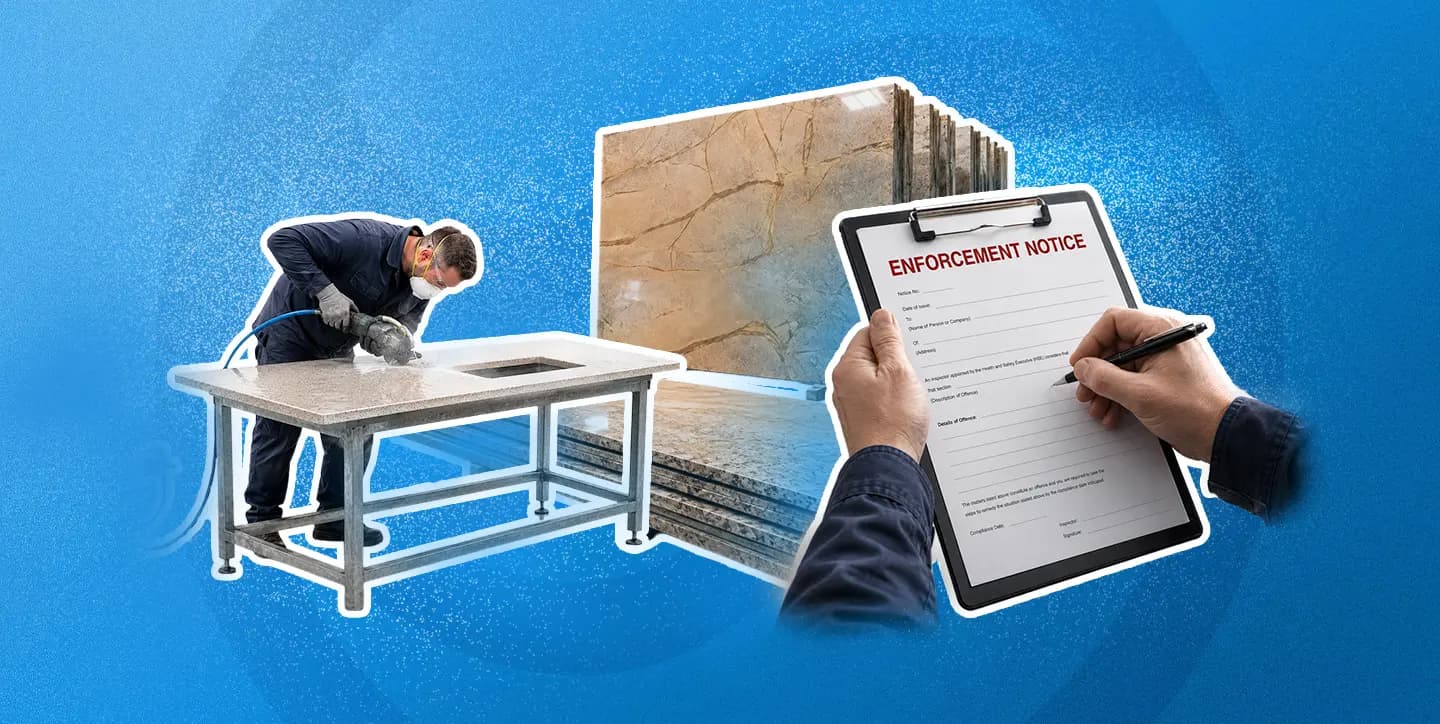

Two young workers are dead from a disease that takes decades in natural stone and was entirely preventable. That is the backdrop to HSE's biggest move yet on silica dust. On 11 May 2026 the regulator made dry cutting of engineered stone unacceptable, published the first COSHH guidance written for the material, and lined up more than 1,000 inspections.
If your work cuts, grinds or polishes engineered stone, this lands on your bench this week. The change is not abstract, and it is not a consultation for some future year. So what exactly changed, and what does an inspector expect to see when they walk in?
Dry cutting is now off the table
HSE published a full package on engineered stone dust on 11 May 2026. It carries the first COSHH guidance sheet written specifically for the material, and it is blunt. Dry cutting is unacceptable, and water suppression or on-tool extraction is how businesses are expected to meet the law. Behind the guidance sits a nationwide inspection programme of more than 1,000 visits to fabricators across Great Britain, starting in May and June 2026 and running through 2026/27. It followed the deaths of two young workers from silicosis.
One point matters for accuracy, and it is the one most likely to get muddled in the trade press. This is not a new law, and it is not a ban. Engineered stone and quartz worktops are not banned in Great Britain. What HSE has done is clarify how to meet the existing COSHH duty for a material that has raced ahead of the way many workshops handle it, then put a serious enforcement programme behind that clarification. The duty was always there. The expectation of how you meet it has now been spelled out.
Why this dust acts so fast
Engineered stone is a man-made material of crushed quartz bound with resin, used in most modern kitchen and bathroom worktops. It can contain up to 95 per cent crystalline silica, around three times the level in granite. Cutting, grinding and polishing it releases respirable crystalline silica (RCS), a dust so fine it is invisible in normal light and travels deep into the lungs, past the body's usual defences.
RCS causes silicosis, chronic obstructive pulmonary disease and lung cancer. The danger that sets engineered stone apart from older materials is speed. With natural stone, silica disease usually takes decades to develop, which gave at least some warning. The high silica content in engineered stone compresses that timeline. Silicosis can develop in months or a few years, the damage is permanent, and it often appears before any symptom does. By the time a worker feels breathless, the scarring is already there. Australia took the view that the risk could not be controlled reliably enough in many workshops and banned engineered stone in 2024, with its import banned in 2025. Great Britain has chosen the route of strict control and enforcement rather than a ban, which puts the responsibility squarely on each business.
What the exposure limit is
The workplace exposure limit for RCS in Great Britain is 0.1 mg/m³ averaged over an eight-hour shift, and has applied since 2006. Some argue it is overdue for review, since the United States and Australia work to half that figure. For now, 0.1 remains the legal standard here, and you are expected to keep exposure as far below it as is reasonably practicable, not simply at it.
What the law actually expects
To meet the COSHH duty on engineered stone, HSE expects a layered approach rather than a single fix. The starting point is that there is no dry cutting at all. Water suppression or on-tool extraction stops the dust at source, which is always more effective than trying to capture it once it is airborne. Because the mist thrown up by water suppression still carries silica, that work should sit inside a partially enclosed, externally vented booth fitted with local exhaust ventilation.
Even with water and ventilation in place, respiratory protection is still expected, typically a powered air purifying respirator with an assigned protection factor of at least 20. Health surveillance for exposed workers lets you catch early signs before they become permanent. Clean-up matters too, and it is where good practice often slips. Use M-class vacuums as a minimum, and never sweep or use compressed air, both of which simply throw the dust back into the air everyone breathes. Where the job allows, switching to lower silica materials reduces the hazard at source rather than managing it.
Picture the workshop the week after the announcement. An HSE officer is due, and the question is no longer whether you cut stone safely but whether you can prove it. The difference between a smooth visit and a bad one is not heroics. It is whether the silica assessment, the current safety data sheets, the ventilation test certificate and the health surveillance dates are sitting ready to show, or scattered across a drawer and three half-updated spreadsheets that nobody has opened in months.
The duty people forget
Under COSHH, local exhaust ventilation must have a statutory thorough examination and test, usually every 14 months. Without that record, you have no evidence your controls actually work, only a hope that they do. What happens when an inspector asks for the certificate and the file is empty?
It is not only worktop fabricators
Engineered stone has the sharpest focus right now, but respirable crystalline silica turns up across many trades, and the COSHH duty applies wherever it appears. Cutting, drilling or grinding concrete, brick, tile, mortar and natural stone all release it. So do quarrying, brick and tile manufacture, foundry work and monumental masonry. If your work creates stone or concrete dust of any kind, the questions in this guide apply to you, even if you have never touched a quartz worktop. The inspection programme is aimed at fabricators, but the law does not stop at the workshop door.
What to do this week
The actions are not complicated, and most can start today. Stop all dry cutting immediately, before anything else. Read HSE's new engineered stone COSHH guidance and check your setup against it honestly, not generously. Confirm your local exhaust ventilation has been examined and tested within the last 14 months, and book it if it has not. Check that your respiratory protection meets the standard and that face-fit testing is current for everyone who wears a tight-fitting mask. Make sure health surveillance is in place for exposed workers. Update your COSHH assessment for silica tasks and keep the safety data sheets for your materials current. Then train your team on the changes and record everything you have done, because the record is what turns good practice into proof.
Keeping silica controls audit-ready
Doing the work once is one thing. Keeping it current and provable as materials, staff and test dates change is where most businesses come unstuck, and where a system earns its keep. Safety365 holds your current COSHH assessments for silica tasks, links them to up-to-date safety data sheets, and tracks health surveillance and the proof that controls were checked, all in one place rather than scattered across desks. That is the spine of Sevron's Accelerated Compliance approach, taking you from certified to competent to compliant, with the evidence ready when someone asks. The controls are known and the guidance is published. The gap now is doing it, and showing you have.
See how Safety365 keeps silica controls audit-ready.
Assessments, safety data sheets, surveillance and proof of checks, in one place.
Watch the demo · Read the Ultimate Guide to Chemical Safety
Frequently Asked Questions
Is engineered stone banned in the UK?
No. Quartz worktops and engineered stone are not banned in Great Britain. HSE has made dry cutting unacceptable and expects water suppression or extraction, controls and health surveillance under COSHH.
What is the silica exposure limit?
0.1 mg/m³ averaged over an eight-hour shift. The figure has stood since 2006 and remains the legal standard despite calls for review.
Do I still need RPE if I use water suppression?
Yes. HSE expects respiratory protection, typically a powered air purifying respirator, even alongside water suppression and ventilation, because the mist still carries silica.
How quickly can silicosis develop from engineered stone?
Far faster than from natural stone. The high silica content means it can develop in months or a few years, and the damage is permanent and often shows before symptoms do.
When do the inspections start?
The programme of more than 1,000 fabricator visits runs from May and June 2026 through 2026/27. The safest assumption is that your turn could come any week.
Stop the dry cutting today, then make the records prove it. See how Safety365 handles silica compliance.

Safety & Compliance Experts
The Sevron team brings decades of combined experience in health and safety compliance, risk assessment, and workplace safety solutions.

Reviewed by
Dale Allen
CEO & Founder