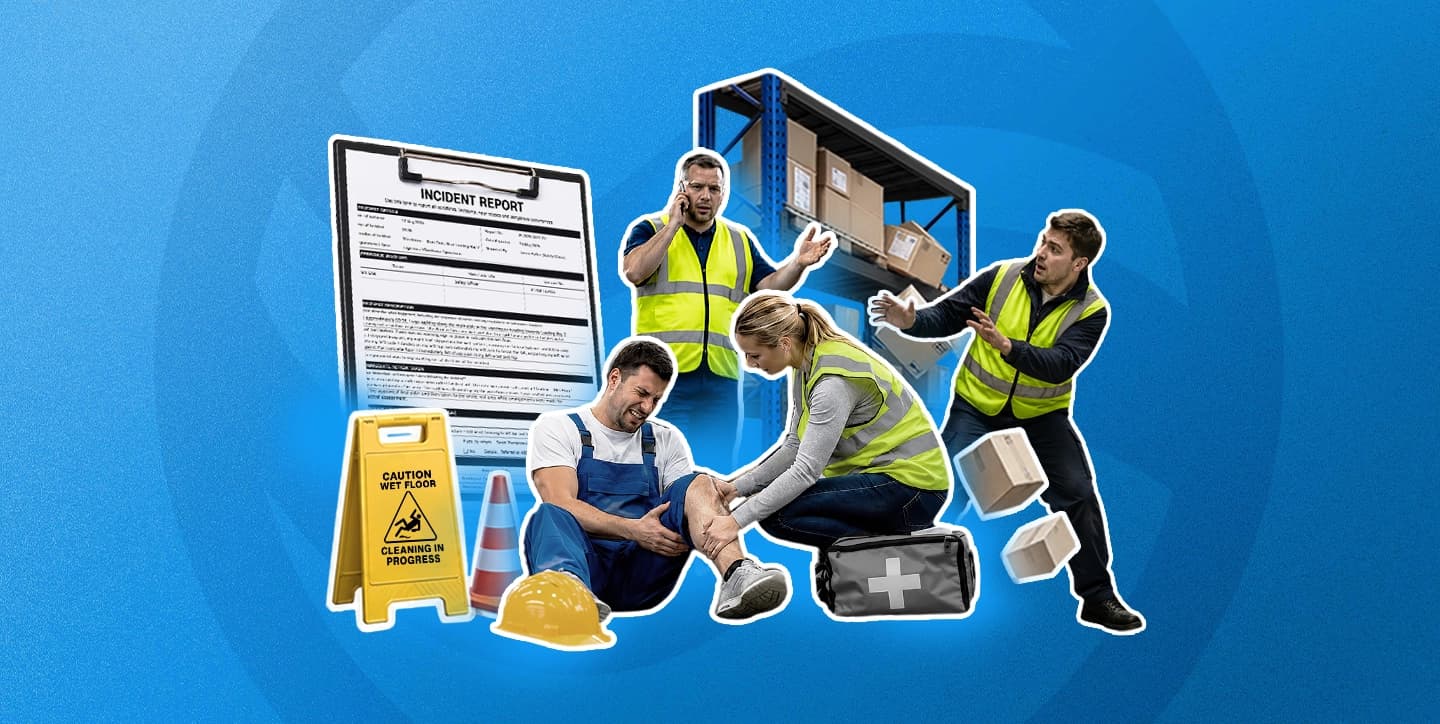

RIDDOR, the Reporting of Injuries, Diseases and Dangerous Occurrences Regulations 2013, is the UK law that requires employers, the self-employed and people in control of premises to report certain workplace events to HSE. It covers deaths, specified injuries, over-seven-day injuries, occupational diseases and the dangerous occurrences listed in Schedule 2. HSE describes those dangerous occurrences as near-miss incidents, so some near misses must be reported even where nobody is hurt.
Most near misses are never reported. Many that are reported are never used. Either way the warning is wasted, and the next time the same set-up may not miss.
So how do you build incident reporting that reduces harm, instead of a logbook that fills up and changes nothing?
What counts as a near miss, and which ones RIDDOR covers
Incidents run from near misses, where something could have gone wrong and did not, through minor injuries up to serious harm.
There is a common assumption that RIDDOR only bites once somebody is hurt. HSE's guidance on reportable incidents says otherwise: Schedule 2 lists the specific near-miss incidents that must be reported. A scaffold collapse, a lifting device failure, an electrical short circuit causing fire, an accidental release of a hazardous substance. Nobody injured, and the report is still a legal duty.
The categories under RIDDOR 2013 and their deadlines run as follows:
- Deaths and specified injuries such as fractures, amputations and serious burns. Notify without delay, then report within 10 days.
- Over-seven-day injuries, where a worker cannot do their normal duties for more than seven consecutive days. Report within 15 days of the accident, not of the seventh day.
- Injuries to people not at work who are taken from your premises directly to hospital for treatment. Ten days.
- Diagnosed occupational diseases, including occupational dermatitis and hand-arm vibration syndrome. On receipt of the diagnosis.
- Dangerous occurrences from the Schedule 2 list. Without delay, then within 10 days.
Alongside that sits a recording duty that catches people out. An injury keeping someone off normal work for more than three consecutive days must be recorded even where no report is required, and RIDDOR records must be kept for at least three years.
The shape of the problem
Serious incidents are rare and visible. Near misses are common and quiet. Treating the quiet many as data is what lets a business act before harm arrives, and the loud few are usually the ones that were signalled first.
What RIDDOR does not require, and why it matters anyway
RIDDOR is a reporting duty. Submitting the form discharges it. Nothing in the regulations obliges you to work out why the incident happened, which is why a business can be fully compliant on reporting and learning nothing at all.
A report that is filed and forgotten changes nothing. The value comes from what follows: investigating what happened, asking why until you reach the underlying condition, and acting on what you find. The classic failure is to blame the person nearest the event, close the report, and leave the condition in place, so the same incident waits patiently for someone else.
Root cause work is the difference between treating a symptom and fixing the cause. In practice that means a structured method, whether five whys, a fishbone, or a guided template, applied consistently enough that two investigators reach the same place.
Why the investigation trail matters
A clear, connected record does two jobs at once.
It protects the business. When an incident is investigated by HSE or tested by a claim, the evidence of what happened, what was found and what changed is what stands up. The same principle applies here as it does to proving your COSHH position: the document has to exist and it has to show its history.
It also protects people, because the trail is what turns one incident into a lesson that reaches the next shift and the next site. A scattered record, notes here, an email there, a form in a drawer, does neither job. It cannot be searched, it cannot show a pattern, and it cannot prove the action was ever taken.
Pattern is the word worth sitting with. One drum falling is an event. Four drums falling across three sites in a year is a system telling you something, and only a connected record can say that out loud. For organisations running several locations, that visibility is the whole difference between reacting and anticipating.
Under-reporting is a culture signal
A quiet incident log usually means the reporting has stopped rather than the incidents. Reporting goes slow, or the last person to raise something was treated as the problem, and the flow dries up. Read a sudden drop in near-miss reports as information about the culture, and check it before congratulating anyone.
How to make reporting quick and worth doing
Two things decide whether incident reporting works.
It has to be fast and blame-free at the point of reporting, so the warnings keep arriving. If logging a near miss takes ten minutes and an awkward conversation, it will not happen.
And every report has to lead somewhere. To an investigation, a root cause, and an action with a name and a date against it. People report when they see that raising something changes something. Get both right and reporting becomes a habit that feeds prevention. Get either wrong and it withers.
Two futures for the same shelf
Here is how it plays out on the floor.
A drum is stored on the wrong shelf and almost falls. On paper nothing happened, so under a system that is slow to use or quick to blame, nothing is logged.
Weeks later the same shelf drops a drum onto someone's foot. Now it is a specified injury, a RIDDOR report inside ten days, a claim, and a line standing idle while somebody works out what went wrong.
Run it again with a system that takes sixty seconds. The first near miss is logged that morning. The investigation finds a storage rule nobody enforced. The action is assigned, dated and closed out. The injury never happens, and the only thing that changed was whether the free warning was captured and used.
That loop, capture and investigate and act and keep the record, is the safety half of Sevron's Accelerated Compliance sitting alongside the chemical side. Safety365's incident management module lets teams report incidents and near misses from any device, assesses whether the incident meets RIDDOR thresholds and prompts the notification, runs the investigation through built-in root cause tools, and tracks corrective actions to closure with the full trail in one place.
Are your near misses turning into prevention, or filling a log?
Watch how incident reporting, investigation and corrective action work together in one system.
See how it works · Book a call
Frequently Asked Questions
What is the difference between an incident and a near miss?
An incident caused harm or loss. A near miss could have and did not. Both are worth reporting, because the near miss is a warning that cost nothing.
Do near misses have to be reported to HSE?
Only where they fall into the dangerous occurrences listed in Schedule 2 of RIDDOR, such as a scaffold collapse or a lifting equipment failure. Those must be reported even where nobody was injured.
What has to be reported under RIDDOR?
Deaths, specified injuries, over-seven-day injuries, injuries to non-workers taken to hospital, diagnosed occupational diseases, and Schedule 2 dangerous occurrences. Reports go to HSE, or to the local authority for some sectors.
How long do you have to report a RIDDOR incident?
Deaths, specified injuries and dangerous occurrences must be notified without delay and reported within 10 days. Over-seven-day injuries have 15 days from the date of the accident.
Does RIDDOR require an incident investigation?
No. RIDDOR is a duty to notify HSE of certain events. Investigating the cause sits under the general duty to manage risk, and it is what stops the same incident happening again.
Why do people stop reporting near misses?
Usually because reporting is slow, or because raising one led to blame. Quick, blame-free reporting that leads to visible action keeps the warnings coming.
A near miss is a warning you get for free. Waste it and the next one may not miss. See how Safety365 closes the loop.

Safety & Compliance Experts
The Sevron team brings decades of combined experience in health and safety compliance, risk assessment, and workplace safety solutions.

Reviewed by
Dale Allen
CEO & Founder