
Automate Task Risk Assessment With Safety365
685,800+ health and safety professionals in 135+ countries
rely on Sevron to simplify chemical safety compliance.

Meet task risk assessments that assess
risks the way work really happens
Task-Based Approach
Risks assessed per task, not per substance
Contextual Controls
Controls tailored to each work activity
Real-World Accuracy
Reflects actual workplace exposure risks
AI Integration
Smart support when & where needed
The Task Risk Assessment
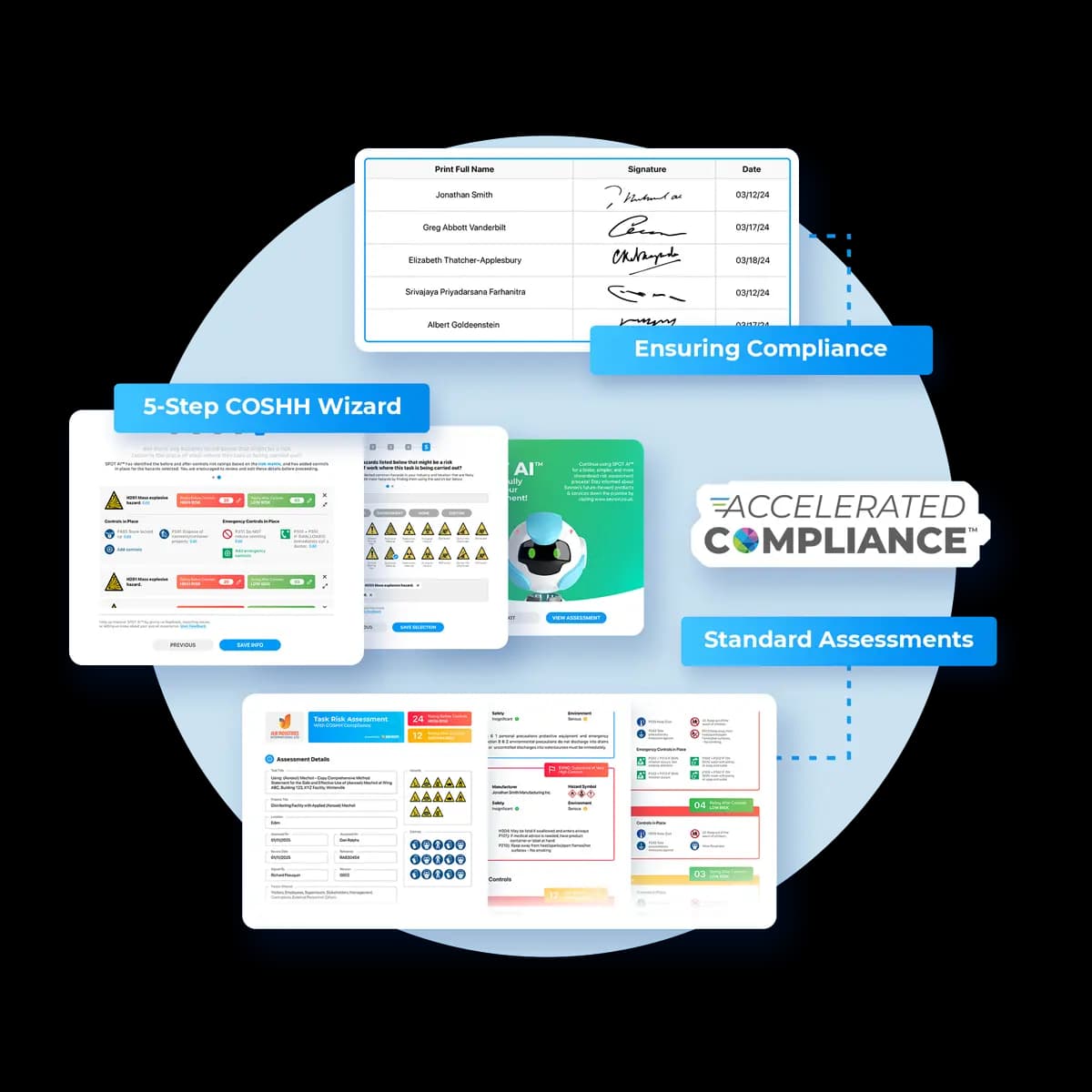
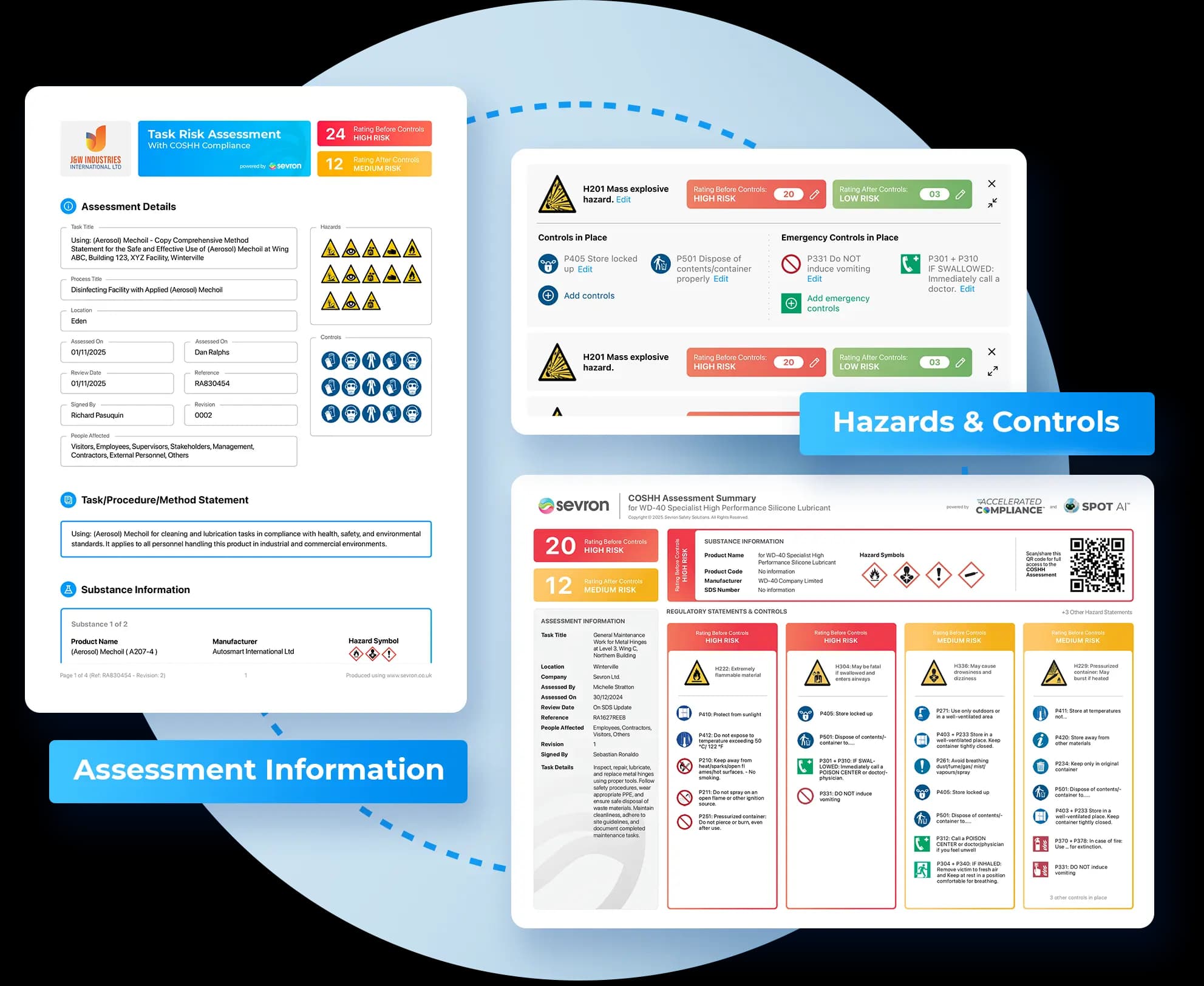
Our task-based risk assessments evaluate how hazardous substances are used in specific workplace activities, linking each task to its own risks, controls, and safety measures for precise, real-world compliance.
Online Task Risk Assessments
A task risk assessment is a structured process we use to define the hazards linked to a specific workplace activity, evaluate the level of risk each one presents, and decide what controls to put in place. Unlike broader site-level assessments, a TRA focuses on individual tasks: operating a piece of plant or machinery, performing maintenance on equipment, completing manual handling, or working at height. Any activity where someone could be harmed gets its own assessment.
Managers carry out task risk assessments whenever new tasks are introduced, when an existing job changes, or when an incident reveals that our current measures are not working. For example, if a team starts using new substances during a cleaning process, we need a fresh TRA before that work begins. The assessment captures who is involved, what hazards they face, and what controls we implement to keep exposure within safe limits.
Task Risk Assessment Summary
Moving our task risk assessments online gives us advantages that paper-based systems simply cannot match. Digital TRAs minimise risk by catching gaps in our controls before they lead to injury or ill health records piling up on someone's desk. They also build awareness across organisations, because every assessment is accessible to the workers and supervisors who need it.
Here is what a cloud-based TRA platform delivers:
- Automatic risk scoring: Safety365 calculates Likelihood × Severity both before and after we apply controls, giving us a clear picture of residual risk.
- Sign-off workflow: Assessments move through a publish-with-sign-off flow, and signees receive email notifications so nothing sits in limbo.
- Assessment versioning: Every assessment has draft and published states with a full audit trail, so we can record what changed and when.
- PDF generation: A dedicated TRA strategy produces professional, documented outputs ready for auditors or contractors.
- Configurable risk matrix: Each company can tailor the risk matrix to match its own risk appetite and industry practice.
These features lead to better compliance outcomes because they make the risk assessment process repeatable and transparent. We implement controls, record the results, and the system holds us accountable.
Task-Based Risk Assessment and Comparisons
Task risk assessments sit alongside other assessment methods, and it helps to understand where each one applies. Here is a comparison of the approaches most commonly used across many industries.
| TRA | JSA | HIRA | |
|---|---|---|---|
| Focus | Individual tasks or activities | Step-by-step breakdown of a specific job | Broad identification across an entire operation |
| When we use it | Before any task where harm could happen | When we need to evaluate each step of a job in sequence | During strategic safety planning for a site or process |
| What it covers | Hazards, risk scoring, control measures for one task | Sequential hazards and safe work procedures | All identifiable hazards across operations |
| Output | Documented assessment with before/after risk scores | Step-by-step safe work procedure | Comprehensive hazard register |
All of these methods identify hazards and evaluate risk. The difference is scope. A TRA zooms in on one task; a HIRA pulls back to assess everything. We choose based on what we need at that moment.
Industry-Specific Solutions and Multilingual Safety
Our assessment templates are fully customisable, so organisations in construction, manufacturing, logistics, healthcare, and other industries can adapt them to their own work environment. We do not lock anyone into a rigid format. The assessment form bends to fit the company, and the details of each hazard entry reflect how work is actually performed on site.
Safety365 supports eight languages: English, Danish, German, Greek, Spanish, Italian, Norwegian, and Portuguese. For organisations with a multilingual workforce, this means every employee can engage with the assessment in their own language. Workers who are aware of the hazards they face, in a language they understand, make better decisions about their own health and safety. This is particularly relevant where contractors from different countries share a safe working environment.
Safety365 vs Manual Compliance
When we rely on spreadsheets, Word documents, and filing cabinets, our risk assessment process is only as strong as the person who remembers to update it. Manual systems fail in predictable ways.
| Safety365 | Manual | |
|---|---|---|
| Risk scoring | Automatic Likelihood × Severity, before and after controls | Manual calculation, prone to inconsistency |
| Sign-off | Email notifications, digital sign-off with audit trail | Chasing signatures on paperwork, easy to lose |
| Version control | Draft and published states, full history | Overwritten files, no record of previous versions |
| Accessibility | Cloud-based, any device | Filing cabinet or shared drive |
| Legal compliance | Structured to meet the Health and Safety at Work Act 1974 and the Management Regulations 1999 | Depends entirely on the assessor's knowledge |
The gap between these approaches widens as our company grows. What works for five employees becomes unmanageable at fifty. A checklist on paper does not scale. A digital platform ensures every assessment is captured, stored, and retrievable under law.
Create a Task Risk Assessment in Just 6 Simple Steps
Define the task
Describe the activity and its work environment. Include details about the location, the equipment used, and who will carry out the work. Identify any new or expectant mothers, young workers, or others who may need additional protection.
Identify hazards
Record every hazard associated with the task. Less obvious hazards, such as noise exposure from nearby machinery, awkward postures during maintenance, or substances released as a by-product of the process, are the ones most likely to cause harm over time.
Evaluate the risk
Safety365 scores each hazard using Likelihood × Severity to assess the level of risk before controls are applied. This gives us a baseline and helps us decide where to act first.
Implement controls
For each hazard, apply effective controls following the hierarchy: eliminate the hazard where possible, substitute for something less dangerous, add engineering controls, then administrative measures, and finally PPE. We manage the risk down to an acceptable level so it is mitigated properly.
Score the residual risk
After controls are in place, Safety365 recalculates the score. This before-and-after comparison shows us, and any auditor, exactly how our controls minimise risk.
Review and publish
Publish the assessment with sign-off, triggering email notifications. The assessment moves from draft to published, creating a documented record. We review it whenever the task changes, after any accidents, or at scheduled intervals to ensure our measures remain adequate.
Effortless Task Risk Compliance
Safety365 brings our task risk assessments into a single cloud-based platform where every assessment is scored, signed off, versioned, and stored. We build an effective risk assessment once, and the system helps us keep it current. It is how we minimise risk and protect our teams without drowning in admin.
Save Time & Money vs. Manual Task Risk Assessments
Why waste hours on manual, error-prone processes? Sevron's task-based approach streamlines every stage of risk assessment from hazard identification to review scheduling.
*Based on a £22/hour rate and a typical mid-size organisation managing 50+ task risk assessments per year
ProcessSevron
SystemTime
SavedCost
Saved
Hazard Identification
Manual
Manual SDS review
Sevron
AI-powered detection
Time Saved
24 hrs
Cost Saved
£528
Multi-Substance Assessment
Manual
Separate per-substance forms
Sevron
Combined task view
Time Saved
40 hrs
Cost Saved
£880
Control Assignment
Manual
Generic lookups
Sevron
Contextual recommendations
Time Saved
32 hrs
Cost Saved
£704
Review Cycles
Manual
Calendar reminders
Sevron
Auto-scheduling
Time Saved
Max
Cost Saved
Max
Overall Assessment Process
Manual
132+ hrs
Sevron
12.8 hrs
Time Saved
120 hrs
Cost Saved
£2,112/year
Trusted by 685,800+
Safety professionals worldwide rely on Sevron to simplify chemical safety compliance


"We generate COSHH assessments in under a minute. It's transformed our chemical safety process."— Josephine Smith, ACM



Related Pages
SDS Management
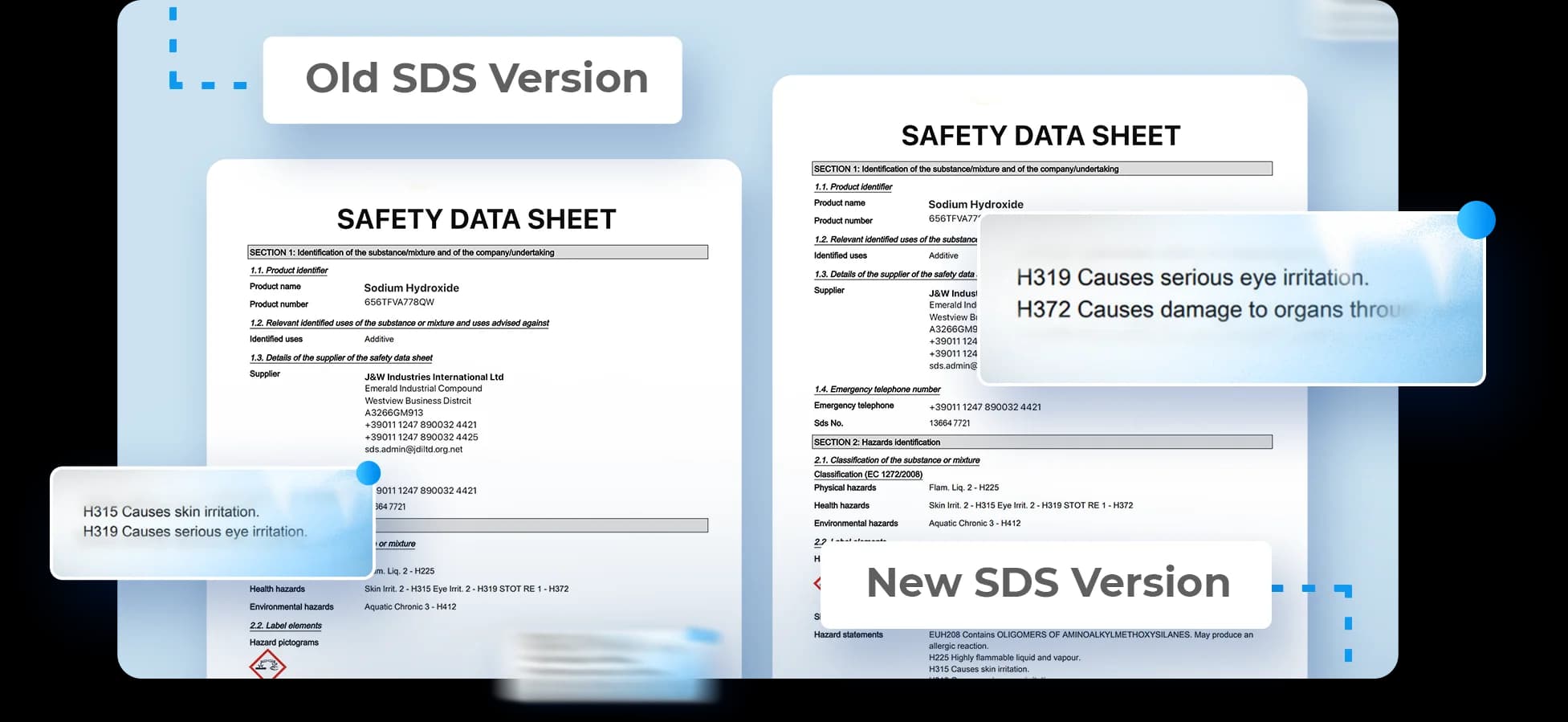
Search, store, and manage Safety Data Sheets with automatic updates and instant access.
Chemical Management
Complete chemical management platform with COSHH assessments, SDS library, and compliance tracking.
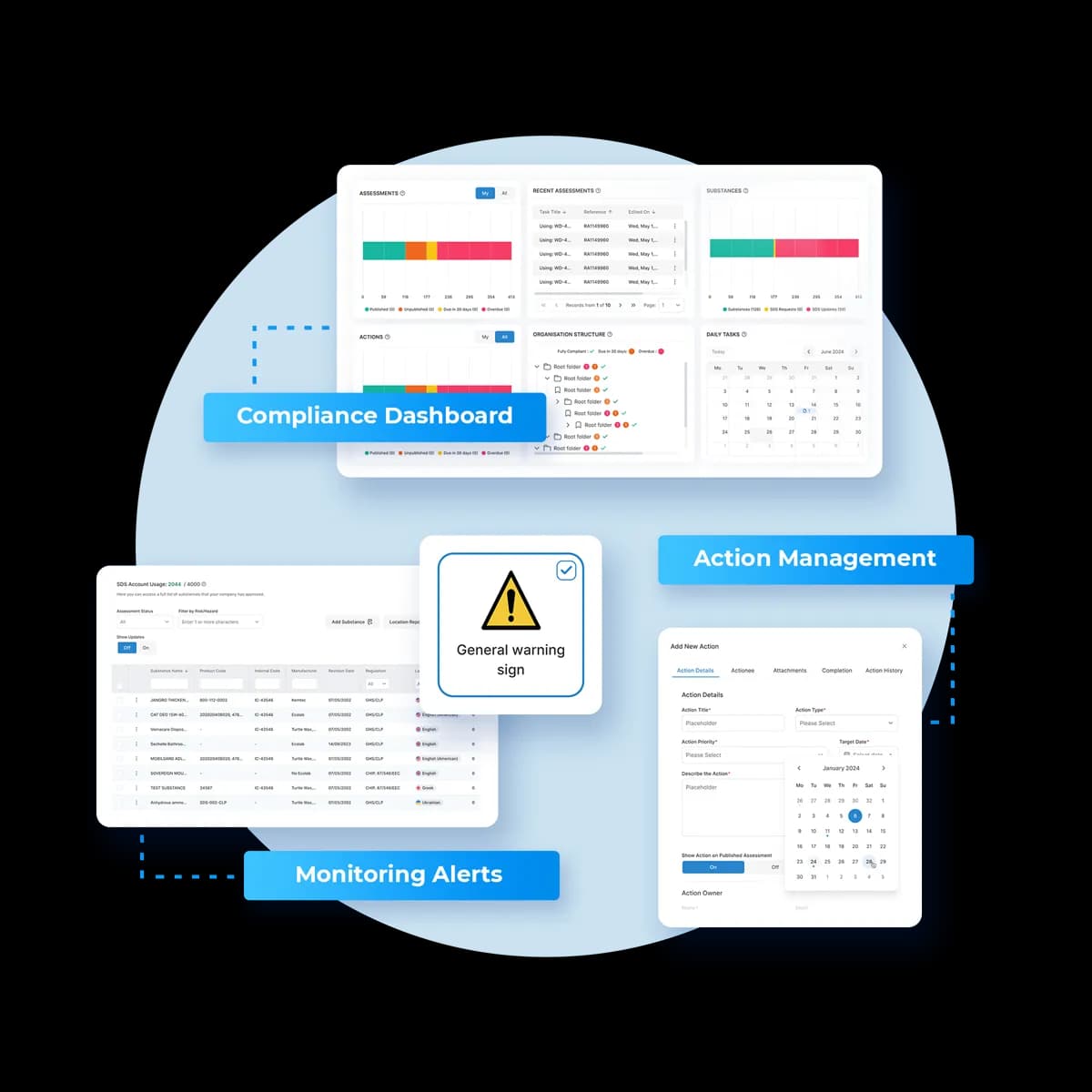
EHS Management
End-to-end environment, health and safety management with real-time dashboards and audit trails.
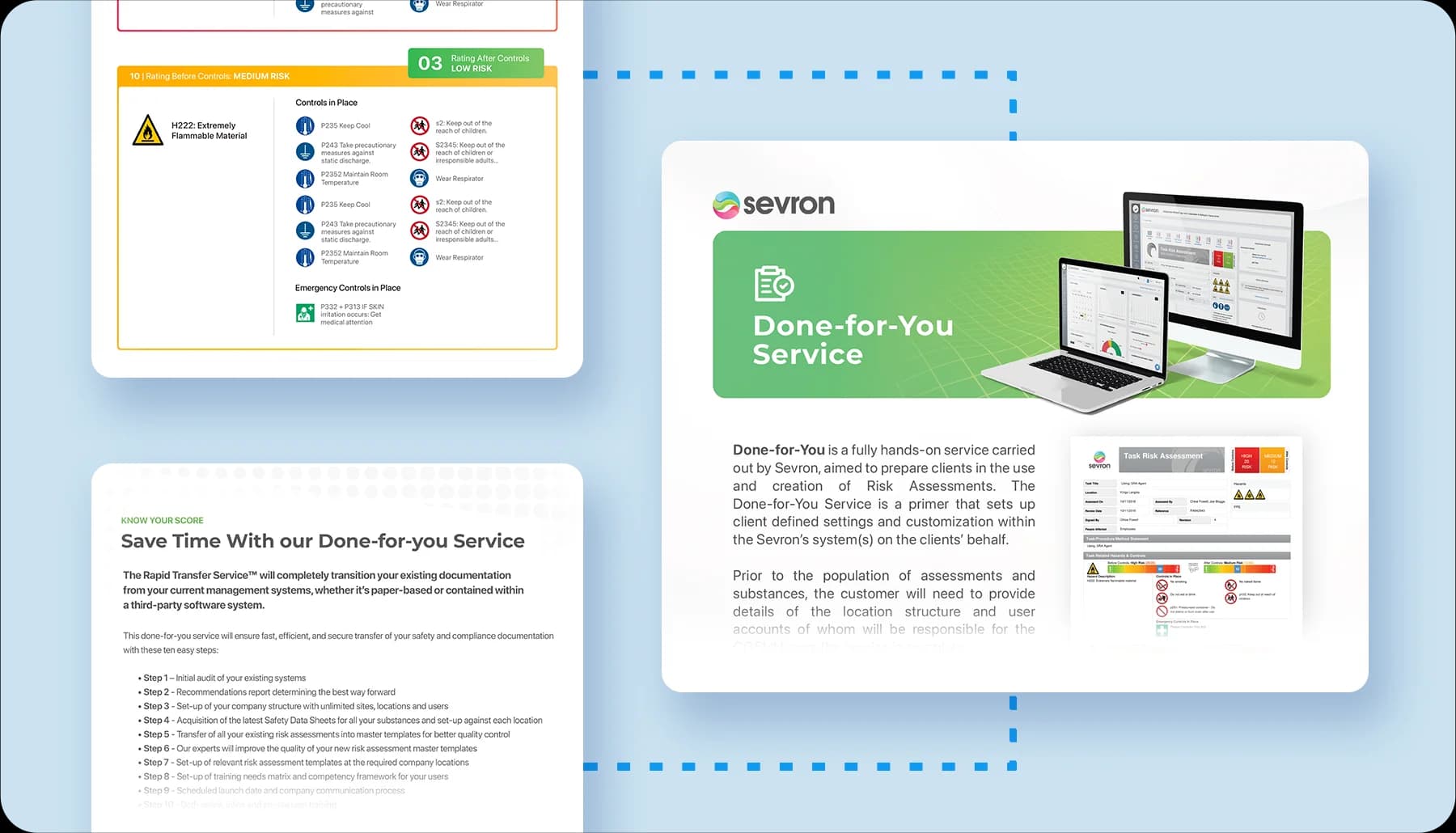
Done-For-You
Let our experts handle your compliance documentation and train your team.
Frequently Asked Questions
What is a task risk assessment?
A documented process for identifying hazards associated with a specific workplace task, evaluating the risk level, and recording the control measures we put in place to eliminate or reduce harm. It focuses on individual activities rather than an entire site.
Who is responsible for completing a task risk assessment?
Under the Health and Safety at Work Act 1974, the employer holds the legal duty. In practice, a competent person with the right knowledge and experience carries it out. This might be a safety executive, a line manager, or a supervisor. Whoever is responsible must have the training and job-specific awareness to identify all relevant hazards.
When should we review a task risk assessment?
Whenever the task changes, when new equipment or substances are introduced, after any accidents or near-misses, or when ill health records suggest our controls are not adequate. The Management of Health and Safety at Work Regulations 1999 also require regular review as good practice.
What are significant findings in a risk assessment?
Under regulation 3 of the Management Regulations, employers with five or more employees must record the significant findings of their assessments. These include the hazards identified, the groups of workers at risk, and the measures taken to manage those risks. The findings must be kept accessible and up to date.
How does a TRA differ from a general risk assessment?
A general assessment looks at the overall workplace. A TRA narrows the focus to one specific activity. If our business involves multiple tasks with different hazard profiles, each one gets its own assessment performed separately.
Can contractors use our task risk assessments?
Contractors working on our site should be aware of our assessments and the control measures in place. We can share published TRA PDFs directly so they understand the hazards before starting work. Where contractors bring their own processes, they remain responsible for completing their own assessments.
What happens if we fail to carry out a task risk assessment?
We expose our employees to preventable injury. Beyond the human cost, enforcement action from the safety executive can lead to improvement notices, prohibition notices, or prosecution. The risk is not worth taking.