The Health and Safety Executive (HSE) defines a risk assessment as a careful examination of what could cause harm to people. This careful examination forms the foundation of modern occupational health management. Without it, businesses cannot adequately protect their workers.
Risk assessment is a systematic process of identifying hazards and evaluating any associated risks within a workplace. This risk assessment process requires a structured approach to observing the working environment and assessing risk at every operational level. This systematic method ensures that no potential threat is overlooked during the safety review.
Furthermore, risk assessment is a process for identifying hazards and evaluating associated risks within a workplace. It goes beyond a simple visual check of the facility floor. A formal risk assessment demands a deep analysis of operational procedures, employee behaviours, and the risk factors that could lead to health and safety risks.
Organisations rely on this risk management process to safeguard their operations. Risk assessment helps organizations understand the potential risks they might face and how they might mitigate them. This understanding allows management to implement protective measures and prevent harm before incidents occur.
The process of risk assessment involves identifying hazards, assessing the risk of hazards, and prioritizing hazards associated with a specific activity or task. Risk evaluation helps determine the level of risk and ensures serious threats receive immediate attention and funding.
Risk assessment tools identify and categorize risks, analyze the likelihood and severity of each risk, and develop strategies to prevent, mitigate, or eliminate those risks. These tools standardise the approach across different departments and sites. They ensure every manager applies the same standards when assessing risk.
Risk assessments are an integral part of an occupational health and safety management plan. They are not standalone documents to be filed away and ignored. They interact directly with training protocols, equipment purchasing, and daily operational policies.
See Sevron in Action
Watch our demo to see how Sevron simplifies COSHH compliance with automated risk assessments and real-time SDS data.
BOOK A DEMOWhy Is Risk Assessment Important?
Risk assessments are crucial to preventing accidents in the workplace. By identifying safety hazards early through proper hazard identification, organisations can address them before an incident occurs. This approach protects employees from physical harm.
Risk assessments are a legal requirement for employers and self-employed individuals. Adhering to these regulations ensures legal compliance and avoids penalties. Regulatory bodies expect to see documented proof that these assessments take place regularly.
Many industries require performing a risk assessment to protect employees and stakeholders, making legal compliance a critical aspect of the process. Failure to conduct adequate risk assessments can lead to financial loss, legal penalties, and damage to reputation. Failing to conduct risk assessments can lead to financial loss and negative publicity for businesses.
Risk assessments help to reduce injuries and save lives. They ensure reasonable control measures are implemented to handle dangerous tasks safely. This risk management approach directly impacts workforce wellbeing and public health outcomes.
Risk assessments help generate awareness about hazards in the workplace. When workers understand the risks involved in their daily routines, they operate with more caution.
Risk assessments provide a clearer understanding of potential outcomes, allowing leaders to weigh risks against benefits. This clarity supports better decision-making when assessing risk across operations. Risk assessments are essential for decision-making that can affect the financial health and sustainability of organizations.
Proactively identifying risks through assessments prevents costly accidents, legal fines, and operational disruptions. This risk analysis and proactive threat management enables organizations to spot vulnerabilities before they are exploited. It keeps operations running smoothly and protects financial stability.
Risk assessments help organizations allocate resources and identify potential areas of improvement. Safety budgets can be directed toward areas with the highest risk severity. Risk assessments are an integral part of an occupational health and safety management plan.
What Is the Goal of Risk Assessment?
The goal of risk assessment is to evaluate hazards and then remove or minimize the level of risk by adding control measures as necessary. This aims to create a working environment where potential harm is reduced. It shifts focus from reacting to accidents to preventing them.
Risk assessment is a vital element for health and safety management and aims to determine the measures required to comply with statutory duty. It bridges the gap between legal obligations and practical workplace safety. The goal is to translate the law into actionable safety steps that control the risks.
Employers must ensure that risk assessments are suitable and sufficient to protect the health and safety of employees. A superficial glance at the premises will not achieve this goal. The assessment must accurately reflect the true complexities of the site and the tasks performed.
Risk assessment involves identifying hazards, assessing the risks associated with those hazards, and prioritizing them based on their potential impact. The goal is to address the most dangerous issues first through effective risk management. This targeted approach prevents serious injuries or fatalities.
Risk assessment is an ongoing discipline that should be reviewed regularly and updated whenever necessary. The goal is continuous improvement rather than a one-off compliance check. Safety must evolve alongside the business through regular risk evaluation and risk analysis.
When Should a Risk Assessment Be Done?
A risk assessment must be completed before any new operational processes or equipment are introduced to the site. This ensures that new workplace hazards are identified and controlled immediately. This is particularly important when a particular activity involves higher risk operations.
Risk assessments must be reviewed periodically and whenever there are significant changes in the workplace. Examples of significant changes include structural modifications, altered shift patterns, or a high turnover of staff. The assessment must adapt to the new working environment and should be part of the overall risk management plan.
The introduction of new or expectant mothers to a team requires a specific assessment. This ensures their vulnerabilities are addressed with appropriate control measures. The working environment must be adjusted to protect their health and safety.
Working with new hazardous substances triggers the need for an immediate assessment under COSHH regulations. Any process involving chemicals, fumes, or biological agents requires evaluation before work begins. The risks associated with ill health from exposure must be managed through proper control measures.
If an accident or a near-miss occurs, the existing risk assessment must be reviewed immediately. The safety team needs to understand why the existing control measures failed to prevent the incident. Assessing risk after incidents helps identify gaps in the current risk management plan. The assessment must then be updated to prevent a recurrence.
How Do You Plan for a Risk Assessment?
Employers are required to take reasonable steps for the effective planning, organization, control, monitoring, and review of preventive measures. Planning begins with defining the boundaries of the assessment. The scope must be clear so the assessor knows exactly what areas and processes to cover.
It is the employer's responsibility to carry out risk assessments or appoint someone competent to do so. A competent person possesses the training, skills, and industry experience to identify potential hazards accurately through effective hazard identification. Selecting the right competent person is the most critical planning step in the risk assessment process.
The planner must gather all relevant health and safety information before the physical inspection begins. This includes reviewing past ill health records, incident reports, and machinery manuals. This historical data highlights areas where potential harm has previously occurred and helps with assessing risk.
The assessment should be scheduled during normal operational hours. Assessing a quiet factory floor will not reveal the true operational risks. The assessor needs to observe the reality of peak workflow and employee interactions.
Consultation schedules should also be planned in advance. Time must be blocked out to speak directly with the employees performing the tasks. Their input identifies less obvious hazards and other factors that might affect health and safety. This consultation also helps raise awareness among workers about the importance of risk management.
Start Managing COSHH Compliance Today
Get a demo of our premium software, or get started with free tools.
How Is a Risk Assessment Done?
Organizations follow a multi-step process in risk assessments to effectively identify, analyze, and manage potential threats. This ensures nothing is overlooked during the evaluation. The typical five steps in conducting a risk assessment are identifying hazards, determining who might be harmed, evaluating risks to implement control measures, recording findings, and reviewing the assessment regularly. Following this sequence guarantees a thorough review of health and safety risks.
The first step in conducting a risk assessment is to identify potential hazards. This requires a physical inspection of the working environment by the competent person. They must actively search for sources of potential harm.
The second step is to identify who might be harmed by those hazards. The assessor must clearly define the groups at risk. This includes employees, outside contractors, site visitors, and members of the public who might be harmed by workplace hazards.
The third step is to evaluate the severity of the risks and establish precautions to mitigate them. Evaluating risks includes assessing the likelihood and severity of potential harm to rank risks and determine if existing controls are adequate. This stage determines if current protective measures are sufficient to prevent injuries. If they are not, new control measures must be designed to minimise risk.
The fourth step is to implement changes and record the findings of the risk assessment. When you record your findings, document the significant findings, control measures implemented, and any actions required. The process of risk assessment should include documenting the results and control measures implemented. This documentation is vital for legal compliance and communication across the organisation.
The fifth step is to review the assessment and reassess if necessary. Workplaces change, and the risk assessment must be updated to reflect these changes. Regular reviews help manage health and safety effectively.
How Are Hazards Identified?
Identifying hazards involves recognizing potential sources of harm, including physical, chemical, and psychological factors. The competent person must conduct a systematic walk-through of the entire facility during the hazard identification process. They search for trailing cables, unguarded machinery, and poor structural integrity.
Consulting with employees is an effective way to identify hazards that visual inspections miss. Workers interact with the equipment daily and understand the practical safety risks. They can point out repetitive strain issues or poorly designed workflows that create less obvious hazards.
Reviewing accident logs and ill health records helps identify recurring issues within specific departments. This historical data highlights areas where the potential for harm exists. The data collected directs the assessor's attention to known vulnerabilities and helps identify potential hazards more effectively.
Checking manufacturer instructions for machinery provides safety information regarding operational limits. These documents detail the specific risks involved with operating, cleaning, and maintaining the equipment. Following these instructions prevents safety failures.
Safety data sheets must be reviewed when identifying hazardous chemicals. These sheets dictate the required handling, storage, and emergency procedures under COSHH guidelines. They are essential for understanding the health risks of hazardous substances and ensuring hazards identified are properly controlled.
How Do You Know If the Hazard Will Cause Harm (Poses a Risk)?
Evaluating risks includes assessing the likelihood and severity of potential harm to rank risks and determine if existing controls are adequate. A hazard only poses a risk if there is a realistic chance of human exposure. The context of the hazard matters when conducting proper risk evaluation.
The assessor must look at how the task is performed and how often employees are exposed to the hazard. Frequent daily exposure increases the likelihood of an incident occurring. A rare task carries a different risk profile than a continuous operation. Understanding these risk factors helps determine the level of risk present.
They must also consider the potential severity of the worst-case scenario. A hazard that could cause a minor scratch requires different handling than a hazard capable of causing fatal injuries. The severity dictates the urgency of the response and influences risk management priorities.
This careful examination confirms the true level of risk present in the environment. It separates theoretical dangers from genuine workplace threats. It provides the data collected needed to justify safety investments and helps control risks effectively through targeted control measures.
How Are Risks Ranked or Prioritised?
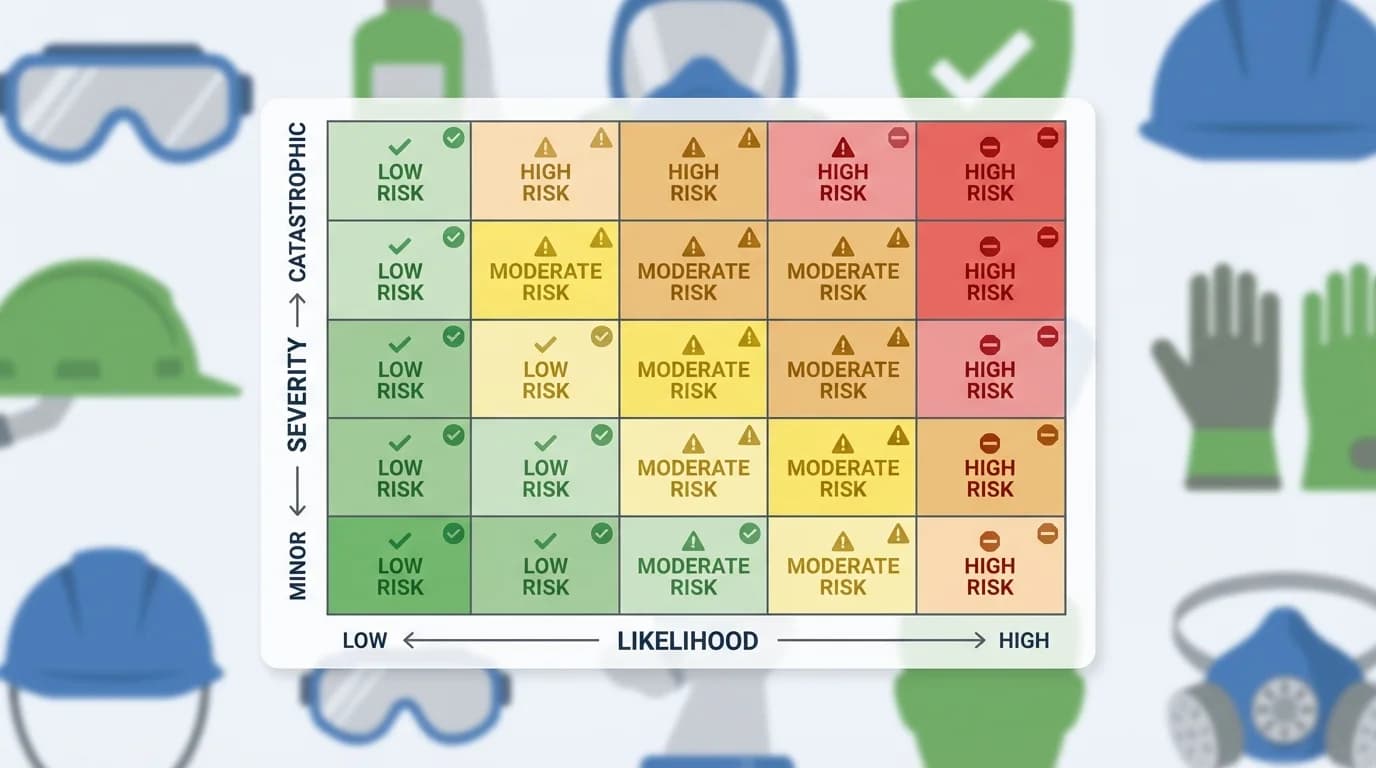
The risk assessment matrix is often used to prioritize high-level threats for immediate attention by assessing the likelihood of threats and their severity. A risk matrix is a visual tool used to assess the likelihood and severity of potential risks. It plots these two variables on a simple grid, making risk evaluation more systematic.
| Likelihood ↓ / Severity → | Negligible (1) | Minor (2) | Moderate (3) | Major (4) | Catastrophic (5) |
|---|---|---|---|---|---|
| Almost Certain (5) | 5Medium | 10High | 15Very High | 20Very High | 25Very High |
| Likely (4) | 4Medium | 8High | 12High | 16Very High | 20Very High |
| Possible (3) | 3Low | 6Medium | 9High | 12High | 15Very High |
| Unlikely (2) | 2Low | 4Medium | 6Medium | 8High | 10High |
| Rare (1) | 1Low | 2Low | 3Low | 4Medium | 5Medium |
Risk Score = Likelihood × Severity. Based on HSE risk assessment guidance.
By plotting data on this risk matrix, the safety team can categorise risks from low to extreme. Higher risk issues that are highly likely and highly severe require immediate intervention. Control measures must be deployed to secure the area and address health and safety hazards.
Lower-ranked risks might only require routine monitoring and basic awareness training. This structured ranking through the risk matrix ensures resources are allocated to the most critical safety hazards first. Assessing risk severity helps prioritise where to invest safety budgets and which control measures to implement.
What Risk Assessment Methods Should Be Used?
Risk assessment can be expressed in a quantitative or qualitative fashion. There are numerous methods available, and the chosen risk assessment methods depend on the complexity of the workplace and the specific operational risks involved. A construction site will use different risk assessment methodologies than a corporate office.
Basic Qualitative Methods
Qualitative methods involve collecting and analyzing non-numerical data to understand concepts, opinions, or experiences. This approach uses descriptive categories like high, medium, and low to rank the severity of risks. It is the most common method for general workplace safety and helps teams decide how to control risks effectively.
It relies on the professional judgment and experience of the competent person. This method is effective for standard office environments, retail spaces, and general safety management. It provides clear directions without requiring complex mathematics when assessing risk.
Semi-quantitative Methods
Semi-quantitative methods assign numerical scores to the descriptive qualitative categories. For example, likelihood and severity might be scored from one to five. These numbers are then multiplied to create a specific risk score as part of the risk assessment process.
This provides a more structured way to compare and prioritise different risks. It helps safety teams rank issues with more precision than purely descriptive methods allow. It creates a clearer hierarchy of required actions when you need to control the risks.
Field-level Risk Assessment
Quantitative methods involve collecting and analyzing numerical data that can be quantified and subjected to statistical procedures. These risk assessment methods use engineering data to calculate precise failure probabilities. They are essential in high-risk industries like aerospace or chemical manufacturing.
Scenario risk analysis involves creating hypothetical scenarios that could potentially occur and then assessing the risks associated with each scenario. Fault tree analysis (FTA) is a top-down approach to identifying the causes of a hazard or system failure. These tools deconstruct complex systems to find vulnerabilities.
Failure modes and effects analysis (FMEA) is a way to identify and evaluate all potential failures in a manufacturing or assembly process. Hazard and operability analysis (HAZOP) involves breaking down a system or process into smaller components to identify potential hazards. These advanced methods prevent catastrophic industrial failures and help assess hazards decide which control measures are most appropriate.
What Are the Methods of Hazard Control?
Implementing control measures involves applying the Hierarchy of Controls, including elimination, substitution, engineering controls, administrative controls, and personal protective equipment (PPE). This framework dictates the order in which safety solutions should be applied. Safety teams must always start at the top of the hierarchy when deciding how to control risks.
Elimination is the most effective method of hazard control. Completely removing the physical hazard from the workplace reduces the risk to zero. If a dangerous process is not necessary, it should be stopped entirely to prevent harm.
Substitution involves replacing a dangerous item or process with a safer alternative. For example, swapping a highly toxic solvent for a water-based cleaner to comply with COSHH rules. The work continues, but the core danger is reduced. This method addresses health and safety risks while maintaining productivity.
Engineering controls physically isolate the worker from the remaining hazards. Installing physical machine guards, safety interlocks, or local exhaust ventilation systems are examples. These control measures do not rely on human behaviour to be effective and help minimise risk.
Administrative controls focus on changing the way employees behave and interact with the work. Implementing safety policies, job rotation, and comprehensive safety training fall into this category. These controls require constant enforcement by management and help control the risks through procedural changes.
Personal protective equipment is the last line of defence. Items such as safety goggles, respirators, and hard hats should only be used when all other reasonable control measures are insufficient. PPE only protects the wearer and does nothing to eliminate the hazard itself. It should be part of a broader risk management plan.
Dynamic risk assessment is the continuous assessment of risk in rapidly changing circumstances. Front-line workers use this method to evaluate their immediate surroundings in real-time. It is essential for emergency responders and construction teams who face changing operational risks.
This method empowers workers to pause a task immediately if an unforeseen safety risk emerges. It relies on extensive training and situational awareness. It is the final safety net when operational environments become unpredictable and new potential hazards appear.
Why Is It Important to Review and Monitor Assessments?
Reviewing and updating the risk assessment ensures it remains relevant, especially when there are changes in the workplace or processes. A static safety document cannot protect a dynamic business. The assessment must be treated as a living document that reflects current operational risks and health and safety conditions.
Regularly reviewing and updating risk assessments demonstrates due diligence in meeting legal obligations, protecting the company from fines and litigation. It proves to regulatory bodies that the business actively manages its health and safety responsibilities through effective risk management. Regular reviews also help control risks and ensure legal compliance remains current.
Monitoring the assessments confirms whether the implemented control measures are actually functioning as designed. Safety teams must verify that engineering controls are maintained and administrative rules are followed. This ongoing risk evaluation helps identify if further risk reduction is necessary to prevent harm and manage health effectively across the organisation.
What Documentation Should Be Done for a Risk Assessment?
Recording findings in a risk assessment is essential for compliance and communication, documenting significant risks, findings, and implemented actions. Written records provide proof that a formal risk assessment occurred. Without documentation, it is impossible to demonstrate legal compliance or maintain a proper risk management plan.
Employers must document risk assessments when five or more people are employed. However, creating a formal risk assessment document is considered best practice for all businesses, regardless of size. Risk assessment forms establish a clear baseline for future safety audits and help record your findings systematically.
Risk assessments are integral to complying with statutory duties under the Health and Safety at Work Act 1974. The documentation must clearly list the hazards identified and the specific groups who might be harmed. It should also detail the level of risk associated with each hazard.
It must also detail the existing control measures and list any further steps required to control the risks adequately. This paperwork acts as a communication tool for raising awareness among the workforce. It ensures everyone understands the established safety protocols and their legal obligation to follow them.
Reviewing and updating the risk assessment ensures it remains relevant, especially when there are changes in the workplace or processes. Regular reviews demonstrate due diligence in meeting legal obligations and help prevent harm. Regularly reviewing and updating risk assessments demonstrates due diligence in meeting legal obligations, protecting the company from fines and litigation.
Ready to Simplify Your COSHH Assessments?
Create professional COSHH risk assessments in minutes with our free online tool. No credit card required.
CREATE FREE ASSESSMENTTopics:
