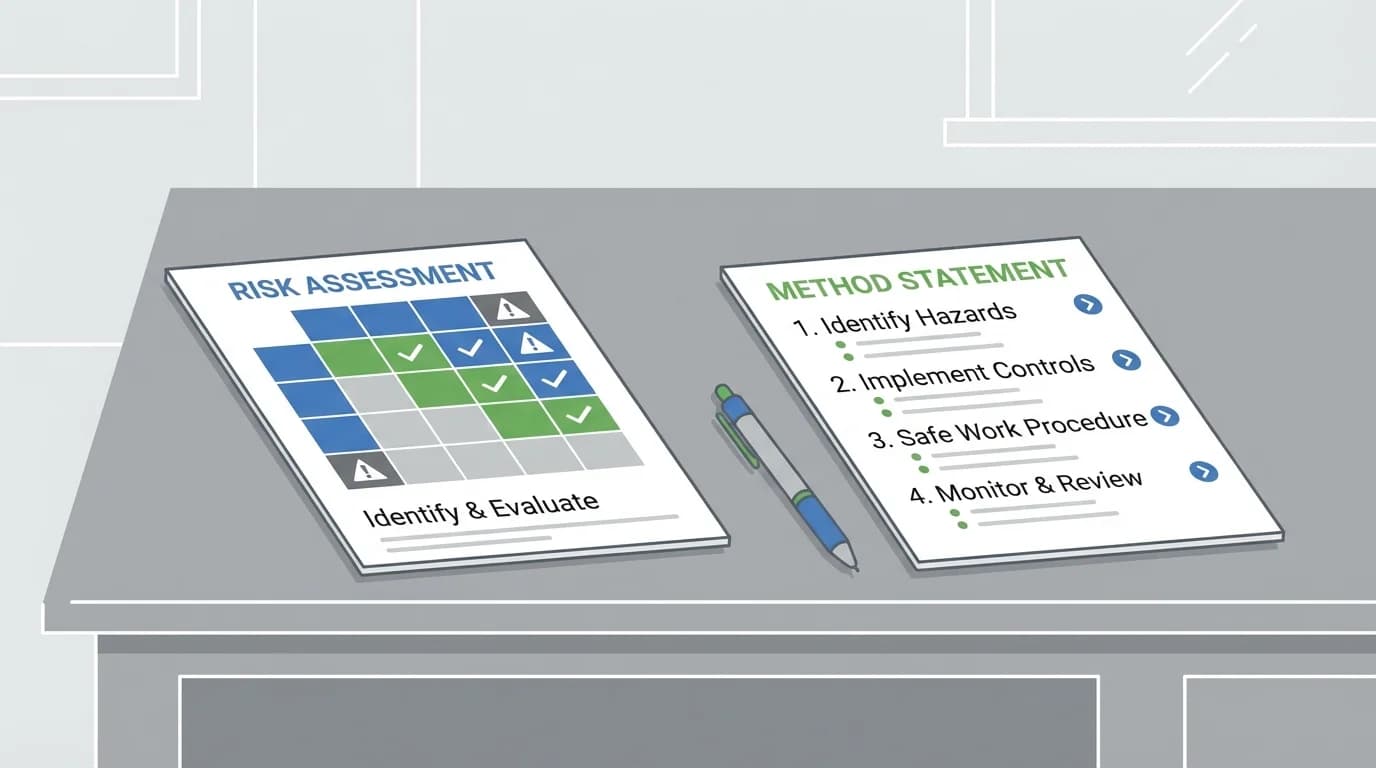
Risk assessments and method statements are frequently confused, lumped together, or treated as interchangeable documents. Understanding the difference is essential for duty holders, managers, and contractors who need to protect their workforce and satisfy legal obligations without drowning in unnecessary paperwork.
See Sevron in Action
Watch our demo to see how Sevron simplifies COSHH compliance with automated risk assessments and real-time SDS data.
BOOK A DEMOWhat Is a Risk Assessment?
A risk assessment is a systematic process for identifying hazards, evaluating the risks they present, and determining appropriate control measures to eliminate or reduce those risks.
Employers are legally required to assess risks within the workplace. Risk assessments are a legal requirement under the Health and Safety at Work Act 1974 and the Management of Health and Safety at Work Regulations 1999. Employers with five or more employees must document their findings in writing.
The purpose is straightforward: identify potential hazards, assess risks, and put control measures in place before harm occurs. The risk assessment process focuses on hazards and control measures needed to reduce risk, not on describing how a specific task will be performed.
The Five Steps of Risk Assessment
- Identify the hazards — spot anything that could cause harm
- Determine who might be harmed and how — employees, contractors, visitors
- Evaluate the risks and decide on precautions — assess likelihood and severity, identify control measures needed
- Record your findings and implement them — document and ensure safety measures are in place
- Review and update — revisit when conditions, equipment, or processes change
Examples include evaluating manual handling risks in a warehouse, assessing slip and trip hazards in an office, or identifying risks associated with operating heavy machinery on a construction project.
A comprehensive risk assessment means a safe working environment and less risk of financial and reputational consequences if something goes wrong. Risk assessments help prevent accidents, injuries, and fatalities in the workplace. They also reduce the risk of ill health from prolonged exposure to hazards.
What Is a Method Statement?
A method statement is a step-by-step description of how a specific task will be carried out safely. While risk assessments identify potential risks, method statements outline the step-by-step procedures for carrying out a specific task safely.
Method statements are not a legal requirement in themselves, but they are often required by clients or as best practice, particularly in the construction industry and other high-risk industries such as engineering, manufacturing, and logistics.
Typical Contents of a Method Statement
- Scope of works and task description
- Sequence of tasks with step-by-step procedures
- Equipment and tools to be used
- PPE requirements for workers
- Supervision and responsibility
- Emergency procedures and first aid provision
- Training requirements for the team
Method statements are typically reserved for high-risk, complex tasks where more detail is necessary to ensure compliance with health and safety regulations. They establish a safe system of work.
Practical Examples
Method statements are commonly used in high-risk industries to ensure that work activities are carried out safely. Examples include:
- Working at height (scaffolding erection, roof work)
- Hot works (welding, cutting, grinding)
- Demolition and structural alterations
- Confined spaces entry
- Lifting operations with cranes or hoists
- Using hazardous substances
Start Managing COSHH Compliance Today
Get a demo of our premium software, or get started with free tools.
The Key Differences at a Glance
| Aspect | Risk Assessment | Method Statement |
|---|---|---|
| Purpose | Identify hazards and evaluate risks | Describe how work will be carried out safely |
| Focus | What could go wrong | How the job will be done |
| Legal Requirement | Yes (under HSWA 1974 and Management Regs) | No, but often required by contract or best practice |
| Level of Detail | Broad, covers hazards and control measures | Detailed, step-by-step instructions for a particular task |
| When Required | All work activities where risks are present | High-risk, complex, or client-specified tasks |
| Who Prepares It | Employer or competent person | Contractor, supervisor, or project manager |
Risk assessments identify what could go wrong and the control measures needed. Method statements describe the step-by-step procedures to get the work done safely.
Do You Need Both?
Both risk assessments and method statements are essential for workplace safety and compliance, particularly during high-risk activities.
A Risk Assessment Method Statement (RAMS) combines a risk assessment and a method statement to plan work safely. RAMS documents are particularly important for high-risk activities such as demolition, structural alterations, working at height, lifting operations, or using hazardous substances. In industries such as construction, engineering, manufacturing, and logistics, a RAMS is an essential tool for minimising the risk of accidents, injuries, and costly delays.
Risk assessments inform the development of method statements by identifying hazards and control measures. Method statements ensure that the risk mitigation strategies identified in risk assessments are implemented properly and effectively. A method statement written without a proper risk assessment is incomplete.
RAMS is often treated as a live working document that should be reviewed when conditions, equipment, or processes change. Method statements should be revised for every new project or when the team or project location changes. This keeps safety precautions relevant.
For low-risk environments like routine office work, a risk assessment alone may be sufficient. But for any task involving significant specific hazards, associated risks, or regulatory requirements, both documents are necessary.
Using a combination of risk assessments and method statements offers a range of benefits including enhanced workplace safety, improved communication, better legal compliance, and fewer incidents.
Common Mistakes Businesses Make
Even well-intentioned organisations make errors when preparing these documents. Common mistakes include:
- Using generic templates — copying and pasting without tailoring to the actual workplace creates documents that miss specific hazards
- Writing method statements in isolation — failing to base them on a proper risk assessment means procedures do not control the identified risks
- Overcomplicating simple tasks — unnecessary paperwork for low-risk activities wastes time
- Failing to communicate — treating documents as tick-box exercises rather than sharing them with the workforce undermines their purpose
- Ignoring updates — failing to review when new hazards emerge or work conditions change leaves teams working to outdated information
These mistakes undermine safety compliance, increase enforcement risk, and contribute to real-world incidents. The findings of a risk assessment must be communicated to employees and they must be consulted.
How to Make Your Documentation Audit-Ready
Practical steps to ensure your risk assessments and method statements stand up to scrutiny:
- Keep them task-specific — avoid generic templates that do not reflect your workplace
- Review regularly — both documents should be updated to reflect changes in work conditions
- Link control measures to work steps — ensure method statements directly address the control measures identified in risk assessments
- Ensure sign-off and communication — obtain approval from supervisors and communicate clearly to the team
- Store centrally with version control — maintain clear records of revisions and a documented start date for each version
Position your documentation as part of a broader compliance system that includes COSHH assessments, health and safety management, and incident reporting. For further information on regulatory requirements, consult your industry guidance.
Ready to Simplify Your COSHH Assessments?
Create professional COSHH risk assessments in minutes with our free online tool. No credit card required.
CREATE FREE ASSESSMENTFinal Thoughts
Risk assessments identify what could go wrong and how to control it. Method statements describe how work will be carried out safely. Get both right, keep them current, and ensure your team understands them. Proper documentation protects people and protects your business.
Topics:
