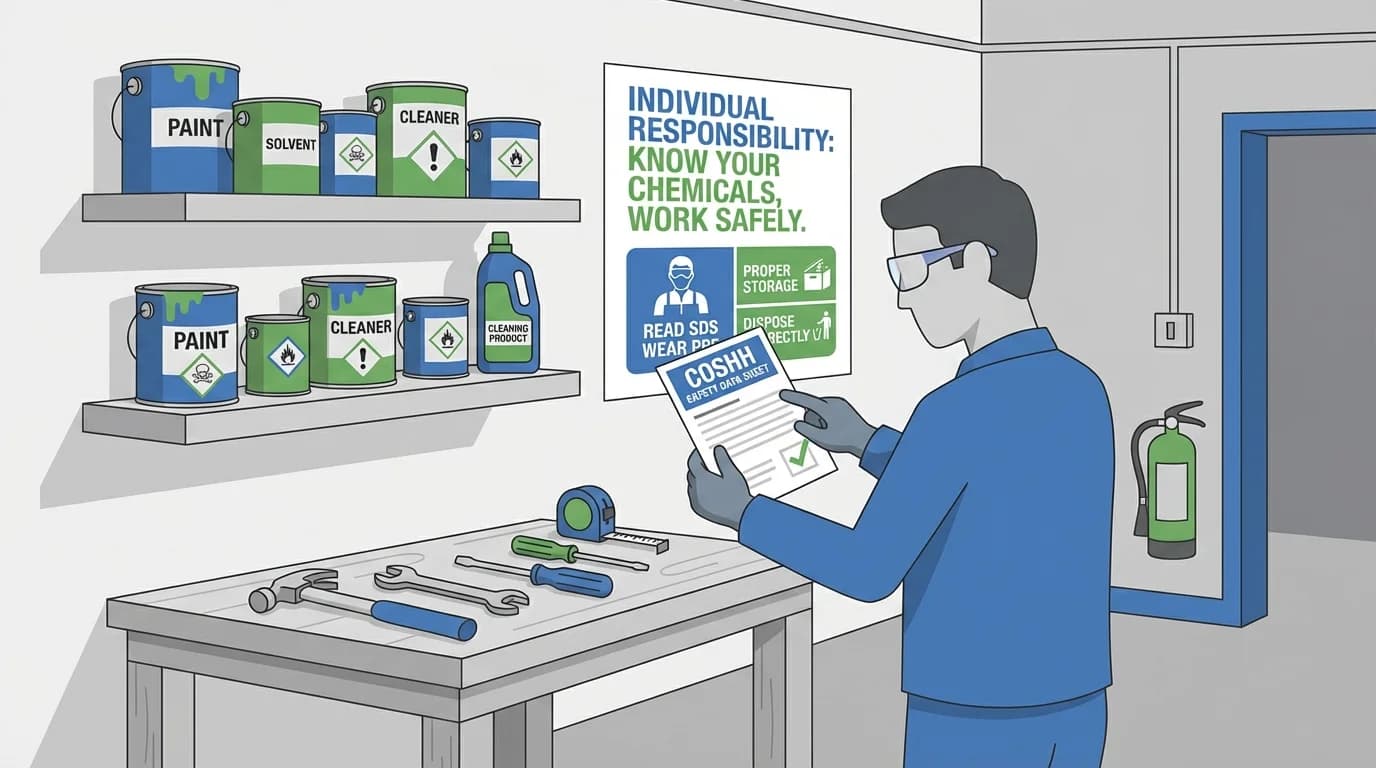
COSHH stands for Control of Substances Hazardous to Health (COSHH) and its regulations form part of UK health and safety law. Many sole traders and freelancers assume these rules only apply to large industrial operations or companies with hundreds of employees. That's not the case. The legal framework for managing hazardous substances extends to almost everyone in the workforce.
If your work involves hazardous substances or creates dust, fumes, or biological hazards, you need to understand your responsibilities. This keeps you compliant with Health and Safety Executive (HSE) standards and helps protect workers and the public from harm.
See Sevron in Action
Watch our demo to see how Sevron simplifies COSHH compliance with automated risk assessments and real-time SDS data.
BOOK A DEMODoes COSHH Apply to the Self-Employed?
Yes. COSHH applies to you if your work involves substances hazardous to health. Whether you are a sole trader, contractor, or freelancer, if your work requires chemicals or creates fumes, dust, or biological agents, you must take steps to prevent exposure and protect workers or the public.
COSHH regulations apply to you in the same way they apply to employers and employees, with specific exceptions. If you work alone, you are generally exempt from Regulations 10 and 11, which cover monitoring and health surveillance for yourself. However, you must still conduct risk assessment and implement suitable control measures.
What COSHH Expects from Self-Employed People
The Health and Safety Executive (HSE) bases the responsibility to manage risks on the nature of the work, not your employment status. If your work involves hazardous substances, you have legal duties. When working for yourself, you are considered both the employer and the employee.
This means you are responsible for your own health and anyone affected by your work. COSHH requires you to implement control measures to minimise exposure to hazardous substances. You must identify hazardous substances and understand the health risks they pose. Take all reasonable steps to avoid working with hazardous substances entirely. If elimination is not possible, conduct a thorough risk assessment to evaluate the risks posed and put in place appropriate control of substances hazardous to everyone and the environment, including aquatic life.
When COSHH Applies to the Self-Employed
COSHH regulations apply to you if your work creates hazardous substances or requires you to use them. "Hazardous" does not just mean toxic industrial chemicals. Many everyday products used in trade and service industries fall under these rules.
You must comply with COSHH if you:
-
Use chemicals, solvents, paints, adhesives, cleaners: Many common chemical products used in trade or cleaning services contain hazardous materials that require safety precautions.
-
Create dusts (wood, silica, cement): Activities like sanding or cutting stone create fine particles that pose risks to the respiratory system. Wood dust is a common example.
-
Generate fumes and vapours (welding, cutting, exhaust): Heat processes often release hazardous chemicals and gases like carbon monoxide that can lead to work-related ill health.
-
Work with biological agents (mould, waste, water systems): Those in plumbing or restoration may encounter biohazards such as leptospirosis or legionnaires' disease.
-
Engage in physical processes: Spraying, grinding, or cleaning with chemical products all trigger the need for safety precautions and control measures.
When COSHH Does NOT Apply to the Self-Employed
While the regulations are extensive, there are specific scenarios where they do not trigger legal duties. Generally, this occurs when there is:
-
No hazardous substances used or created: If your work is purely intellectual or administrative with no chemical exposure, the regulations do not apply.
-
No dust, fumes, vapours, or biological exposure: Work that does not generate airborne contaminants or involve skin contact with irritants falls outside the scope.
-
Office-based work with no chemical or process risk: Standard office tasks usually do not involve health hazards beyond everyday low-risk items.
COSHH does not cover work with asbestos, lead, or radioactive substances. These materials are governed by their own specific regulations that set out unique exposure limits and safety procedures.
Do Self-Employed People Need COSHH Risk Assessments?
A formal written COSHH assessment may not always be required if you work entirely by yourself with no employees. However, COSHH regulations still require you to assess risks and implement control measures. You need to show that you have identified health hazards and taken steps to reduce exposure.
What Should a Risk Assessment Cover?
A COSHH risk assessment should identify all hazardous substances you use or create and evaluate the health risks they pose. This includes looking at how exposure occurs, who might be affected, and the likelihood of harm occurring. Your risk assessment should consider all exposure routes: inhalation, skin or eye contact, injection, and ingestion.
When Is a Written Assessment Required?
If your work affects others, or if you are working as a contractor on a larger site, written COSHH risk assessments are usually expected and often demanded by the principal contractor. Clients and site managers need evidence that you are managing hazardous substances effectively. A documented risk assessment demonstrates you understand the health risks, have evaluated exposure levels, and know what personal protective equipment or other controls are necessary.
Reviewing Your Risk Assessment
COSHH regulations require you to review your risk assessment whenever work conditions change. This includes using new hazardous substances, changing your working methods, or taking on new types of projects. Regular reviews ensure your risk assessment remains accurate and your control measures stay effective. Even as a sole trader, having a documented process for identifying hazardous substances shows professional competence and ensures you are following the correct safety measures to prevent exposure.
If you later employ workers or subcontractors, your risk assessment will also determine if health surveillance is necessary for those exposed to certain hazardous substances.
Start Managing COSHH Compliance Today
Get a demo of our premium software, or get started with free tools.
COSHH Responsibilities for the Self-Employed
When working for yourself, you must manage your own workplace safety. This involves handling hazardous substances correctly and ensuring that all control equipment is properly maintained and used.
Your key responsibilities include:
-
Identify substances hazardous to health: Check labels for hazard symbols and review safety data sheets (SDS) to understand the chemical profile.
-
Assess how exposure occurs: Determine if harm is likely through breathing in wood dust, inhaling chemicals fumes or gases, or skin contact with hazardous materials.
-
Prevent or control exposure: Follow the hierarchy of control to minimise exposure, starting with elimination and ending with personal protective equipment.
-
Use appropriate control measures: This includes ensuring proper ventilation or using local exhaust ventilation to capture fumes at the source.
-
Follow manufacturer instructions (SDS): Adhere to the safe handling practices and storage requirements outlined by the supplier.
-
Review controls if work changes: COSHH requires regular monitoring and review to ensure your safety measures stay up to date.
-
Emergency procedures: Have emergency plans for incidents involving hazardous substances and maintain equipment for control exposure.
What About Working on Someone Else's Site?
When you operate on a client's premises, the lines of responsibility are shared. If you take hazardous substances onto other people's premises, you must comply with COSHH regulations.
-
Host employers still have COSHH duties: The host must ensure their activities do not expose you to risks and must provide you with information about hazards on their site, including any gases, biological agents, or hazardous chemicals present.
-
You must cooperate with site rules: You are legally required to align your work with the host's safety regulations and put control measures in place that protect workers and others on-site.
-
You may need your own COSHH assessment as well: Clients must cooperate with contractors to manage risks when those workers are present on the client's site.
What Happens If a Self-Employed Person Ignores COSHH?
Failure to comply with COSHH regulations leads to serious consequences, including enforcement actions by the HSE, unlimited fines, and imprisonment for serious violations.
-
Enforcement action: This can include improvement or prohibition notices issued by health and safety authorities.
-
Prohibition notices: These can halt your business activities immediately if a risk of serious injury or potential to damage health is identified.
-
Fines: Companies found breaking COSHH protocol can face unlimited fines. A 2021 HSE report showed that companies collectively received £26.9 million in fines for failing to enforce health and safety regulations.
-
Loss of contracts: Non-compliance with COSHH can harm your reputation, leading to lost business and challenges in recruiting talent or securing work.
-
Operational disruptions: Enforcement actions can force changes or halts in business activities, affecting productivity and overall performance.
Simple COSHH Compliance for the Self-Employed
COSHH for independent workers is usually straightforward if you follow a logical process. The goal is to reduce exposure to the lowest level reasonably practicable.
Focus on:
-
Knowing your substances: Maintain an up-to-date folder of safety data sheets for all chemical products you use.
-
Using safer alternatives: Swap out hazardous materials for water-based or low-VOC alternatives whenever possible.
-
Controlling dust and fumes: Use tools with integrated dust extraction and ensure you work in areas with proper ventilation.
-
Wearing PPE where needed: When other controls are not enough, you must ensure you are providing personal protective equipment such as gloves, eye protection, or a respirator that meets the workplace exposure limit.
-
Training and Information: Under COSHH, self-employed workers are required to provide sufficient information and COSHH training to anyone affected by their work, including any temporary assistants or subcontractors. This ensures everyone understands how to limit exposure to hazardous substances.
Ready to Simplify Your COSHH Assessments?
Create professional COSHH risk assessments in minutes with our free online tool. No credit card required.
CREATE FREE ASSESSMENTTopics:
