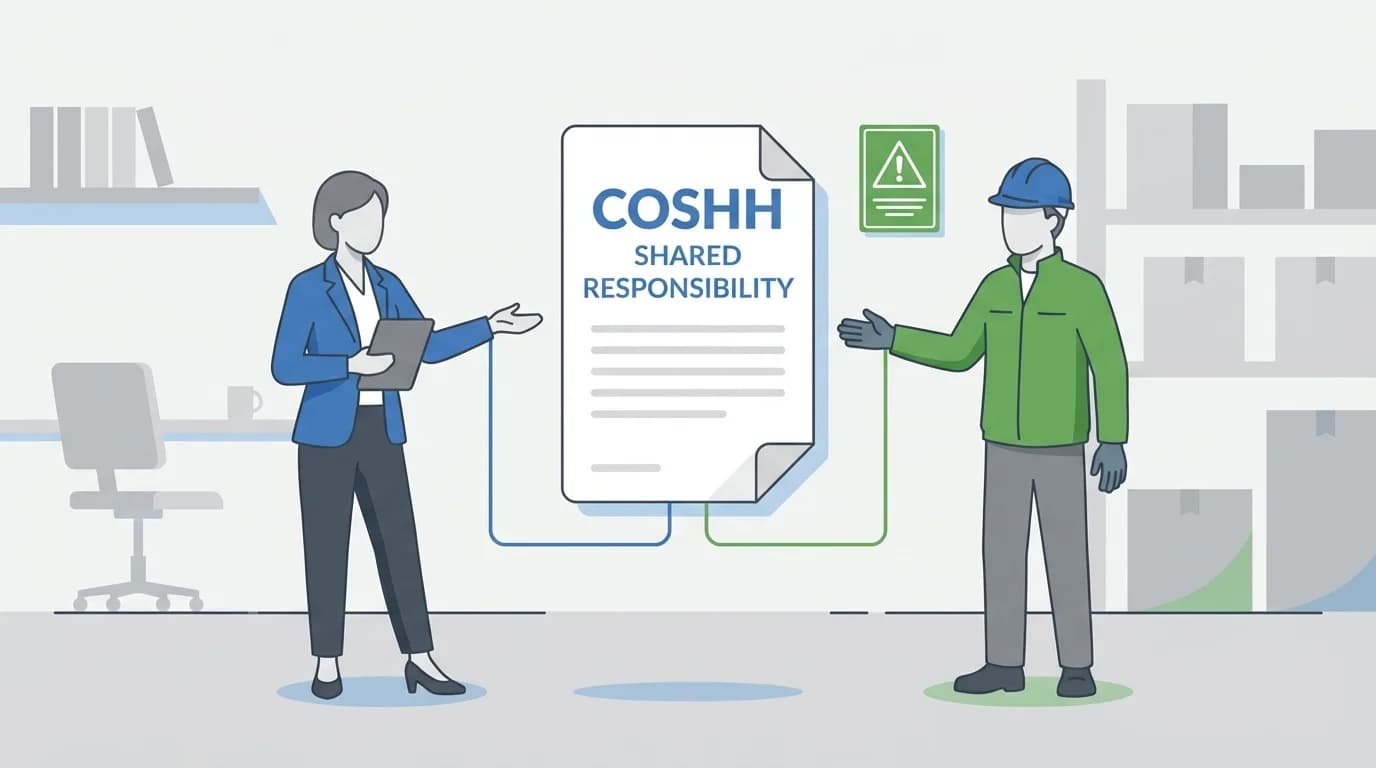
The Control of Substances Hazardous to Health (COSHH) regulations represent a statutory duty designed to protect people from the risks of hazardous materials in the workplace. Hazardous substances can cause chronic conditions like lung disease and skin diseases, as well as fatal conditions like cancer.
While the primary responsibility for compliance lies with the employer, the responsibilities of employees include a strict legal obligation to cooperate with all safety measures. Effective COSHH management relies on both parties fulfilling their specific roles to prevent ill health and manage hazardous substances correctly to protect workers.
See Sevron in Action
Watch our demo to see how Sevron simplifies COSHH compliance with automated risk assessments and real-time SDS data.
BOOK A DEMOWhat "Responsibility" Means Under COSHH
The "Duty Holder" concept is central to understanding the legal framework, meaning that the person in control of the workplace is ultimately responsible for decision-making and risk management. This structure ensures that those with the power to influence safety standards are held accountable for the protection of all personnel. For many, understanding what COSHH stands for is the first step, a set of regulations that work alongside others like the asbestos regulations.
A COSHH assessment focuses specifically on identifying and controlling the risk associated with substances hazardous to health. In contrast, a general risk assessment addresses a broader range of workplace hazards such as electrical safety, trips, and falls.
Employers should note that breaching these health regulations is a crime punishable by an unlimited fine. Furthermore, individuals can face imprisonment for breaches of health and safety law, including COSHH, with sentences of up to six months in magistrates' courts and up to two years in Crown Courts.
Employer Responsibilities Under COSHH
Adhering to COSHH regulations is essential for maintaining workplace safety, and while employers have primary responsibility, employees must actively support these measures. Employers are ultimately responsible for COSHH within the workplace and must ensure that control measures are properly used and maintained.
Failure to meet these employers' responsibilities can lead to civil claims from employees, with average fines for non-compliance with the control of substances hazardous to health rising to £150,000 in 2018/2019.
Identify hazardous substances (used, stored, created)
The first stage of managing health risk involves identifying every substance that could potentially harm the workforce. Employers must look for substances hazardous to health that are used, stored correctly on the premises, or created as a by-product of work processes. This identification process requires a thorough review of each safety data sheet provided by suppliers to understand the specific properties of hazardous chemicals.
Remember that substances harmful to health include more than just liquids; they encompass wood dust, fumes, vapours, and biological agents. For example, wood dust can lead to occupational asthma, while brick dust contains silica that might cause fatal lung disease decades after the initial exposure to hazardous substances.
Carry out COSHH risk assessments
An employer must conduct a suitable and sufficient COSHH risk assessment to evaluate the potential for harm to individuals. This risk assessment must identify who may be harmed, the routes of exposure such as skin absorption or inhalation, and the frequency of the tasks being performed. The documentation should be reviewed regularly to ensure that it reflects the current conditions of the workplace.
By developing control measures based on these findings, an employer can effectively control exposure and protect the workforce. A thorough assessment is mandatory to help businesses stay compliant with the health and safety executive.
Prevent or adequately control exposure
The goal under COSHH regulations is to prevent exposure to hazardous substances entirely whenever possible. If prevention cannot be achieved by removing the hazard, the employer must ensure adequate control is maintained by following the hierarchy of control. This hierarchy prioritises the elimination or substitution of hazardous substances before moving on to engineering controls, administrative changes, and lastly, personal protective equipment.
It is a vital rule that personal protective equipment isn't the default; suitable personal protective equipment should only be used as a final resort when other methods cannot sufficiently manage hazardous substances. This approach is similar to how one might use noise protection equipment only after engineering solutions are exhausted.
Provide and maintain control measures
Once control measures have been selected, the employer is responsible for providing and maintaining them to ensure they continue to protect everyone. This includes the installation and regular testing of ventilation systems, such as local exhaust ventilation, and the provision of correct storage facilities.
Employers must also ensure that all equipment is in good working order and that any defects are rectified immediately to prevent employee exposure to hazardous substances. Regular maintenance checks are essential to ensure that the measures intended to limit exposure remain effective over the long term and that workers exposed to chemicals stay safe.
Provide information, instruction, and training
The provision of suitable and sufficient information, instruction, and training is a core responsibility for every employer. This COSHH training must be designed to ensure worker competence rather than simply serving as a paperwork exercise. Employees must understand the nature of the hazardous substances they work with and the safety procedures they must follow.
Effective appropriate training ensures that workers can accomplish tasks safely and know the proper use of the provided protective equipment. Regular refresher courses or a dedicated COSHH course can help maintain a high standard of health and safety across the organisation. Beyond compliance, effective COSHH training can lead to improved productivity and reduced absenteeism in the workplace.
Exposure monitoring and WELs (where relevant)
Where a risk assessment suggests it is necessary, an employer must monitor employee exposure to ensure that any workplace exposure limit is not exceeded. Monitoring is essential when there is a risk of a serious adverse health effect or when it is necessary to check the performance of control measures. This process must be carried out by a competent person using professional sampling techniques to ensure the data is accurate.
If exposure limits are found to be exceeded, the employer must immediately investigate the cause and implement additional appropriate control measures to protect employees. Understanding each workplace exposure limit is crucial for controlling hazardous substances effectively in high-risk environments.
Health surveillance (when required)
Employers must provide suitable health surveillance when a risk assessment identifies that workers may be at risk of developing specific health issues. This is particularly important for employees exposed to sensitizers that can cause allergic contact dermatitis or occupational asthma.
Appropriate health surveillance allows for the early detection of ill health and provides a way to monitor the effectiveness of current control measures. This may involve examinations by a qualified health professional to ensure that any adverse health effect is identified early. Suitable health surveillance is a legal requirement under the hazardous to health regulations when certain exposure thresholds are met.
Emergency arrangements
The employer must have robust procedures in place for dealing with emergencies involving hazardous substances. This includes creating clear emergency procedures for handling chemical spills, providing first aid, and reporting any accidents that may result in the release of hazardous substances.
All staff must be familiar with these arrangements and know how to access the correct equipment, such as eye wash stations or neutralising agents. Having these procedures ready ensures that the workplace can respond quickly to stop accidents from escalating and shield workers from prolonged exposure to hazardous substances.
Review and update
A COSHH risk assessment must be reviewed and updated whenever there is a significant change in the workplace environment. Triggers for a review include the introduction of a new substance, a change in a manufacturing process, or the occurrence of an incident.
It is also important to update the assessment if new evidence emerges regarding the health risk of a specific hazardous substance or if the workforce changes. Regular reviews ensure that the business continues to meet its legal requirements and that the control measures remain suitable and sufficient against hazardous substances.
Start Managing COSHH Compliance Today
Get a demo of our premium software, or get started with free tools.
Employee Responsibilities Under COSHH (Supporting Duties)
While the employer provides the framework for safety, the COSHH responsibilities of employees are vital for maintaining a healthy environment. Employees are responsible for properly using the control measures provided by their employer and must use provided control measures correctly to protect themselves and colleagues.
Under the COSHH regulations and wider health and safety law, worker employee responsibilities include a commitment to take reasonable care of their own safety and cooperate with the measures put in place to manage hazardous substances.
Follow safe systems of work
Employees must adhere to all instructions provided by their employer to ensure they can complete tasks safely. This involves following the established methods for handling, storing, and disposing of substances harmful to health. By consistently following these safe systems, employees help to manage the hazardous substances and ensure that the organisation remains compliant with health and safety regulations.
Ignoring these established protocols can lead to danger and potential prosecution for the individual, which could result in a sentence of up to two years in a Crown Court.
Use PPE properly
If suitable personal protective equipment (PPE) is provided, workers must ensure they use it exactly as they have been trained. This includes ensuring a proper equipment fit and immediately reporting any gear defects or issues.
Workers must also remember to remove any contaminated gear and use cleaning and showering facilities before eating or drinking to prevent the spread of hazardous substances.
The provision of showering facilities is necessary to help workers maintain high standards of personal hygiene after working with toxic hazardous substances.
Report hazards and defects
It is a crucial part of employee responsibilities to report any faults or defects in the control measures provided. This includes identifying a faulty ventilation network, noticing a leak in a chemical container, or discovering that safety data sheet information is missing.
Employees should also report any symptoms of ill health, such as skin rashes or persistent coughing, to their supervisor immediately.
Early reporting is key to stopping accidents and allow the employer to rectify issues before they lead to serious harm from hazardous substances.
Cooperate with monitoring and health surveillance
Employees must cooperate with any requirement to attend medical check ups or participate in health surveillance programmes. If health surveillance is necessary, employees must participate in medical check-ups or examinations at scheduled times as determined by workplace risk assessment.
This cooperation is a legal obligation that allows the employer to monitor the effectiveness of the control measures and protect people from long term damage. During these sessions, trained workers should provide honest reporting about their health and any potential exposure to hazardous substances.
Don't interfere with controls
No employee should ever interfere with or intentionally damage any of the control measures provided for their protection. This includes avoiding the removal of guards, not tampering with ventilation systems, and never decanting hazardous substances into unlabelled containers.
Such actions create an immediate risk for the individual and their colleagues and are a serious breach of health and safety law. Respecting the integrity of all safety systems is a fundamental part of the employee's role in managing hazardous substances.
Managers, Supervisors, and "Competent Persons": Where They Fit
Managers and supervisors play a key role in the daily management of health and safety by enforcing compliance and ensuring that safety procedures are followed on the floor. While an employer can delegate the task of conducting a COSHH risk assessment to a competent person, the employer always retains the legal liability for the results.
It is often necessary to replace trained workers who leave to ensure that safety standards do not slip and that those remaining can manage hazardous substances safely. In workplaces where contractors or agency workers are present, there are shared duties to protect workers; however, the host employer still holds the primary obligations for the site and the hazardous substances present.
Following COSHH legislation is not optional, and managers must ensure that COSHH signs are clearly visible and that all emergency procedures are understood and observed.
Ready to Simplify Your COSHH Assessments?
Create professional COSHH risk assessments in minutes with our free online tool. No credit card required.
CREATE FREE ASSESSMENTPractical COSHH Responsibility Matrix
To maintain clarity and ensure no tasks are overlooked, many businesses use a responsibility matrix. This table helps map out specific roles to ensure that everything from training to maintenance is handled by the correct person.
| Task | Responsible Party | Requirement |
|---|---|---|
| COSHH assessment | Employer / Competent Person | Identify all hazardous substances |
| Control selection | Employer / Manager | Implement appropriate control measures |
| Training | Employer | Check competence and safety training |
| Enforcement | Manager / Supervisor | Ensure daily tasks safely completed |
| Reporting | Employee | Notify employer of any ill health or defects |
| Maintenance | Employer / Technician | Regular testing of ventilation systems |
| Review | Employer | Annual check or update after incident |
Topics:
